


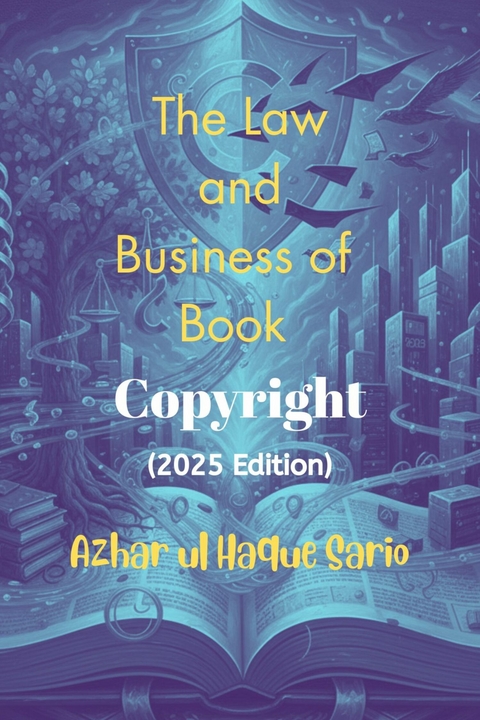
The Law and Business of Book Copyright (2025 Edition) (eBook)
200 Seiten
Azhar Sario Hungary (Verlag)
978-3-384-74265-0 (ISBN)
This is your complete guide to the law and business of book copyright.
It starts with the basics. What is copyright? You will learn what it protects (your expression) and what it doesn't (your idea). We explain when protection begins. (Hint: it's automatic, the moment you write it down!) The book covers the 'bundle of rights' you get as an author. These include economic rights, like the power to copy, sell, and adapt your work. They also include moral rights, like the right to be named as the author. We then go global. You'll understand the international treaties that protect your book around the world, like the Berne Convention. The book explains how digital copyright works, from ebooks to the WIPO 'internet treaty'. We also cover the full lifecycle of your copyright. This includes how long it lasts (usually your life plus 70 years) and what happens when it enters the public domain. You will learn how to value your copyright as a financial asset. We show you how to monetize it through subsidiary rights, like film deals and translations. The book explains the difference between selling your copyright (an assignment) and renting it (a license). Finally, we teach you how to protect your work. You'll learn about infringement , DMCA takedown notices , and legal exceptions like fair use.
Many books tell you that copyright protection is automatic. This book explains why that simple fact is not enough. It bridges the gap between just having rights and actually being able to enforce them. We show you why formal registration is a critical business strategy, not just a formality. This book is your practical guide to turning a theoretical right into a powerful, enforceable asset. It provides a detailed, comparative guide to the registration systems in key global markets. You'll learn the step-by-step process for registering your work with the U.S. Copyright Office to unlock statutory damages. You will also understand the strategic importance of registering in China and India , and why the process is completely different in the UK , Germany , and Australia. We also provide specific advice for self-published authors, from crafting a professional copyright page to using group registration for your blog posts.
Disclaimer: The author is not affiliated with any national copyright office or board. This book is an independent publication produced under the principle of nominative fair use for commentary and educational purposes.
Part II: Securing and Managing Copyright
The Automatic Shield: Copyright Protection upon Creation
4.1: The Principle of Automatic Protection Explained
Imagine you’re sitting in a café. You pull out a notebook and, inspired, you write a short poem. Or perhaps you’re a musician, and you hum a new melody into your phone's voice recorder. Maybe you’re a designer, and you sketch a logo on a napkin. In that exact instant—the second the ink dries, the digital file is saved, the soundwave is captured—you have created a copyright.
You didn't fill out a form. You didn't mail anything to a government office. You didn't pay a fee.
This is the single most important and often misunderstood concept in all of copyright law: protection is automatic. It is a fundamental, global right that springs into existence with the very act of creation. It’s not something you have to "get." It's something you have, immediately and without cost.
This powerful global standard is the cornerstone of the modern international copyright system. Its legal backbone is a treaty called the Berne Convention for the Protection of Literary and Artistic Works. This agreement, which has been signed by over 180 countries, sets a minimum standard of protection for creators. And its most crucial mandate is that copyright protection cannot be dependent on any "formality."
What does this mean, "no formality"? It means countries that sign the treaty agree to throw out all the old, bureaucratic hoops that creators used to have to jump through. In the past, you might have had to publish your work, or put a special notice on it, or register it with a national office just to claim it was yours. The Berne Convention abolished all of that. It leveled the playing field, ensuring that a poet in a small village has the same immediate protection as a massive publishing house in a major city.
The only requirement, the single trigger for this automatic shield, is a concept called "fixation."
A work must be "fixed in a tangible medium of expression." This sounds like complex legal jargon, but it’s incredibly simple. It just means the work has to be recorded in some way that is stable and can be perceived or reproduced. It must be moved from a pure idea into a form.
Copyright does not protect ideas. You cannot copyright the idea of a boy wizard who goes to a magic school, or the idea of a tragic romance between families at war. But the moment you write a story about a specific wizard named Harry Potter, or a play about two specific lovers named Romeo and Juliet, you have "fixed" that idea into a unique expression. That expression is protected.
Fixation is the line in the sand.
Thinking about a song in your head? Not fixed. No copyright.
Singing that song and recording it on your laptop? It is now fixed. You have a copyright in that recording and the underlying musical work.
Having an idea for a painting? Not fixed.
Applying paint to a canvas to create that painting? It is fixed. You have a copyright.
Saving a document on your computer, writing in a journal, taking a photograph, or sculpting a piece of clay—all of these are acts of fixation.
This principle isn't just a theory; it is the law of the land in major jurisdictions across the globe. The United Kingdom, for example, does not have a government-run register of copyrights. Protection is simply automatic when an original work is created. The same principle holds true in Canada, where your rights are established under both Canadian and international law from the very second of creation.
Look to Australia, and you'll find the same philosophy: copyright protection is described as "free and automatic" from the moment the work is put into a "material form." Across the entire European Union, this standard is universal. Nations like Spain, Germany, and France grant copyright based on the "sole act of creation," with no need for any deposit or registration formalities.
This global harmony provides a powerful, immediate, and reassuring shield for authors, artists, and creators of all kinds. It means your rights are not fragile. They don't depend on a piece of paper in a filing cabinet. Your creative work is born with its own suit of armor, established the instant you save the file, snap the photo, or write the final word. This understanding is the first and most critical step in managing your creative assets.
4.2: The Role and Proper Use of the Copyright Notice (©)
If copyright protection is truly automatic from the moment of creation, it begs a very logical question: Why does everyone still use the little © symbol?
It’s one of the most recognizable symbols in the world, appearing on books, movies, websites, and album covers. Its persistence creates a common point of confusion, leading many to believe it's a legal requirement. For a long time, in some places, it was.
The answer lies in a major historical shift, particularly in the United States. Before March 1, 1989, U.S. law was different. To secure and maintain copyright for any work that was "published" (made available to the public), the U.S. required the use of a proper copyright notice. If an author published a book and forgot to include the notice, or formatted it incorrectly, the consequences could be catastrophic. The work could be irreversibly injected into the public domain, all rights lost forever.
Everything changed in 1989. This was the year the United States fully joined the Berne Convention. To align its laws with the rest of the world and adopt the "automatic protection" principle, Congress had to abolish the mandatory notice.
Since that date, the copyright notice has been legally optional in the United States, just as it is in most of the world. You do not need it for your copyright to exist. You will not lose your rights if you forget to add it. Your work is protected from the moment of fixation, period.
So, we return to the question: If it’s not required, why bother?
The answer is that while the notice has lost its foundational legal power, it has retained enormous practical and strategic power. Using it is no longer a legal necessity, but it remains a highly recommended best practice. Think of it less as the shield itself (fixation is the shield) and more as a bright, clear label painted on the shield, warning everyone that it exists and telling them who holds it.
There are several strategic reasons to use it.
First, it serves as a clear public declaration of your rights. It's a "No Trespassing" sign for your intellectual property. It instantly dispels any ambiguity. It tells the world, "This is not in the public domain. Someone owns this, and they are aware of their rights." This simple act can deter a huge amount of casual, opportunistic infringement. An amateur blogger looking for an image is far more likely to skip over the one with a clear copyright notice and look for one that appears to be "free."
Second, it identifies the owner and simplifies licensing. The notice acts like a business card for your work. If a filmmaker, publisher, or marketing agency wants to legitimately license your photograph, song, or article, the notice tells them exactly who to contact. Without it, they may not know where to even begin seeking permission, and a potential licensing opportunity could be lost.
Third, and perhaps most importantly in the U.S., it provides a powerful legal weapon in court. In the United States, an infringer might try to lessen their financial penalty by claiming "innocent infringement." They might argue, "I had no idea this was copyrighted! I found it on the internet; I thought it was free to use." This defense, if successful, can significantly reduce the "statutory damages" a court will award.
A proper copyright notice makes this entire defense evaporate. The law is clear: if a proper notice is present on the work, no court will accept a defense of "innocent infringement." The infringer is considered to be on notice, and they are fully liable. This single benefit can be worth thousands, or even tens of thousands, of dollars in a legal dispute.
Given these benefits, adding a notice is a low-cost, high-impact tool. And fortunately, formatting it is extremely simple. A proper notice consists of three parts, in any order:
The Symbol: The © (the letter C in a circle) is the most recognized international symbol. You can also use the word "Copyright" or the abbreviation "Copr."
The Year of First Publication: This is the year you first made the work available to the public. If the work is updated over time (like a website or a software program), you might see a range (e.g., "© 2018-2025").
The Name of the Copyright Owner: This can be the author's real name, a pen name, or the name of the company that owns the copyright.
A perfect, simple example would be: © 2025 Jane Doe
This simple line, typically placed on the copyright page of a book, in the footer of a website, or on the back of a print, is one of the easiest and most effective things a creator can do to assert their ownership and protect their work in the...
| Erscheint lt. Verlag | 29.10.2025 |
|---|---|
| Sprache | englisch |
| Themenwelt | Recht / Steuern |
| Schlagworte | author rights • book monetization • Copyright Law • copyright registration • Intellectual Property • International Copyright • publishing business |
| ISBN-10 | 3-384-74265-6 / 3384742656 |
| ISBN-13 | 978-3-384-74265-0 / 9783384742650 |
| Informationen gemäß Produktsicherheitsverordnung (GPSR) | |
| Haben Sie eine Frage zum Produkt? |
 EPUB (Ohne DRM)
Digital Rights Management: ohne DRM
Dieses eBook enthält kein DRM oder Kopierschutz. Eine Weitergabe an Dritte ist jedoch rechtlich nicht zulässig, weil Sie beim Kauf nur die Rechte an der persönlichen Nutzung erwerben.
Dateiformat: EPUB (Electronic Publication)
EPUB ist ein offener Standard für eBooks und eignet sich besonders zur Darstellung von Belletristik und Sachbüchern. Der Fließtext wird dynamisch an die Display- und Schriftgröße angepasst. Auch für mobile Lesegeräte ist EPUB daher gut geeignet.
Systemvoraussetzungen:
PC/Mac: Mit einem PC oder Mac können Sie dieses eBook lesen. Sie benötigen dafür die kostenlose Software Adobe Digital Editions.
eReader: Dieses eBook kann mit (fast) allen eBook-Readern gelesen werden. Mit dem amazon-Kindle ist es aber nicht kompatibel.
Smartphone/Tablet: Egal ob Apple oder Android, dieses eBook können Sie lesen. Sie benötigen dafür eine kostenlose App.
Geräteliste und zusätzliche Hinweise
Buying eBooks from abroad
For tax law reasons we can sell eBooks just within Germany and Switzerland. Regrettably we cannot fulfill eBook-orders from other countries.
aus dem Bereich


