


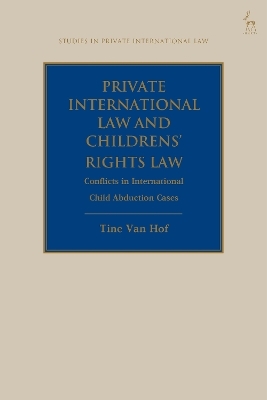
Private International Law and Children's Rights Law
Conflicts in International Child Abduction Cases
Seiten
2026
Hart Publishing (Verlag)
978-1-5099-7705-5 (ISBN)
Hart Publishing (Verlag)
978-1-5099-7705-5 (ISBN)
- Noch nicht erschienen (ca. Mai 2026)
- Versandkostenfrei
- Auch auf Rechnung
- Artikel merken
Assesses the application of the current private international law framework protecting against child abduction.
How do private international law and children’s rights law interact—and conflict—in international child abduction cases?
This book examines the relationship between two legal fields when courts decide on cross-border child abduction. While private international law prioritises the child’s prompt return and applies the best interests principle in abstracto, children’s rights law demands an in concreto, individualised assessment of the child’s best interests. These differing approaches can lead to legal friction in practice.
Through a detailed analysis of legal instruments and supranational case law, the book explores how these conflicts arise and how they might be resolved. Using the theoretical lens of international law’s diversification and expansion, it identifies nine conflict-management tools, grouped into four categories: coordination, hierarchy, priority, and harmony. It argues that two of these tools offer promising solutions.
The book evaluates 839 cases from the CJEU, ECtHR, the UN Committee on the Rights of the Child, and national courts in Belgium, England & Wales, Ireland, the Netherlands, and Switzerland. This empirical study assesses how effectively the proposed tools address conflicts between the two legal fields.
Offering clear recommendations for lawmakers, international organisations, and courts, the book provides a roadmap for fostering constructive relationships between legal fields. It is an essential resource for scholars of private international law, judges and practitioners in cross-border family law, and policymakers working at the intersection of international law and children’s rights.
How do private international law and children’s rights law interact—and conflict—in international child abduction cases?
This book examines the relationship between two legal fields when courts decide on cross-border child abduction. While private international law prioritises the child’s prompt return and applies the best interests principle in abstracto, children’s rights law demands an in concreto, individualised assessment of the child’s best interests. These differing approaches can lead to legal friction in practice.
Through a detailed analysis of legal instruments and supranational case law, the book explores how these conflicts arise and how they might be resolved. Using the theoretical lens of international law’s diversification and expansion, it identifies nine conflict-management tools, grouped into four categories: coordination, hierarchy, priority, and harmony. It argues that two of these tools offer promising solutions.
The book evaluates 839 cases from the CJEU, ECtHR, the UN Committee on the Rights of the Child, and national courts in Belgium, England & Wales, Ireland, the Netherlands, and Switzerland. This empirical study assesses how effectively the proposed tools address conflicts between the two legal fields.
Offering clear recommendations for lawmakers, international organisations, and courts, the book provides a roadmap for fostering constructive relationships between legal fields. It is an essential resource for scholars of private international law, judges and practitioners in cross-border family law, and policymakers working at the intersection of international law and children’s rights.
Tine Van Hof is a legal researcher at the University of Antwerp, Belgium.
1. Introduction
Part I: Defining the Conflicts between Private International Law and Children’s Rights Law
2 Legal Framework
3. Application of the Legal Framework
Part II: Addressing the Conflicts between Private International Law and Children’s Rights Law
4. The Theoretical Framework of the Diversification and Expansion of International Law and it’s Tools
5. Comity as a Possible Way to Address the Conflicts
6. Dialogue as a Possible Way to Address the Conflicts
7. Treaty Interpretation as a Possible Way to Address Conflicts
8. General Conclusions
| Erscheint lt. Verlag | 28.5.2026 |
|---|---|
| Reihe/Serie | Studies in Private International Law |
| Verlagsort | Oxford |
| Sprache | englisch |
| Maße | 156 x 234 mm |
| Themenwelt | Recht / Steuern ► EU / Internationales Recht |
| Recht / Steuern ► Privatrecht / Bürgerliches Recht ► Familienrecht | |
| Recht / Steuern ► Privatrecht / Bürgerliches Recht ► Internationales Privatrecht | |
| ISBN-10 | 1-5099-7705-8 / 1509977058 |
| ISBN-13 | 978-1-5099-7705-5 / 9781509977055 |
| Zustand | Neuware |
| Informationen gemäß Produktsicherheitsverordnung (GPSR) | |
| Haben Sie eine Frage zum Produkt? |
Mehr entdecken
aus dem Bereich


aus dem Bereich
Buch | Softcover (2025)
Vahlen, Franz (Verlag)
CHF 29,25


