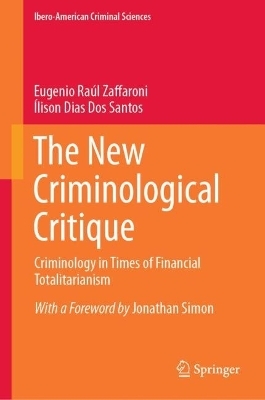
The New Criminological Critique
Springer International Publishing (Verlag)
978-3-032-11534-8 (ISBN)
- Noch nicht erschienen - erscheint am 13.02.2026
- Versandkostenfrei
- Auch auf Rechnung
- Artikel merken
This book examines the rise of financial totalitarianism and its profound implications for criminal justice and criminological theory. It explores how the concentration of wealth and social exclusion, driven by corporate CEOs, has altered the role of politics in shaping criminal justice systems. The text argues that these shifts have given rise to a dystopian criminology, marked by a focus on total security, extreme prevention, zero tolerance policies, and pervasive surveillance. It critically assesses how these developments contribute to the criminalization of dissent, foster societal fears of outsiders, and institutionalize ethnic and cultural discrimination, all while maintaining a façade of administrative control. Drawing on historical and contemporary analysis, the book offers a framework for rethinking criminology in the context of financial and political power, advocating for a more critical approach to understanding crime, punishment, and justice in an increasingly unequal world.
Eugenio Raúl Zaffaroni is a distinguished Ibero-American jurist, renowned for his contributions to criminology, criminal law, and human rights. He served as a Justice of the Supreme Court of Argentina and as a Judge of the Inter-American Court of Human Rights. He also held the position of General Director of the United Nations Latin American Institute for the Prevention of Crime and the Treatment of Offenders (ILANUD). Academically, he is a Professor Emeritus at the University of Buenos Aires, where he chaired the Department of Criminal Law and Criminology for several decades. He is the author of numerous influential works, including the five-volume Tratado de Derecho Penal and La nueva crítica criminológica (co-authored with Ílison Dias Dos Santos), both widely disseminated in multiple languages. Throughout his career, he has received more than fifty honorary doctorates from prestigious universities across Latin America and Europe. In 2009, he was awarded the Stockholm Prize in Criminology for his research on genocide, often referred to as the "Nobel Prize of Criminology." His scholarship has significantly shaped the field of criminal sciences in Latin America and Europe, and he is regarded as a central figure in the development of contemporary criminology and criminal law, noted for his critical and humanistic approach to the interpretation and application of penal law.
Ílison Dias Dos Santos is a postdoctoral researcher at the University of Barcelona (Margarita Salas Postdoctoral Fellowship, 2023 2024) and a collaborating professor in the Master's Program in Criminology, Criminal Policy, and Sociology of Criminal Law (2023 2024). Previously, he was a Gastwissenschaftler (postdoctoral fellow) at Humboldt University of Berlin (2022 2023). He holds a PhD in Law from the University of Salamanca (Summa Cum Laude with International Distinction, 2020), where he received the Extraordinary Doctorate Award. He has been awarded several research fellowships, which enabled him to undertake academic stays in Brazil, Spain, Germany, Italy, and Argentina.
He has contributed to interdisciplinary research projects across Europe and Latin America, focusing on criminology, criminal law, and criminal policy. He is the author of several academic articles and books, including The New Critical Criminology
Chapter 1. The Criminal Issue in Time and Space.- Chapter 2. Two Urgent Questions and Their Indispensable Answers.- Chapter 3. What Changed in Power?.- Chapter 4. From Where to Criticize the Reality of Power?.- Chapter 5. The Neoliberal Ideology Is Not Liberal and Is False.- Chapter 6. Accidents and Tactics of the Emptying of Politics.- Chapter 7. The Nature of the Activity of Financial Totalitarianism.- Chapter 8. The Massive Injury of Legal Goods as a Result of Financial Macro-Criminality .- Chapter 9. Selective Peculiarities of Punitive Social Control in Late Colonialism.- Chapter 10. Media Manipulation and Reality Creation.- Chapter 11. The Reproduction of Violence, Selectivity and Weakening of the States.- Chapter 12. The Totalitarian Control of Surveillance and Determination of Behaviors.- Chapter 13. The Technological Potential of Totalitarian Control.- Chapter 14. New Etiology and Paths of Utopia?.- Chapter 15. Challenges in the Struggle and Possible Perspectives.- Chapter 16. Some Inconclusive Conclusions.
| Erscheinungsdatum | 29.11.2025 |
|---|---|
| Reihe/Serie | Ibero-American Criminal Sciences |
| Zusatzinfo | XIX, 139 p. 1 illus. |
| Verlagsort | Cham |
| Sprache | englisch |
| Maße | 155 x 235 mm |
| Themenwelt | Recht / Steuern ► Strafrecht ► Kriminologie |
| Schlagworte | Corporate influence on criminal justice • Dystopian criminology • Ethnic and cultural discrimination in criminology • Financial totalitarianism and crime • Southern Criminology • Surveillance and social control |
| ISBN-10 | 3-032-11534-5 / 3032115345 |
| ISBN-13 | 978-3-032-11534-8 / 9783032115348 |
| Zustand | Neuware |
| Informationen gemäß Produktsicherheitsverordnung (GPSR) | |
| Haben Sie eine Frage zum Produkt? |
aus dem Bereich