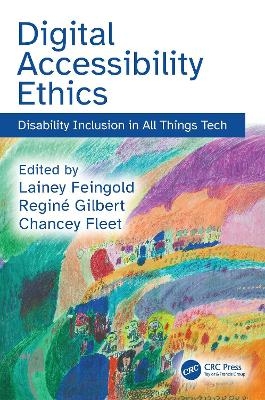
Digital Accessibility Ethics
CRC Press (Verlag)
978-1-041-01869-8 (ISBN)
- Noch nicht erschienen (ca. April 2026)
- Versandkostenfrei
- Auch auf Rechnung
- Artikel merken
Digital Accessibility Ethics is a practical guide with an urgent goal: to help end tech exclusion of 1.3 billion people across the world with disabilities.
The book introduces the first Digital Accessibility Ethics Framework – an action-oriented, three-part tool designed to influence, change, and disrupt patterns of exclusion with values, actions, and questions. This edited collection is written by 39 authors from 10 countries and one commonwealth, the majority of whom are disabled.
The editors and authors have over 600 years of combined accessibility and disability advocacy experience. They offer and apply an ethics lens that supports disabled people’s right to fully participate in every facet of digital life. It is a lens that helps organizations reduce the financial, legal, privacy, safety, and other risks and harms of disability exclusion.
Through stories, recommendations, strategies, and other guidance, the book looks at a wide range of topics through the Digital Accessibility Ethics Framework: from gaming and smart cities to hackathons, procurement, and cybersecurity. From accessibility practitioner burnout, to robots, artificial intelligence, workplace software, aerospace, design, healthcare, open source, emergency preparedness, legal ethics, publishing, and much more.
This book is for leaders in all these fields. And it is for all technologists, educators, students, marketers, policy makers and everyone who has ever posted on social media or sent an email. It encourages us to stop and ask ourselves: who are we excluding when digital accessibility is ignored? Who are we harming, what are we risking, by our decisions?
As the world grows more digital, as AI is marketed everywhere, and as the number of people with disabilities continues to grow, there has never been a more urgent time to expose, explore, and act at the intersection of ethics, disability, and digital accessibility. Digital Accessibility Ethics offers a roadmap to show us the way.
An accessible digital version of the book will be available, upon publication.
Lainey Feingold is a globally recognized disability rights lawyer, author, and international speaker who has worked in the digital accessibility space since 1995. She helped negotiate the first web accessibility agreement in the United States in 2000 and has worked with the blind community and dozens of companies on accessibility initiatives since then. More information on Lainey’s website at https://www.lflegal.com/ Reginé Gilbert helps people and organizations reimagine possibilities at the intersection of inclusive design, emerging technology, and transformational change. Her research explores how inclusive design principles can guide the development of artificial intelligence, immersive realities, and spatially aware systems to better serve diverse communities. Reginé is an author and a recognized voice in the field of Design, featured in numerous publications. Reginé Gilbert website: https://reginegilbert.com/. Chancey Fleet is a Brooklyn-based tech educator and activist who identifies as Blind. Chancey is the Assistive Technology Coordinator at the New York Public Library. Chancey is a 2018-19 Data & Society Fellow and current Affiliate-in-Residence whose writing, organizing and advocacy aims to catalyze critical inquiry into how cloud-connected accessibility tools benefit and harm, empower and expose communities of disability. Her writing has appeared in Urban Omnibus and MIT Technology Review.
Part 1: Foundation 1. Introducing the Digital Accessibility Ethics Framework 2. Disability and Accessibility: Understanding the Terms at the Heart of this Collection 3. The Ethical Dilemmas of Artificial Intelligence 4. The Global Digital Accessibility Legal Landscape Part 2: Ethical Accessibility Practices 5. Designing With: Widening Power and Participation of Disabled People in the Design Process 6. Achieving Ethical Accessibility in the Development Process 7. The Ethics of Accessibility Leadership in India and Across the Globe 8. Empower All Minds: Cognitive Accessibility Ethics 9. Don’t Buy Broken Things: Ethical Accessible Procurement 10. Hackathons, Student Projects, and Digital Accessibility Ethics 11. Deaf Leaders Now! The Ethics of Hiring Disabled People in Science and Technology 12. Making Every Voice Heard: The Ethics of Voice Recognition Technology 13. Digital Accessibility Ethics in Africa: Progress, Challenges, and Opportunities 14. Who Sees What? Ethics Issues in Describing the Visual World 15. Facial Difference, AI Bias, and Digital Accessibility Ethics 16. Everyone Needs (At Least A Little) Accessibility Education 17. Accessibility Overlays and the Harms of Marketing “Quick Fixes” 18. Accessibility Practitioner Burnout is an Ethics Issue Part 3: Digital Accessibility Ethics Across Sectors 19. No One Left Behind: Digital Accessibility Ethics and Emergency Preparedness 20. When My Seeing Eye Dog and I Surprise a Delivery Robot: New Technologies Need to be Accessible, Too 21. Secure by Design, Accessible by Default: Building Cybersecurity Ethics That Include Everyone 22. From Both Sides of the Stethoscope: Digital Accessibility Ethics in Healthcare 23. Beyond Technology: Ethics and Strategies for Inclusive Smart Cities 24. Tech-Facilitated Disability Discrimination and Artificial Intelligence Tools at Work 25. Who Gets to Read, Who Gets to Publish? Digital Accessibility Ethics for Authors, Journalists, and Publishers 26. Democracy for All: Addressing Accessibility Challenges for Disabled Voters 27. Digital Accessibility and Open Source Need Each Other 28. Immersive Technology Needs Digital Accessibility Ethics 29. Public Relations, Marketing, Accessibility, and Ethics 30. The Future of Game Accessibility is Grounded in Ethics 31. Digital Accessibility and Public Digital Amenities 32. Legal Ethics, Access to Justice, and the Need for Digital Accessibility Conclusion: What’s Next for Digital Accessibility Ethics?
| Erscheint lt. Verlag | 15.4.2026 |
|---|---|
| Zusatzinfo | 1 Tables, color; 2 Tables, black and white; 4 Line drawings, color; 18 Line drawings, black and white; 17 Halftones, color; 2 Halftones, black and white; 21 Illustrations, color; 20 Illustrations, black and white |
| Verlagsort | London |
| Sprache | englisch |
| Maße | 178 x 254 mm |
| Themenwelt | Mathematik / Informatik ► Informatik ► Theorie / Studium |
| Recht / Steuern ► Arbeits- / Sozialrecht ► Sozialrecht | |
| Recht / Steuern ► EU / Internationales Recht | |
| Recht / Steuern ► Privatrecht / Bürgerliches Recht ► IT-Recht | |
| Wirtschaft ► Betriebswirtschaft / Management ► Marketing / Vertrieb | |
| Wirtschaft ► Betriebswirtschaft / Management ► Unternehmensführung / Management | |
| ISBN-10 | 1-041-01869-X / 104101869X |
| ISBN-13 | 978-1-041-01869-8 / 9781041018698 |
| Zustand | Neuware |
| Informationen gemäß Produktsicherheitsverordnung (GPSR) | |
| Haben Sie eine Frage zum Produkt? |
aus dem Bereich