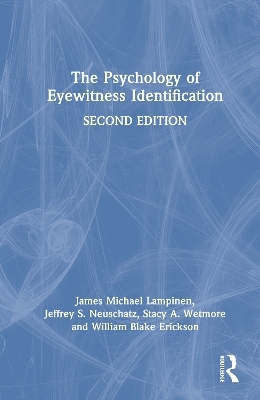
The Psychology of Eyewitness Identification
Routledge (Verlag)
978-1-032-55849-3 (ISBN)
- Noch nicht erschienen (ca. April 2026)
- Versandkostenfrei
- Auch auf Rechnung
- Artikel merken
The book covers topics including measurement of eyewitness performance, eyewitness theory, social media's impact on identification, and technological approaches to investigating eyewitness reliability. The volume presents research on eyewitness identification as an exemplary case of psychological science successfully applied to real-world problems.
Featuring real-life case studies, this comprehensive text is essential reading for scholars and advanced students of forensic psychology, cognitive psychology and memory studies who seek to understand the complex relationship between memory processes and the criminal justice system.
James Michael Lampinen, Ph.D. is a Distinguished Professor of Psychological Science at the University of Arkansas. His research explores eyewitness identification, false memories, dual process models, and prospective person memory. He has published over 90 works and co-authored Memory 101. Jeffrey S. Neuschatz, Ph.D. is Core Faculty at Fielding Graduate University and Professor of Psychology. His research centers on eyewitness memory, lineup procedures, secondary confessions, and jury decision-making, with major contributions on showup reliability and jailhouse informants. He has published 65 works and co-authored Jailhouse Informants: Psychological and Legal Perspectives. Stacy A. Wetmore, Ph.D. is Associate Professor of Psychology at Butler University. Her research examines cognitive psychology in legal contexts, with a focus on wrongful convictions, eyewitness memory, informant reliability, and jury decision-making. She earned her Ph.D. at the University of Oklahoma and has published more than 35 scholarly articles and chapters. William Blake Erickson, Ph.D. is Associate Professor of Psychology at Texas A&M University–San Antonio. His research applies face recognition to law enforcement and national security, focusing on eyewitness memory, forensic imaging, and older witnesses. He also writes for the Popular Culture Psychology series, analyzing franchises such as Star Trek, Handmaid’s Tale, and Stranger Things.
Acknowledgements. About the Authors. Chapter 1 Twenty-Seven Years. Chapter 2 Theoretical Approaches to Eyewitness Identification. Chapter 3 Measuring Eyewitness Performance. Chapter 4 Indicia of Reliability – Reflector Variables. Chapter 5 Estimator Variables: Characteristics of the Witness. Chapter 6 Estimator Variables: Characteristics of the Situation and the Suspect. Chapter 7 System Variables: Pre-identification. Chapter 8 System Variables: The Identification Procedure. Chapter 9 Prospective Person Memory, Missing Persons and Identity Screening. Chapter 10 Field Studies of Eyewitness Identification. Chapter 11 Expert Testimony. Chapter 12 Conclusions and Thoughts.
| Erscheint lt. Verlag | 1.4.2026 |
|---|---|
| Zusatzinfo | 11 Tables, black and white; 45 Line drawings, black and white; 10 Halftones, black and white; 55 Illustrations, black and white |
| Verlagsort | London |
| Sprache | englisch |
| Maße | 152 x 229 mm |
| Gewicht | 453 g |
| Themenwelt | Geisteswissenschaften ► Psychologie ► Allgemeine Psychologie |
| Geisteswissenschaften ► Psychologie ► Biopsychologie / Neurowissenschaften | |
| Recht / Steuern ► Strafrecht ► Kriminologie | |
| ISBN-10 | 1-032-55849-0 / 1032558490 |
| ISBN-13 | 978-1-032-55849-3 / 9781032558493 |
| Zustand | Neuware |
| Informationen gemäß Produktsicherheitsverordnung (GPSR) | |
| Haben Sie eine Frage zum Produkt? |
aus dem Bereich