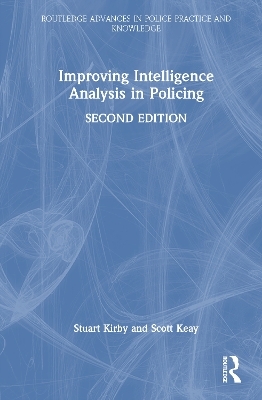
Improving Intelligence Analysis in Policing
Routledge (Verlag)
978-1-032-91482-4 (ISBN)
- Noch nicht erschienen (ca. März 2026)
- Versandkostenfrei
- Auch auf Rechnung
- Artikel merken
The use of criminal intelligence remains a significant area of growth, especially across the wider ‘policing’ arena. This book offers an accessible and critical account of how intelligence analysis can improve policing and law enforcement.
This second edition has been updated with new research and material offering inventive modes of critical thinking, including both practical knowledge and an evaluative understanding of the applications and risks associated with intelligence. Some of the key features of the book include:
Advances theories of intelligence analysis
Critical evaluation of intelligence sources
Includes recommendations to improve practice
Leadership and management approaches in intelligence-led policing
Strategic applications of intelligence for crime reduction
Technological innovation and data science integration in intelligence work
Future-focused and offers new ideas to develop policy and practice
This volume is aimed at students and scholars of law enforcement intelligence studies, policing, and criminology. It will also be a useful resource for policymakers as well as practitioners in a range of law enforcement settings.
Stuart Kirby is a Chartered Psychologist who previously served as a Detective Chief Superintendent (Lancashire UK), with responsibility for Intelligence, Forensic, Major Crime, Organised Crime and Counter Terrorism. On retirement he became an academic and is now Emeritus Professor in Policing at the University of Lancashire. Scott Keay is a senior lecturer in Policing at Edge Hill University (UK). He is a former intelligence analyst and worked in various analytical roles from criminal intelligence through to community safety and partnership intelligence. His research continues to develop and support crime and intelligence analysis.
1. Why intelligence analysis remains essential in policing 2. Understanding the value and danger of intelligence sources 3. How leaders / managers improve the intelligence process 4. How analysts can improve intelligence analysis 5. Intelligence and crime reduction 6. The use of intelligence techniques in reactive and proactive investigations 7. The enduring importance of partnership intelligence 8. Technology and data science 9. Improving intelligence analysis to meet future challenges
| Erscheint lt. Verlag | 5.3.2026 |
|---|---|
| Reihe/Serie | Routledge Advances in Police Practice and Knowledge |
| Zusatzinfo | 5 Tables, black and white; 6 Line drawings, black and white; 6 Illustrations, black and white |
| Verlagsort | London |
| Sprache | englisch |
| Maße | 156 x 234 mm |
| Themenwelt | Recht / Steuern ► EU / Internationales Recht |
| Recht / Steuern ► Strafrecht ► Kriminologie | |
| Sozialwissenschaften ► Soziologie | |
| ISBN-10 | 1-032-91482-3 / 1032914823 |
| ISBN-13 | 978-1-032-91482-4 / 9781032914824 |
| Zustand | Neuware |
| Informationen gemäß Produktsicherheitsverordnung (GPSR) | |
| Haben Sie eine Frage zum Produkt? |
aus dem Bereich