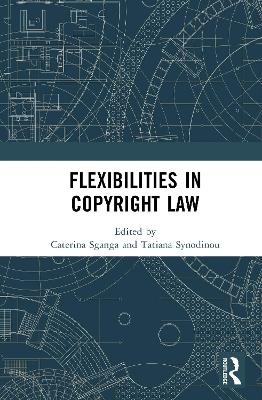
Flexibilities in Copyright Law
Routledge (Verlag)
978-1-032-72084-5 (ISBN)
- Noch nicht erschienen (ca. März 2026)
- Versandkostenfrei
- Auch auf Rechnung
- Artikel merken
Caterina Sganga is Full Professor of Comparative Private Law at Scuola Superiore Sant’Anna (Pisa, Italy). She is member of the European Copyright Society, past President of the European Policy for Intellectual Property Association (EPIP, 2024-2025) and its Board Member since 2022, and fellow of the European Law Institute. Her main research areas are European copyright law, IP and new technologies, the balance between IP and fundamental/human rights, and the law and economics of cultural and creative industries. Her recent research works cover also the regulation of data ownership and governance, with a focus on non-personal data, and Open Science law and policies. Tatiana Eleni Synodinou is a Professor of Private and Commercial law at the Law Department of the University of Cyprus. Her main research areas are European Copyright law, European Internet Law, digital copyright law, digital platform regulation, property law. She is currently the Holder of the Jean Monnet Chair DIGI ( Jean Monnet Centre of Excellence DIGIU - Digital Platforms: Under the Scope of the New Era in Digital Services). She is founding member and President of the Union of Copyright Law of Cyprus (EDPI), that is the Cypriot affiliate of International Literary and Artistic Association (ALAI). She is member of the European Copyright Society. Since November 2022 she is the Vice Rector for Academic Affairs of the University of Cyprus.
Introduction 1. The Aims and Objectives of the European Union as Imperatives for more Flexibility in Copyright Law 2. Transforming Copyright Exceptions Into User Rights 3. Five years after. A critical re-evaluation of end-user flexibilities under the CDSM Directive 4. Article 3(3) InfoSoc Directive under the CJEU jurisprudence: the need for flexibility rather than a pre-emptive statement 5. The Dynamic Interpretation of Lending Right in VOB: a Precedent for Copyright Flexibilities? 6. Free Use-As-Free Labor: UGC Platforms’ Data Capture Model 7. Originality as a fortress resisting technological evolution. Some comments inspired by the copyrightability of 3D digitization and printing 8. The nebulous notion of interoperability and its growing importance in EU copyright law 9. Flexibility Through Openness in Research Exceptions 10. Algorithmic propagation: How the data-platform regulatory framework may increase bias in content moderation 11. Fair Enforcement Procedures as a Means to Enhance Substantive Flexibility in Copyright Law 12. Article 17 of the CDSM Directive: the new route to publication for cover songs and remixes 13. Copyright Governance of Algorithms? Algorithmic transparency as a regulatory tool to ensure a fairer and more accountable copyright governance regime 14. Conceptualising the Right to Secondary Publication 15. Permitted but Paid: The Flexibilisation of Copyright Law through Statutory Remuneration Rights 16. Mind the (Accessibilities) Gap: Copyright Flexibilities and Media Regulation 17. What Should Pastiche Mean in a Copyright Context? 18. Internet memes as an element of free speech online 19. Towards Resilient Educational Systems in the EU – Proposal for an Operational Education Exception 20. Encouraging the Use of Copyright Flexibilities through Codes of Best Practices: A Deliberative Approach 21. A (flexible) call to arms to safeguard creative reuse 22. Territoriality as a Copyright Inflexibility? The Case of European Film Distribution 23. To opt-out or not to opt-out? Music as data to be mined: a music industry perspective
| Erscheint lt. Verlag | 30.3.2026 |
|---|---|
| Zusatzinfo | 7 Tables, black and white; 1 Line drawings, black and white; 11 Halftones, black and white; 12 Illustrations, black and white |
| Verlagsort | London |
| Sprache | englisch |
| Maße | 156 x 234 mm |
| Themenwelt | Recht / Steuern ► Allgemeines / Lexika |
| Recht / Steuern ► EU / Internationales Recht | |
| Recht / Steuern ► Wirtschaftsrecht ► Urheberrecht | |
| ISBN-10 | 1-032-72084-0 / 1032720840 |
| ISBN-13 | 978-1-032-72084-5 / 9781032720845 |
| Zustand | Neuware |
| Informationen gemäß Produktsicherheitsverordnung (GPSR) | |
| Haben Sie eine Frage zum Produkt? |
aus dem Bereich