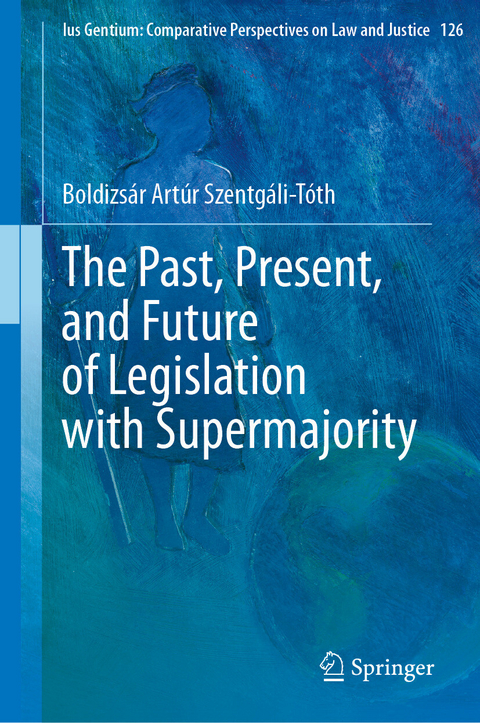
The Past, Present, and Future of Legislation with Supermajority (eBook)
193 Seiten
Springer (Verlag)
978-3-031-99324-4 (ISBN)
This book revisits the main challenges raised by the implementation of supermajority legislation – a constitutionally prescribed subcategory of statutory norms that covers, at least in principle, the most important fields of legislation, and which is subject to stricter procedural requirements than the ordinary legislative process. The book puts the issue in a broader context, yielding valuable comparative insights.
It lays the theoretical groundwork for the interdisciplinary assessment of supermajority law concepts, which are ranked somewhere between the constitutional and statutory level in the legal pyramid. To cite the most important example, there is still no coherent standard to help constitutional courts decide whether individual statutory provisions should be covered by supermajority legislation or ordinary legislation. The three main points of departure are the following:
Firstly, the book posits that supermajority shall be distinguished from ordinary laws as a separate constitutional concept and a category of legal sources with a legal rank falling clearly under the constitution, but over ordinary laws. The second assumption states that due to several short-comings, the current procedural frameworks of supermajority law could not maximize its efficiency as a constitutional instrument. Other tools might better highlight the role of supermajority laws as safeguards vis-á-vis their currently mostly restrictive character. Thirdly, the book relies on the assumption that the current concept of supermajority law covers an overbroad range of statutes. Therefore, the volume argues for the necessity of narrowing the supermajority legislation to counterbalance the distortive effects of this framework.
In light of these three considerations, more legitimate alternative directions can be identified to further develop the existing main models: the scope of this legal instrument might be diminished; mandatory a priori review might be established; while the reconsideration of the legislative process; or the elaboration of precise contours for the hierarchy of norms might also be necessary.
This book is intended for policymakers, scholars and university students interested in understanding the mechanisms of parliamentary legislation in more depth.
| Erscheint lt. Verlag | 24.7.2025 |
|---|---|
| Reihe/Serie | Ius Gentium: Comparative Perspectives on Law and Justice |
| Zusatzinfo | X, 193 p. 6 illus., 5 illus. in color. |
| Sprache | englisch |
| Themenwelt | Recht / Steuern ► Allgemeines / Lexika |
| Recht / Steuern ► EU / Internationales Recht | |
| Recht / Steuern ► Öffentliches Recht ► Verfassungsrecht | |
| Recht / Steuern ► Privatrecht / Bürgerliches Recht | |
| Schlagworte | comparative constitutional law • constitutional law • Decision-Making • Fundamental Rights • Legislation • parliamentary law • Political Science • public law • Qualified majority • Separation of Powers • Sociology • Stability of the constitution • supermajority |
| ISBN-10 | 3-031-99324-1 / 3031993241 |
| ISBN-13 | 978-3-031-99324-4 / 9783031993244 |
| Informationen gemäß Produktsicherheitsverordnung (GPSR) | |
| Haben Sie eine Frage zum Produkt? |
 PDF (Wasserzeichen)
DRM: Digitales Wasserzeichen
Dieses eBook enthält ein digitales Wasserzeichen und ist damit für Sie personalisiert. Bei einer missbräuchlichen Weitergabe des eBooks an Dritte ist eine Rückverfolgung an die Quelle möglich.
Dateiformat: PDF (Portable Document Format)
Mit einem festen Seitenlayout eignet sich die PDF besonders für Fachbücher mit Spalten, Tabellen und Abbildungen. Eine PDF kann auf fast allen Geräten angezeigt werden, ist aber für kleine Displays (Smartphone, eReader) nur eingeschränkt geeignet.
Systemvoraussetzungen:
PC/Mac: Mit einem PC oder Mac können Sie dieses eBook lesen. Sie benötigen dafür einen PDF-Viewer - z.B. den Adobe Reader oder Adobe Digital Editions.
eReader: Dieses eBook kann mit (fast) allen eBook-Readern gelesen werden. Mit dem amazon-Kindle ist es aber nicht kompatibel.
Smartphone/Tablet: Egal ob Apple oder Android, dieses eBook können Sie lesen. Sie benötigen dafür einen PDF-Viewer - z.B. die kostenlose Adobe Digital Editions-App.
Buying eBooks from abroad
For tax law reasons we can sell eBooks just within Germany and Switzerland. Regrettably we cannot fulfill eBook-orders from other countries.
aus dem Bereich