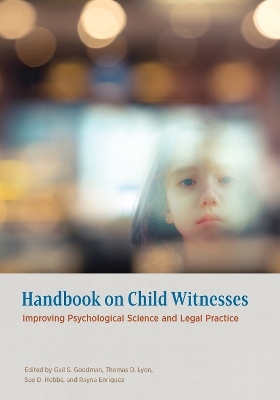
Handbook on Child Witnesses
American Psychological Association (Verlag)
978-1-4338-4265-8 (ISBN)
- Noch nicht erschienen (ca. April 2026)
- Versandkostenfrei
- Auch auf Rechnung
- Artikel merken
This comprehensive text describes the science and practice of child forensic interviewing, with an emphasis on child abuse cases.
For the forensic interviewer, eliciting descriptions of childhood assaults, at any age, is no easy task. Over the last several decades, research on children and the law has greatly expanded, especially on the topics of forensic interviewing, memory, suggestibility, linguistic development, and social and emotional development. This area of study and practice is especially concerned with both false denials and false allegations. These concerns have led to the development of useful evidence-informed protocols, but there is still more research to be done.
This book offers a holistic overview of current research directions and policy implications regarding child witnesses’ interactions with the legal system, including the long-term outcomes after their initial involvement. Children and families impacted by the trauma of a sexual assault, or the trauma of a false report, can experience lasting mental and physical effects. Children are especially vulnerable to experiencing distress when interacting with the legal process. This volume covers the best techniques that minimize further distress when child witnesses are involved in legal proceedings, and illustrates how best to deal with the inevitable stressors. Chapters delve into interviewing methods, social support, child understanding of legal proceedings, true versus false reporting, and countering juror bias.
Gail S. Goodman, PhD, is distinguished professor of psychology, emerita at the University of California, Davis. Dr. Goodman received many national and international awards and grants for her writings and research on child witnesses. Her research is cited pivotally in U.S. Supreme Court decisions concerning child witnesses and courtroom testimony. She obtained her doctoral degree in psychology from UCLA. She published for many years with Dr. Karen J. Saywitz, and they were very close friends. Dr. Goodman and Dr. Saywitz are often credited with starting the modern scientific study of children’s eyewitness memory and children in the legal context. Thomas D. Lyon, JD, PhD, is the Judge Edward J. and Ruey L. Guirado chair in law and psychology at the University of Southern California Gould School of Law. After graduating from Harvard Law School, he worked as an attorney for the Children’s Services Division of the Los Angeles County Counsel. He obtained a PhD in developmental psychology from Stanford University, and was a post-doctoral researcher with Karen Saywitz, PhD at UCLA. His work has been funded by the National Institute of Child Health and Development, the National Science Foundation, and the Department of Justice. Sue D. Hobbs, PhD, is professor of child and adolescent development and chair of undergraduate studies in education in the College of Education at California State University, Sacramento. Dr. Hobbs received her doctoral degree in developmental psychology from the University of California, Davis. She received the Karen Saywitz Early Career Award for Outstanding Contributions to Research and Practice from the American Psychological Association Division 37. Her research and peer-reviewed publications focus on children's eyewitness memory, forensic interviewing techniques, and the experiences of foster youth in the legal system. Rayna Enriquez, PhD, works at the National Institute of Justice and holds a doctoral degree in developmental psychology from the University of California, Davis. Dr. Enriquez obtained her bachelor’s degree in psychology with a specialization in Law, Forensics, and Criminality from the University of Southern California. As part of her training, she served as a researcher of forensic interviewing techniques for children in court actions. She specializes in eyewitness memory and perceptions of children with developmental disorders, as well as in true and false memory in adults.
Chapter 1. Child Witness Research: Introduction
Gail S. Goodman, Thomas D. Lyon, Sue D. Hobbs, and Rayna Enriquez
Part I. Basic Research
Chapter 2. Children’s Mental Health and Childhood Adversity
Yo Jackson, Sherille Bosfield, and Sara Such
Chapter 3. Children’s Memory and Suggestibility for Abuse-Related Events
Yuerui Wu, Nathalie Moriarty, Juan Pablo Hernandez Aldaco, Ben T. Reeb, and Gail S. Goodman
Chapter 4. Adults’ Memory for Childhood Maltreatment and Childhood Trauma: The Continued Relevance of Research on Historic Child Sexual Abuse
Avery Stackle, Martine Fredrickson, and Deborah Goldfarb
Chapter 5. Children’s Memory for Repeated Events in Child Maltreatment Investigations
Sarah L. Deck, Sonja P. Brubacher, and Martine B. Powell
Chapter 6. Initial Denial of Child Sexual Abuse: Reluctance or Suggestibility
Thomas D. Lyon, Breanne E. Wylie, and Zsofia Szojka
Chapter 7. The Development and Correction of Children’s False Memories
Henry Otgaar, Mark L. Howe, and Charlotte BÜcken
Part II. Improving Children’s Reports
Chapter 8. The Developmental Narrative Elaboration Interview: A Toolbox Approach for Interviewing Young Children
Lorinda B. Camparo
Chapter 9. Supportively Questioning Children About Suspected Abuse
Michael E Lamb, Irit Hershkowitz, Yael Karni-Visel, and Uri Blasbalg
Chapter 10. Research on the Use of Ground Rules in Interviews with Children
Sonja P. Brubacher and Deirdre A. Brown
Chapter 11. What We Know and Don’t Know About Eliciting Disclosures from and Interviewing Adolescent Victims and Witnesses
Victoria W. Dykstra, Rachel E. Dianiska, and Jodi A. Quas
Chapter 12. Rapport and Social Support in Children’s Forensic Interviews
Sue D. Hobbs, Rakel P. Larson, and Christine R. Wells
Chapter 13. Mechanisms of Denial: Children’s Deception and Secrecy
Angela M. Crossman and Victoria Talwar
Chapter 14. Child Victims and Witnesses with Autism: Interactions with the Legal System
Rayna Enriquez, Katie Maras, and Lucy A. Henry
Part III. Perceptions of Children in Court
Chapter 15. Children’s Competency and the Effects of Direct- and Cross-Examination on Children’s Accuracy and Productivity
Stacia N. Stolzenberg, Colleen E. Sullivan, and Lea Sobrilsky
Chapter 16. Mock Jurors’ Perceptions of Child Sexual Abuse Victims: A Review
Jonathan M. Golding, Margaret C. Stevenson, Kelly C. Burke, and Mary M. Levi
Part IV. Emotional Reactions and Court Preparation Programs
Chapter 17. Children’s Interactions with the Legal System
Hannah M. Johnson, Michaela G. Ramsey, Alexandria P. Winstead, and Stephanie D. Block
Chapter 18. Children’s Advocacy Centers and Kids in Court Preparation Programs
Rebecca Nathanson
| Erscheint lt. Verlag | 28.4.2026 |
|---|---|
| Reihe/Serie | American Psychology-Law Series |
| Verlagsort | Washington DC |
| Sprache | englisch |
| Maße | 178 x 254 mm |
| Themenwelt | Geisteswissenschaften ► Psychologie |
| Recht / Steuern ► Allgemeines / Lexika | |
| Recht / Steuern ► EU / Internationales Recht | |
| Recht / Steuern ► Privatrecht / Bürgerliches Recht ► Zivilverfahrensrecht | |
| ISBN-10 | 1-4338-4265-3 / 1433842653 |
| ISBN-13 | 978-1-4338-4265-8 / 9781433842658 |
| Zustand | Neuware |
| Informationen gemäß Produktsicherheitsverordnung (GPSR) | |
| Haben Sie eine Frage zum Produkt? |
aus dem Bereich