Zum Hauptinhalt springen
Nicht aus der Schweiz? Besuchen Sie lehmanns.de
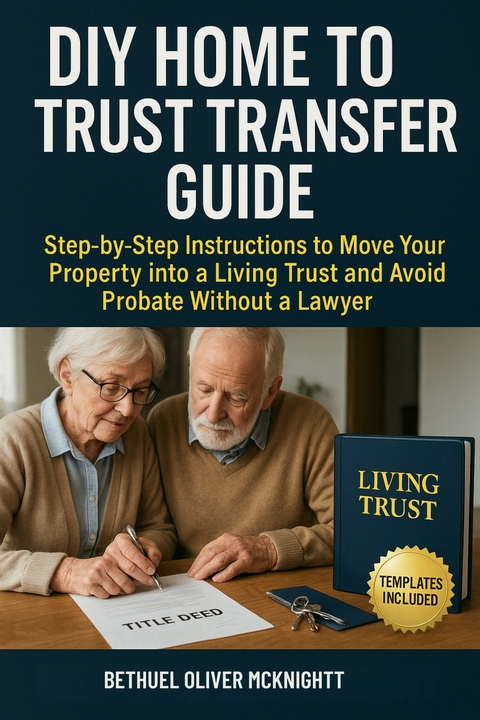
DIY Home to Trust Transfer Guide -  Bethuel Oliver McKnight

DIY Home to Trust Transfer Guide (eBook)

Step-by-Step Instructions to Move Your Property into a Living Trust and Avoid Probate Without a Lawyer
eBook Download: EPUB
2025 | 1. Auflage
390 Seiten
Isohan Publishing (Verlag)
978-0-00-103182-1 (ISBN)
Systemvoraussetzungen
8,61 inkl. MwSt
(CHF 8,40)
Der eBook-Verkauf erfolgt durch die Lehmanns Media GmbH (Berlin) zum Preis in Euro inkl. MwSt.
  • Download sofort lieferbar
  • Zahlungsarten anzeigen

DIY Home to Trust Transfer: Save $5,000+ with Step-by-Step Legal Forms and State-Specific Guides


Stop paying attorneys thousands of dollars to transfer your home to a living trust. This complete guide shows you exactly how to do it yourself safely and legally, with state-specific instructions for all 50 states.


What You'll Learn:


How to prepare legally compliant deeds using proven templates


State-by-state recording requirements and fee schedules


Step-by-step procedures for Tier 1, 2, and 3 complexity states


How to handle mortgaged properties without triggering due-on-sale clauses


Complete forms library with fillable templates for every state


Troubleshooting guide for common problems and corrections


When to seek professional help versus handling transfers yourself


Includes Complete Templates and Forms: ✓ Universal quitclaim deed templates ✓ State-specific grant deed forms ✓ Transfer on Death (TOD) deed options ✓ Lender notification letters citing federal law protections ✓ Insurance company update forms ✓ Property tax exemption applications


Perfect For:


Homeowners with living trusts who want to fund them properly


Property investors managing multiple properties across states


Families avoiding probate costs and delays


Anyone facing $2,000-5,000 attorney fees for simple transfers


Vacation home owners dealing with out-of-state properties


State-Specific Coverage: Complete guidance for DIY-friendly states like Texas, Florida, Nevada, and Arizona. Strategic approaches for moderate complexity states like Illinois, Ohio, and Michigan. Professional consultation guidelines for complex states like California, New York, and Pennsylvania.

Chapter 1: Why Transfer Your Home to a Trust Yourself
Sarah Martinez stared at the attorney's estimate: $4,800 for a simple trust transfer of her Phoenix home. After paying for her daughter's college tuition and dealing with her husband's recent medical bills, nearly five thousand dollars felt like a mountain she couldn't climb. Yet she knew putting her home in a trust was the right thing to do - she'd watched her neighbor's family spend eight months and twelve thousand dollars in probate court just to settle a simple estate.
"There has to be another way," she told herself, sitting at her kitchen table surrounded by legal documents she barely understood. That night, she discovered something that changed everything: she could legally transfer her home to her living trust herself, without an attorney, for less than $200 in fees.
Six weeks later, Sarah completed her DIY trust transfer successfully. She saved $4,600 and gained something equally valuable - the confidence that comes from understanding and controlling her own financial future. Her story isn't unique. Thousands of homeowners across America are discovering they can handle this crucial estate planning task themselves, saving substantial money while protecting their families' inheritance.
The Real Cost of Professional Help
Let's talk numbers, because that's where this conversation gets interesting. The average attorney fee for transferring a home into an existing trust ranges from $2,000 to $6,000, depending on your location and property complexity. In high-cost areas like California's Bay Area or Manhattan, fees can reach $8,000 or more. Even in smaller markets, you'll rarely pay less than $1,500.
Here's what you're actually paying for: document preparation (maybe 2 hours of work), deed recording (often handled by a paralegal), and the attorney's liability insurance. The actual legal complexity? In most straightforward cases, it's surprisingly minimal.
Compare that to the DIY approach. Your total out-of-pocket costs typically include:
  • County recording fee: $15-$75
  • Documentary transfer tax (if applicable): $0-$200
  • Notary fee: $10-$25
  • Certified copies: $15-$40
Total DIY cost: Usually under $300, often much less.
The math is compelling, but money isn't everything. The real question is whether you can handle this process safely and effectively. The answer, for most homeowners in most situations, is yes - if you understand what you're doing and when to step back.
When DIY Makes Perfect Sense
Tom and Linda Harrison owned their Colorado home free and clear. They'd established their living trust three years earlier and wanted to transfer their property into it. Their situation was textbook simple: one property, two owners (married couple), clear title, no liens, and Colorado's straightforward recording requirements.
Tom, a retired engineer, appreciated systematic processes. He spent two weekends researching the requirements, downloaded the proper forms from the county recorder's office, and carefully prepared their quitclaim deed. The entire process took him about eight hours spread over three weeks. His total cost: $47.
"I've built airplane engines," Tom laughed. "I figured I could handle a property deed."
The Harrisons represent the sweet spot for DIY trust transfers. They had:
  • An existing, properly drafted living trust
  • A straightforward property situation
  • The time and patience to do it right
  • Access to clear, reliable information
  • A backup plan (they knew their attorney's phone number)
The Complexity Spectrum
Not every situation is right for the DIY approach. Property transfers exist on a complexity spectrum, and understanding where your situation falls is crucial for success.
Simple scenarios perfect for DIY include:
  • Single-family residence with clear title
  • Married couple transferring to joint trust
  • No mortgage or mortgage with major lender
  • Property in a DIY-friendly state
  • Standard ownership structure
Moderate complexity situations where DIY is possible but requires extra care:
  • Properties with existing mortgages
  • Co-owned properties with unmarried owners
  • Investment or rental properties
  • Properties in states with additional requirements
  • Situations involving recent divorces or title issues
High complexity scenarios where professional help is strongly recommended:
  • Commercial properties or unusual property types
  • Properties with existing title problems
  • Situations involving disputed ownership
  • Tax-deferred exchanges or seller financing
  • Properties in states with attorney-required processes
The key is honest self-assessment. If your situation involves multiple complications or you're uncomfortable with any aspect of the process, the attorney fee represents good value for peace of mind.
Your Personal Capability Assessment
Before you decide to handle this yourself, you need to evaluate whether you're the right person for the job. This isn't about intelligence - it's about fit. Some brilliant people struggle with bureaucratic processes, while others find them straightforward.
Consider your comfort level with:
Administrative tasks: Do you handle your own tax returns? Have you ever recorded a document with a government office? Are you comfortable following detailed instructions precisely?
Detail orientation: Can you proofread carefully? Do you double-check important documents before signing? Are you good at catching small errors that could cause big problems?
Time availability: Do you have 4-8 hours to spread over several weeks? Can you work during business hours when recorder offices are open? Are you willing to start over if you make a mistake?
Stress tolerance: How do you handle uncertainty? Can you work through problems without getting overwhelmed? Are you comfortable taking reasonable risks when you've done your homework?
Learning style: Do you learn well from written instructions? Can you break complex processes into manageable steps? Are you willing to research unfamiliar terms and concepts?
Margaret Chen, a busy pediatrician in Austin, realized she wasn't the right fit for DIY. "I can handle complex medical procedures," she explained, "but I hate paperwork and I never have time to do it carefully. For me, paying the attorney was worth every penny because I knew it would be done right the first time."
Contrast that with David Rodriguez, a high school history teacher who transferred his family's San Antonio home successfully. "I'm used to breaking complex topics into understandable pieces," he said. "Plus, I had summer vacation to work on it. The process reminded me of grading papers - attention to detail is everything."
The Three-Tier State System
Your location dramatically affects your DIY success odds. After analyzing trust transfer requirements across all 50 states, a clear pattern emerges: states fall into three distinct tiers based on complexity, requirements, and DIY-friendliness.
Tier 1 states make DIY transfers relatively straightforward. These include Texas, Florida, Nevada, Arizona, and 15 others. They typically offer:
  • Simple recording processes
  • Clear fee structures
  • Minimal additional forms
  • Good online resources
  • Transfer-on-death deed options
Tier 2 states add moderate complexity but remain DIY-feasible for most homeowners. Illinois, Ohio, Michigan, and about 20 others require:
  • Additional documentation
  • More complex tax forms
  • Higher fees
  • Some specialized knowledge
  • Extra attention to detail
Tier 3 states present significant challenges that push many homeowners toward professional help. California, New York, Pennsylvania, and New Jersey feature:
  • Extensive additional requirements
  • Complex tax implications
  • Multiple agency interactions
  • Specialized forms and procedures
  • Higher error risks
Living in a Tier 3 state doesn't automatically disqualify you from DIY success, but it does raise the bar considerably. You'll need more time, greater attention to detail, and stronger comfort with bureaucratic...

Erscheint lt. Verlag 24.8.2025
Sprache englisch
Themenwelt Recht / Steuern
ISBN-10 0-00-103182-1 / 0001031821
ISBN-13 978-0-00-103182-1 / 9780001031821
Informationen gemäß Produktsicherheitsverordnung (GPSR)
Haben Sie eine Frage zum Produkt?
EPUBEPUB (Adobe DRM)
Größe: 2,1 MB

Kopierschutz: Adobe-DRM
Adobe-DRM ist ein Kopierschutz, der das eBook vor Mißbrauch schützen soll. Dabei wird das eBook bereits beim Download auf Ihre persönliche Adobe-ID autorisiert. Lesen können Sie das eBook dann nur auf den Geräten, welche ebenfalls auf Ihre Adobe-ID registriert sind.
Details zum Adobe-DRM

Dateiformat: EPUB (Electronic Publication)
EPUB ist ein offener Standard für eBooks und eignet sich besonders zur Darstellung von Belle­tristik und Sach­büchern. Der Fließ­text wird dynamisch an die Display- und Schrift­größe ange­passt. Auch für mobile Lese­geräte ist EPUB daher gut geeignet.

Systemvoraussetzungen:
PC/Mac: Mit einem PC oder Mac können Sie dieses eBook lesen. Sie benötigen eine Adobe-ID und die Software Adobe Digital Editions (kostenlos). Von der Benutzung der OverDrive Media Console raten wir Ihnen ab. Erfahrungsgemäß treten hier gehäuft Probleme mit dem Adobe DRM auf.
eReader: Dieses eBook kann mit (fast) allen eBook-Readern gelesen werden. Mit dem amazon-Kindle ist es aber nicht kompatibel.
Smartphone/Tablet: Egal ob Apple oder Android, dieses eBook können Sie lesen. Sie benötigen eine Adobe-ID sowie eine kostenlose App.
Geräteliste und zusätzliche Hinweise

Buying eBooks from abroad
For tax law reasons we can sell eBooks just within Germany and Switzerland. Regrettably we cannot fulfill eBook-orders from other countries.

Mehr entdecken
aus dem Bereich
Ratgeber mit Mustern, Beispielen und Rechtsprechungshinweisen

von Eugen Ehmann

eBook Download (2025)
Richard Boorberg Verlag
CHF 37,95

von Sascha Bleschick; Ingo Oellerich

eBook Download (2025)
Richard Boorberg Verlag GmbH & Co KG
CHF 28,30