


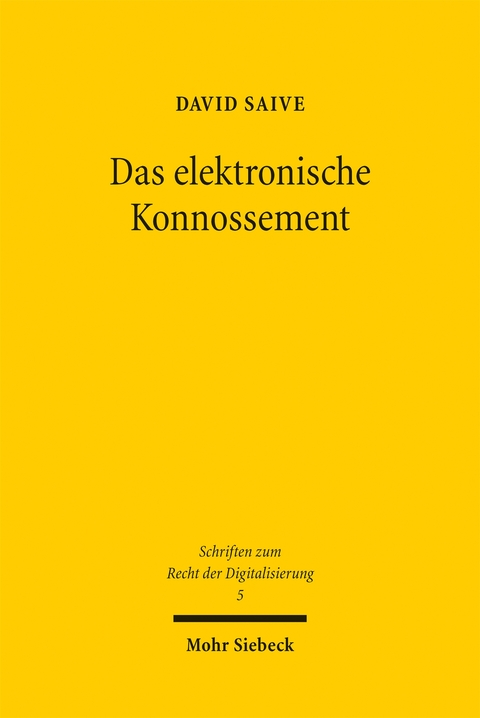
Das elektronische Konnossement
Umsetzung der Anforderungen aus § 516 Abs. 2 HGB durch funktionsäquivalente Blockchain-Token
2020
Mohr Siebeck (Hersteller)
978-3-16-159689-6 (ISBN)
Mohr Siebeck (Hersteller)
978-3-16-159689-6 (ISBN)
Bereits seit 2013 ist der Einsatz elektronischer Wertpapiere nach deutschem Recht zulässig: § 516 Abs. 2 HGB erlaubt im Rahmen des Seefracht- und Exportgeschäfts die Verwendung elektronischer Konnossemente. David Saive untersucht die Auswirkungen auf die Gesamtrechtsordnung und entwickelt konkrete Vorschläge, wie ein blockchainbasiertes elektronisches Konnossement aussehen könnte.
Until today, paper-based maritime trade documents are still used as security in the context of export financing. Of particular importance is the bill of lading. As a document of title, it embodies the claim to delivery against the carrier and represents the transported goods themselves. The digitalisation of the bill of lading is urgently required, because the processing of the document, which is still done by hand, causes considerable delays. As early as 2013, § 516 (2) HGB was introduced to allow the use of electronic bills of lading. David Saive examines the effects of electronic bills of lading and thus electronic securities on the overall legal system and determines under which conditions blockchain technology is suitable for the implementation of electronic bills of lading
Until today, paper-based maritime trade documents are still used as security in the context of export financing. Of particular importance is the bill of lading. As a document of title, it embodies the claim to delivery against the carrier and represents the transported goods themselves. The digitalisation of the bill of lading is urgently required, because the processing of the document, which is still done by hand, causes considerable delays. As early as 2013, § 516 (2) HGB was introduced to allow the use of electronic bills of lading. David Saive examines the effects of electronic bills of lading and thus electronic securities on the overall legal system and determines under which conditions blockchain technology is suitable for the implementation of electronic bills of lading
Geboren 1992; Studium der Rechtswissenschaft an der Universität Hamburg; 2016 Erstes juristisches Staatsexamen; seit 2017 Wissenschaftlicher Mitarbeiter am Lehrstuhl für Bürgerliches Recht, Handels- und Wirtschaftsrecht der Universität Oldenburg und LLM.-Studium Informationsrecht an der Universität Oldenburg; seit 2019 LLM.-Studium International Maritime Law an der World Maritime University in Malmö.
| Erscheint lt. Verlag | 30.9.2020 |
|---|---|
| Reihe/Serie | Schriften zum Recht der Digitalisierung |
| Verlagsort | Tübingen |
| Sprache | deutsch |
| Themenwelt | Recht / Steuern ► Privatrecht / Bürgerliches Recht |
| Recht / Steuern ► Wirtschaftsrecht | |
| Schlagworte | Akkreditiv • bill of lading • Distributed Ledger Technology • Funktionsäquivalenz |
| ISBN-10 | 3-16-159689-7 / 3161596897 |
| ISBN-13 | 978-3-16-159689-6 / 9783161596896 |
| Zustand | Neuware |
| Informationen gemäß Produktsicherheitsverordnung (GPSR) | |
| Haben Sie eine Frage zum Produkt? |
Mehr entdecken
aus dem Bereich
aus dem Bereich


