


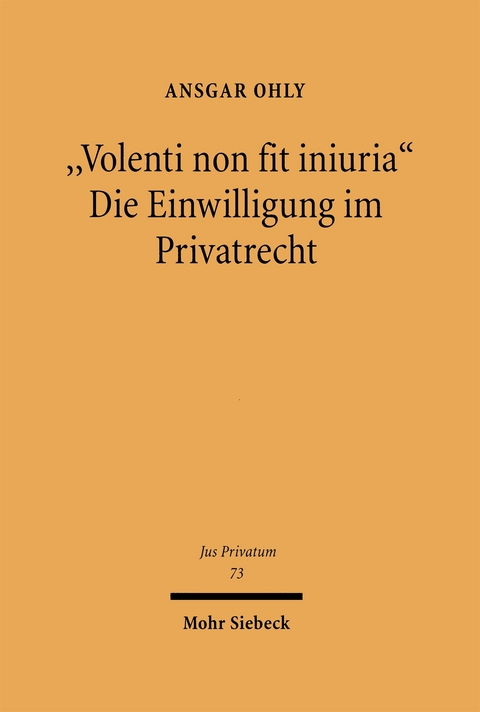
"Volenti non fit iniuria" - Die Einwilligung im Privatrecht
2020
Mohr Siebeck (Hersteller)
978-3-16-157897-7 (ISBN)
Mohr Siebeck (Hersteller)
978-3-16-157897-7 (ISBN)
Ansgar Ohly untersucht das Prinzip "volenti non fit iniuria" aus privatrechtlicher Sicht und entwickelt daraus eine eigenständige Einwilligungslehre, die auf den Gedanken der Selbstbestimmung und der Selbstverantwortung beruht.
Ansgar Ohly untersucht das Prinzip "volenti non fit iniuria" aus privatrechtlicher Sicht und entwickelt daraus eine eigenständige Einwilligungslehre, die auf den Gedanken der Selbstbestimmung und der Selbstverantwortung beruht. The maxim "volenti non fit iniuria" expresses a fundamental principle of justice. Its equivalent in tort law, the defense of consent, however, is surrounded by a penumbra of uncertainty. Starting from a historical and jurisprudential analysis, this study develops a theory of consent in private law based on the concepts of autonomy and responsibility. While the doctrinal part focuses on the nature of consent in German law, in particular its relation to contract law, the subsequent examination of the elements of consent draws on a comparison between German, English and US law. On this basis new legal solutions are offered for problems such as the validity of consent given by minors, the validity of consent to criminal behavior or irreversible injuries, the theory of 'informed consent' in medical law or the function of consent in personality merchandising.
Ansgar Ohly untersucht das Prinzip "volenti non fit iniuria" aus privatrechtlicher Sicht und entwickelt daraus eine eigenständige Einwilligungslehre, die auf den Gedanken der Selbstbestimmung und der Selbstverantwortung beruht. The maxim "volenti non fit iniuria" expresses a fundamental principle of justice. Its equivalent in tort law, the defense of consent, however, is surrounded by a penumbra of uncertainty. Starting from a historical and jurisprudential analysis, this study develops a theory of consent in private law based on the concepts of autonomy and responsibility. While the doctrinal part focuses on the nature of consent in German law, in particular its relation to contract law, the subsequent examination of the elements of consent draws on a comparison between German, English and US law. On this basis new legal solutions are offered for problems such as the validity of consent given by minors, the validity of consent to criminal behavior or irreversible injuries, the theory of 'informed consent' in medical law or the function of consent in personality merchandising.
ist Inhaber des Lehrstuhls für Bürgerliches Recht, Recht des Geistigen Eigentums und Wettbewerbsrecht an der Ludwig-Maximilians-Universität München und ständiger Gastprofessor an der University of Oxford und Visiting Senior Member des St. Peter's College, Oxford.
| Erscheint lt. Verlag | 18.5.2020 |
|---|---|
| Reihe/Serie | Jus Privatum |
| Verlagsort | Tübingen |
| Sprache | deutsch |
| Themenwelt | Recht / Steuern ► Privatrecht / Bürgerliches Recht |
| Schlagworte | Bürgerliches Recht • Einwilligung im Privatrecht • Selbstbestimmung |
| ISBN-10 | 3-16-157897-X / 316157897X |
| ISBN-13 | 978-3-16-157897-7 / 9783161578977 |
| Zustand | Neuware |
| Informationen gemäß Produktsicherheitsverordnung (GPSR) | |
| Haben Sie eine Frage zum Produkt? |
Mehr entdecken
aus dem Bereich
aus dem Bereich


