


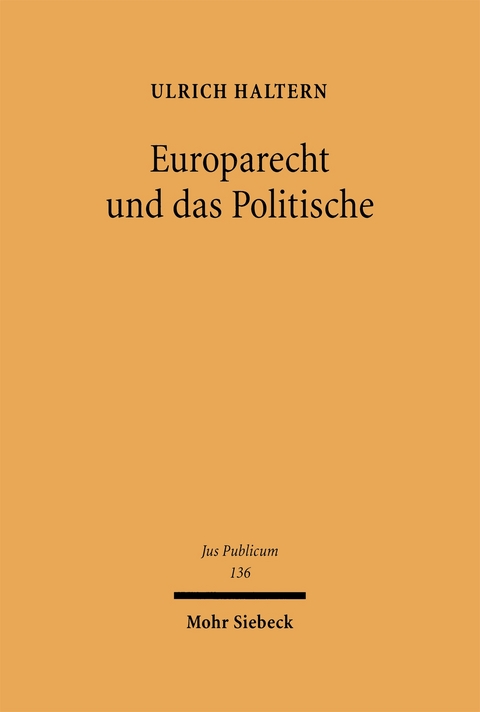
Europarecht und das Politische
2020
Mohr Siebeck (Hersteller)
978-3-16-158000-0 (ISBN)
Mohr Siebeck (Hersteller)
978-3-16-158000-0 (ISBN)
Der Bürger steht der EU weitgehend gleichgültig gegenüber. Dieser Befund fordert auch die Rechtswissenschaft heraus. Ulrich Haltern begreift Recht als symbolische Form und macht anhand einer kulturtheoretischen Analyse des Rechts die Unterschiede zwischen der Imagination des Politischen im Nationalstaat und in der EU sichtbar.
Die Mehrzahl der Bürger Europas steht der europäischen Integration gleichgültig gegenüber. Dieser Dichotomie müssen sich Juristen annehmen, denn Fragen der bürgerlichen Identität und der sozialen Legitimation sind eng mit dem Recht verbunden. Ulrich Haltern macht anhand einer kulturtheoretischen Analyse des Rechts die Unterschiede zwischen der Imagination des Politischen im Nationalstaat und in der Europäischen Union sichtbar. Die Unterschiede spiegeln sich im Recht: Recht ist nicht gleich Recht. Diese theoretische Erkenntnis wird an der europäischen Rechtspraxis in den Bereichen des Warenverkehrs, des Rechtsschutzes, der Grundrechte und der Unionsbürgerschaft erprobt. Dabei wird deutlich, daß der EuGH die Union aus ihrer Fixierung zwischen Interesse und Vernunft zunehmend in den Bereich kollektiven Willens und damit nationalstaatlicher Imagination des Rechts und des Politischen führt. European citizens remain largely indifferent towards the Union. Legal scholars are wrong to funnel the Union's social legitimacy deficit to empirical sociology, or to ignore it altogether, because questions of identity are intimately linked to the law. Engaging in a cultural study of European law, Ulrich Haltern argues that the crisis in social acceptance can be traced back to the texture of EU law. While national law has a rich fabric of cultural resources to rely on, EU law appears less "ours". The way these two bodies of law imagine the political is entirely different, as can be shown with respect to the free movement of goods, the judicial system, fundamental rights, and Union citizenship. As it turns out, the European Court is following the Commission's lead and is taking the Union from a political psychology of interest and reason to a dimension of collective will, thus approximating the imagination of the political in the EU and in nation-states.
Die Mehrzahl der Bürger Europas steht der europäischen Integration gleichgültig gegenüber. Dieser Dichotomie müssen sich Juristen annehmen, denn Fragen der bürgerlichen Identität und der sozialen Legitimation sind eng mit dem Recht verbunden. Ulrich Haltern macht anhand einer kulturtheoretischen Analyse des Rechts die Unterschiede zwischen der Imagination des Politischen im Nationalstaat und in der Europäischen Union sichtbar. Die Unterschiede spiegeln sich im Recht: Recht ist nicht gleich Recht. Diese theoretische Erkenntnis wird an der europäischen Rechtspraxis in den Bereichen des Warenverkehrs, des Rechtsschutzes, der Grundrechte und der Unionsbürgerschaft erprobt. Dabei wird deutlich, daß der EuGH die Union aus ihrer Fixierung zwischen Interesse und Vernunft zunehmend in den Bereich kollektiven Willens und damit nationalstaatlicher Imagination des Rechts und des Politischen führt. European citizens remain largely indifferent towards the Union. Legal scholars are wrong to funnel the Union's social legitimacy deficit to empirical sociology, or to ignore it altogether, because questions of identity are intimately linked to the law. Engaging in a cultural study of European law, Ulrich Haltern argues that the crisis in social acceptance can be traced back to the texture of EU law. While national law has a rich fabric of cultural resources to rely on, EU law appears less "ours". The way these two bodies of law imagine the political is entirely different, as can be shown with respect to the free movement of goods, the judicial system, fundamental rights, and Union citizenship. As it turns out, the European Court is following the Commission's lead and is taking the Union from a political psychology of interest and reason to a dimension of collective will, thus approximating the imagination of the political in the EU and in nation-states.
Geboren 1967; Inhaber des Lehrstuhls für Öffentliches Recht, Europarecht und Rechtsphilosophie und Direktor des Munich Center for Law and the Humanities an der LMU München.
| Erscheint lt. Verlag | 18.5.2020 |
|---|---|
| Reihe/Serie | Jus Publicum |
| Verlagsort | Tübingen |
| Sprache | deutsch |
| Themenwelt | Recht / Steuern ► EU / Internationales Recht |
| Recht / Steuern ► Öffentliches Recht | |
| Schlagworte | Europäische Union • Europarecht • Staatenverbund |
| ISBN-10 | 3-16-158000-1 / 3161580001 |
| ISBN-13 | 978-3-16-158000-0 / 9783161580000 |
| Zustand | Neuware |
| Informationen gemäß Produktsicherheitsverordnung (GPSR) | |
| Haben Sie eine Frage zum Produkt? |


