


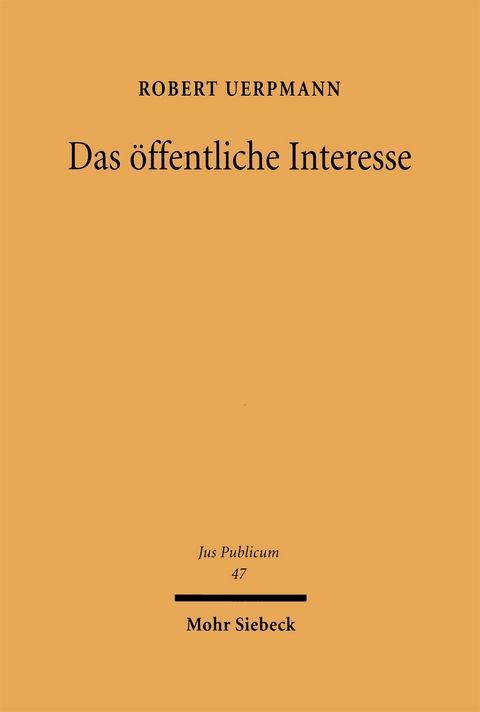
Das öffentliche Interesse
Seine Bedeutung als Tatbestandsmerkmal und als dogmatischer Begriff
2020
Mohr Siebeck (Hersteller)
978-3-16-158096-3 (ISBN)
Mohr Siebeck (Hersteller)
978-3-16-158096-3 (ISBN)
Robert Uerpmann entwickelt eine Theorie des öffentlichen Interesses, die vom Rechtsanwender verlangt, im Rahmen seiner Kompetenz alle relevanten Interessen ordnungsgemäß abzuwägen.
Robert Uerpmann entwickelt eine Theorie des öffentlichen Interesses, die vom Rechtsanwender verlangt, im Rahmen seiner Kompetenz alle relevanten Interessen ordnungsgemäß abzuwägen. Legal elements of a rule often refer to the public interest or related concepts. Even in those cases in which the law does not mention the public interest, judicial decisions and legal doctrines often use this concept as a decisive criterion in dogmatic theories. How is it possible to determine what the public interest is when it appears in the law or in a dogmatic theory? Robert Uerpmann looks for rules and shows that a basic separation of public and private interests, often assumed to be a part of the legal system, is in fact unknown in this system. The concept of public interest begins to take shape when seen within the framework of the rules governing competence. It proves to be an instrument which divides complex decision-making processes and allocates decision-making powers to individual institutions. In order to determine which individual legal consequence is in the public interest, it is also necessary to balance the various interests involved.
Robert Uerpmann entwickelt eine Theorie des öffentlichen Interesses, die vom Rechtsanwender verlangt, im Rahmen seiner Kompetenz alle relevanten Interessen ordnungsgemäß abzuwägen. Legal elements of a rule often refer to the public interest or related concepts. Even in those cases in which the law does not mention the public interest, judicial decisions and legal doctrines often use this concept as a decisive criterion in dogmatic theories. How is it possible to determine what the public interest is when it appears in the law or in a dogmatic theory? Robert Uerpmann looks for rules and shows that a basic separation of public and private interests, often assumed to be a part of the legal system, is in fact unknown in this system. The concept of public interest begins to take shape when seen within the framework of the rules governing competence. It proves to be an instrument which divides complex decision-making processes and allocates decision-making powers to individual institutions. In order to determine which individual legal consequence is in the public interest, it is also necessary to balance the various interests involved.
Geboren 1966; 1985-90 Studium der Rechtswissenschaft in Berlin, Tübingen und Aix-en-Provence; 1988 maîtrise en droit (Aix-Marseille); 1992 Promotion; seit 1994 wiss. Assistent an der Freien Universität Berlin; 1999 Habilitation; seit 1999 Lehrstuhlvertretung an der Universität Frankfurt (Oder).
| Erscheint lt. Verlag | 18.5.2020 |
|---|---|
| Reihe/Serie | Jus Publicum |
| Verlagsort | Tübingen |
| Sprache | deutsch |
| Themenwelt | Recht / Steuern ► Öffentliches Recht |
| Schlagworte | Interesse • Mohr Siebeck • Öffentliches Interesse • Öffentliches Interesse, Recht • Recht |
| ISBN-10 | 3-16-158096-6 / 3161580966 |
| ISBN-13 | 978-3-16-158096-3 / 9783161580963 |
| Zustand | Neuware |
| Informationen gemäß Produktsicherheitsverordnung (GPSR) | |
| Haben Sie eine Frage zum Produkt? |
Mehr entdecken
aus dem Bereich



aus dem Bereich
Arbeitshilfen und Vordrucke für Wahlvorstände; Mit Fristenrechner und …
CD-ROM (Software) (2025)
Walhalla und Praetoria (Hersteller)
CHF 46,30
Arbeitshilfen und Vordrucke für Wahlvorstände; Mit Fristenrechner und …
CD-ROM (Software) (2025)
Walhalla und Praetoria (Hersteller)
CHF 46,30


