The Future of Business Credit (eBook)
141 Seiten
Publishdrive (Verlag)
978-0-00-098471-5 (ISBN)
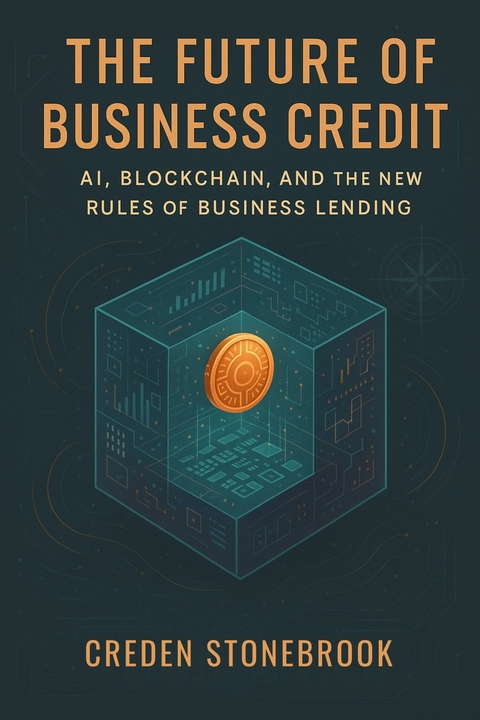
The business lending landscape is being transformed at breakneck speed. Are you ready for what's coming next?
Traditional credit scoring is dying. Banks that once held all the power are scrambling to compete with AI-powered platforms that can approve loans in minutes, not months. Blockchain technology is creating entirely new forms of collateral and trust. And the businesses that understand these shifts first will have an enormous competitive advantage.
The Future of Business Credit pulls back the curtain on the revolutionary technologies reshaping how companies access capital. Whether you're a business owner frustrated with traditional lending, a financial professional trying to stay ahead of disruption, or an investor seeking the next big opportunity in fintech, this book provides the insider knowledge you need to navigate the new landscape.
Why This Book Matters Now
Traditional business lending is fundamentally broken-rigid requirements, slow processes, and inability to assess real business value are driving entrepreneurs to seek alternatives. Meanwhile, AI and blockchain technologies have matured to the point where they can solve these problems at scale. The companies and professionals who understand these changes will thrive. Those who don't risk being left behind.
This isn't just another book about financial technology. It's a strategic guide written by someone who has witnessed these transformations firsthand, providing you with actionable insights you can implement immediately.
The future of business credit is here. The question is: Will you lead the change or be disrupted by it?
Perfect for entrepreneurs, financial professionals, investors, and anyone who wants to understand how technology is revolutionizing business lending.
Chapter 2: AI-Powered Underwriting: The New Decision Makers
2.1 Machine Learning Algorithms Replace Human Intuition
For centuries, lending decisions were deeply personal. A business owner would walk into a local bank, sit across from a loan officer, and present a case. That officer—armed with experience, financial statements, and a feel for the borrower—would make a judgment. This process was far from perfect. It could be biased, slow, inconsistent, and heavily influenced by subjective factors like personal rapport or risk aversion. But at its core, underwriting was a human art form: a mixture of instinct, knowledge, and institutional policy.
That era is rapidly fading.
Today, the most influential decisions about business lending are no longer made in a room by a person. They are made in milliseconds by algorithms that weigh thousands of variables, test them against historical outcomes, and calculate risk with a level of speed and complexity far beyond human capability. This shift, while subtle on the surface, represents one of the most transformative changes in financial history: the replacement of human intuition with machine learning in the domain of credit underwriting.
Machine learning (ML) is not just another buzzword in finance. It’s a functional shift in how creditworthiness is understood, processed, and acted upon. Traditional underwriting relied on linear thinking—if income is X, debt is Y, and collateral is Z, then the likelihood of default is within range A. These models were often based on manually weighted formulas or decision trees. They were slow to adapt and heavily reliant on institutional assumptions. Machine learning, by contrast, allows systems to learn from vast datasets, recognize patterns, adjust parameters in real time, and constantly refine their predictive accuracy.
At the core of this evolution is the idea that risk is not static—it’s dynamic, contextual, and behavioral. Rather than viewing a borrower through five or ten variables, modern algorithms assess hundreds or even thousands. They draw from structured data like bank statements, tax filings, and balance sheets, and unstructured data like email cadence, website activity, inventory turnover, or customer feedback. All this information is processed and interpreted by the algorithm not as isolated facts, but as interconnected signals that reveal deeper truths about business operations.
One of the most compelling advantages of machine learning is its ability to detect non-obvious correlations. A human underwriter might note that a business has three late utility payments and assume financial instability. An algorithm might observe that those late payments coincide with a seasonal revenue dip that historically rebounds within two months and that overall vendor payments remain consistent—signaling temporary fluctuation, not systemic risk. What appears risky at first glance may, in light of hundreds of other factors, be well within the acceptable range.
This level of granular analysis gives lenders a powerful edge. Approval rates go up because more borrowers can be evaluated accurately. Default rates go down because risk is calculated with better precision. Processing times are slashed from days or weeks to seconds. And small businesses, which often operate in unpredictable environments, are finally assessed on their real-world complexity rather than simplified metrics.
Crucially, machine learning models are not static. They improve over time. Each loan issued—successful or not—feeds back into the system as new training data. The model recalibrates, refining its predictive capabilities with every decision it makes. This continuous learning loop creates underwriting systems that evolve in tandem with economic conditions, industry shifts, or borrower behavior trends. In contrast, traditional models remain frozen until manually updated, often lagging behind the realities of the market.
Take, for instance, a business that operates in a niche ecommerce space. It might use multiple payment processors, run ad campaigns with fluctuating ROI, and sell seasonally influenced products. To a human underwriter unfamiliar with the nuances of the sector, the numbers may appear inconsistent or risky. But an algorithm trained on similar businesses in the same category can recognize the patterns. It knows what a healthy account looks like during peak season, what ad conversion rates predict sustained revenue, and what inventory cycles signal overextension or growth. The machine learning system isn't simply checking boxes—it’s interpreting signals within a living, breathing ecosystem.
This is the foundation of intelligent underwriting: credit decisions that reflect context, not just criteria.
It also means that lenders can create specialized models for different industries, geographies, or borrower types. A restaurant in Manhattan is not evaluated the same way as a SaaS company in Austin or a home services provider in rural Ohio. Each business has its own rhythm, its own data profile, and its own risk markers. With machine learning, underwriting is no longer one-size-fits-all. It’s adaptive, modular, and context-sensitive.
Beyond risk prediction, AI-driven underwriting has also introduced a new level of explainability—often referred to as "model interpretability." Early versions of AI in finance were criticized for their “black box” nature: they produced results, but it was hard to understand why. Today, thanks to advancements in interpretable machine learning, we can now trace how specific inputs—such as a spike in vendor payments or changes in customer acquisition costs—contributed to a credit decision. This transparency is essential not only for compliance and regulation but also for borrower trust. Businesses want to know why they were denied credit, what they can improve, and how they were evaluated. AI systems can now provide those answers with clarity, helping borrowers take actionable steps.
Still, the transition has not been universally welcomed. There are valid concerns. Algorithms, after all, are only as unbiased as the data they’re trained on. If historical data reflects systemic inequalities or skewed access to credit, machine learning models can perpetuate those patterns unless carefully audited and corrected. That’s why responsible AI underwriting includes not just technical excellence but also ethical oversight—monitoring models for fairness, inclusion, and unintended consequences.
This is especially important for small businesses owned by minorities, women, or immigrants—groups that have historically been underserved or misrepresented in financial systems. The promise of AI is not just better accuracy, but also better equity. To achieve that, models must be tested for disparate impact, trained on diverse datasets, and constantly evaluated for fairness. Lenders who fail to address these dimensions risk reinforcing the very barriers they claim to overcome.
Another issue is explainability versus performance. The most accurate models are often the most complex, involving neural networks and ensemble methods that are hard to decipher. In regulated environments, particularly in countries with strict financial laws, this complexity can be a liability. That’s why some lenders are choosing hybrid models—pairing machine learning systems with rule-based overlays or human review stages. The goal isn’t to remove humans from the process entirely, but to augment their judgment with powerful tools.
Indeed, in the best systems, human analysts don’t disappear—they evolve. They shift from gatekeepers to interpreters. Rather than spending time on rote data entry or mechanical decision-making, they focus on edge cases, exception handling, and customer engagement. They review flagged applications, adjust policy thresholds, and use the insights generated by AI to make more informed, strategic decisions. This hybrid approach combines the empathy and contextual awareness of humans with the scalability and pattern recognition of machines.
What’s particularly exciting about this transition is the accessibility it brings. Once upon a time, advanced underwriting tools were the domain of multinational banks with billion-dollar R&D budgets. Today, even small lenders or fintech startups can integrate open-source machine learning libraries, leverage cloud-based AI services, and access shared datasets to build intelligent credit systems. This democratization of underwriting technology is accelerating innovation and forcing legacy institutions to evolve or be left behind.
In emerging markets, AI-powered underwriting is even more revolutionary. In regions where credit bureaus are sparse, formal credit histories are rare, and banking infrastructure is limited, machine learning models trained on mobile phone usage, utility payment behavior, or agricultural patterns are enabling loans to first-time borrowers. These models don't just fill gaps—they redefine what it means to be creditworthy in a digital-first world.
And as embedded finance grows—where lending is integrated directly into software platforms, ecommerce checkouts, or vendor portals—the role of machine learning becomes even more central. Credit decisions happen behind the scenes, in real time, often triggered by a user action. There’s no time for paperwork or phone calls. Everything must be instant, seamless, and accurate. This is only possible when underwriting itself is autonomous, intelligent, and deeply integrated into the digital fabric of commerce.
The age of AI-powered underwriting is not a vision of the future. It is already here, operating across industries, continents, and borrower types. It is redefining speed, reshaping standards, and rebalancing power....
| Erscheint lt. Verlag | 2.8.2025 |
|---|---|
| Sprache | englisch |
| Themenwelt | Recht / Steuern ► Wirtschaftsrecht |
| ISBN-10 | 0-00-098471-X / 000098471X |
| ISBN-13 | 978-0-00-098471-5 / 9780000984715 |
| Informationen gemäß Produktsicherheitsverordnung (GPSR) | |
| Haben Sie eine Frage zum Produkt? |
 EPUB (Adobe DRM)
Größe: 3,3 MB
Kopierschutz: Adobe-DRM
Adobe-DRM ist ein Kopierschutz, der das eBook vor Mißbrauch schützen soll. Dabei wird das eBook bereits beim Download auf Ihre persönliche Adobe-ID autorisiert. Lesen können Sie das eBook dann nur auf den Geräten, welche ebenfalls auf Ihre Adobe-ID registriert sind.
Details zum Adobe-DRM
Dateiformat: EPUB (Electronic Publication)
EPUB ist ein offener Standard für eBooks und eignet sich besonders zur Darstellung von Belletristik und Sachbüchern. Der Fließtext wird dynamisch an die Display- und Schriftgröße angepasst. Auch für mobile Lesegeräte ist EPUB daher gut geeignet.
Systemvoraussetzungen:
PC/Mac: Mit einem PC oder Mac können Sie dieses eBook lesen. Sie benötigen eine
eReader: Dieses eBook kann mit (fast) allen eBook-Readern gelesen werden. Mit dem amazon-Kindle ist es aber nicht kompatibel.
Smartphone/Tablet: Egal ob Apple oder Android, dieses eBook können Sie lesen. Sie benötigen eine
Geräteliste und zusätzliche Hinweise
Buying eBooks from abroad
For tax law reasons we can sell eBooks just within Germany and Switzerland. Regrettably we cannot fulfill eBook-orders from other countries.
aus dem Bereich