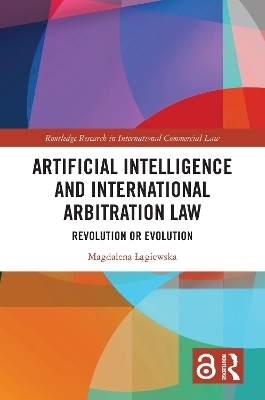
Artificial Intelligence and International Arbitration Law
Routledge (Verlag)
978-1-041-12420-7 (ISBN)
The book asks whether the use of Artificial Intelligence (AI) and Generative AI (GenAI) in international arbitration represents a revolution or an evolution of the international dispute resolution landscape.
Critically engaging with the transformative impact of the Fourth Industrial Revolution (4IR), this book focuses on the integration of AI and GenAI into international commercial arbitration. Set against the backdrop of rapid technological advancement, it explores how arbitral tribunals and stakeholders are cautiously yet progressively adopting these innovations in a manner that respects and preserves the foundational principles of arbitration. Through an interdisciplinary and practice-oriented approach, the book examines the evolving role of AI in arbitration. It analyzes how AI is perceived and applied by parties, arbitral institutions, and arbitrators, as well as assesses the legal frameworks in place to govern it. Offering a balanced analysis of both the opportunities and legal and ethical dilemmas posed by emerging technologies, the book asks if a duty of disclosure is relevant in relation to AI use, and what challenges this might entail. It also covers the status of AI-generated arbitral awards under international law, as well as copyright law.
This book will be of interest to researchers in the field of international arbitration and commercial law.
The Open Access version of this book, available at http://www.taylorfrancis.com, has been made available under a Creative Commons Attribution-Non Commercial-No Derivatives (CC BY-NC-ND) 4.0 license.
Magdalena Łągiewska, Habilitation (postdoctoral degree) in Law (University of Gdańsk 2025), PhD in Law (University of Gdańsk 2017, East China University of Political Science and Law 2020), is Assistant Professor at the University of Gdańsk, Poland (Department of Public International Law), Research Associate in the “China, Law and Development” project at the University of Oxford, UK, Asia Global Fellow 2024 at the University of Hong Kong, Hong Kong, and Fellow of the Chartered Institute of Arbitrators (FCIArb) in London.
Introduction
1. Fourth Industrial Revolution and international commercial arbitration
2. Artificial Intelligence (AI) in international arbitration for different actors
3. Legal issues involved in using AI in international arbitration
4. Response of international arbitration to AI: Revolution or evolution?
Conclusions and recommendations
| Erscheinungsdatum | 19.11.2025 |
|---|---|
| Reihe/Serie | Routledge Research in International Commercial Law |
| Zusatzinfo | 1 Tables, black and white |
| Verlagsort | London |
| Sprache | englisch |
| Maße | 156 x 234 mm |
| Gewicht | 490 g |
| Themenwelt | Recht / Steuern ► Allgemeines / Lexika |
| Recht / Steuern ► EU / Internationales Recht | |
| Recht / Steuern ► Privatrecht / Bürgerliches Recht ► IT-Recht | |
| Recht / Steuern ► Privatrecht / Bürgerliches Recht ► Zivilverfahrensrecht | |
| Recht / Steuern ► Wirtschaftsrecht ► Handelsrecht | |
| ISBN-10 | 1-041-12420-1 / 1041124201 |
| ISBN-13 | 978-1-041-12420-7 / 9781041124207 |
| Zustand | Neuware |
| Informationen gemäß Produktsicherheitsverordnung (GPSR) | |
| Haben Sie eine Frage zum Produkt? |
aus dem Bereich