


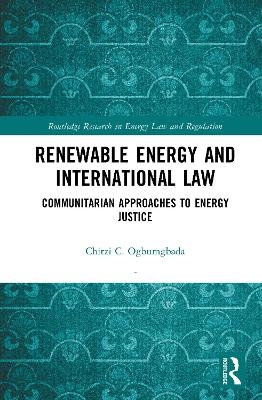
Renewable Energy and International Law
Communitarian Approaches to Energy Justice
Seiten
2025
Routledge (Verlag)
978-1-032-89677-9 (ISBN)
Routledge (Verlag)
978-1-032-89677-9 (ISBN)
This book addresses the injustices associated with renewable energy development and use within the context of the energy transition. It will be of interest to researchers, policymakers, international governmental organisations, and civil society.
This book addresses the injustices associated with renewable energy development and use within the context of the energy transition.
Primarily informed by a communitarian approach to energy justice, the book draws on the philosophical concept of African communitarianism as a guiding principle. This concept emphasises harmonious or communal relationships among members of a political and social community, making it easier to justify solutions to renewable energy injustices, in contrast to an individualistic approach. The book argues that international law can facilitate this approach to energy justice by adapting existing norms, standards, practices, and institutions. Adopting the unfair distribution of renewable energy benefits in the international community as a test case, the book contributes to existing energy justice scholarship by highlighting the significant contribution of non-Western philosophies in addressing renewable energy injustices. It also repositions international law as a tool for operationalising this approach to energy justice.
The book will be of interest to researchers, policymakers, international governmental organisations, and civil society.
This book addresses the injustices associated with renewable energy development and use within the context of the energy transition.
Primarily informed by a communitarian approach to energy justice, the book draws on the philosophical concept of African communitarianism as a guiding principle. This concept emphasises harmonious or communal relationships among members of a political and social community, making it easier to justify solutions to renewable energy injustices, in contrast to an individualistic approach. The book argues that international law can facilitate this approach to energy justice by adapting existing norms, standards, practices, and institutions. Adopting the unfair distribution of renewable energy benefits in the international community as a test case, the book contributes to existing energy justice scholarship by highlighting the significant contribution of non-Western philosophies in addressing renewable energy injustices. It also repositions international law as a tool for operationalising this approach to energy justice.
The book will be of interest to researchers, policymakers, international governmental organisations, and civil society.
Chitzi C. Ogbumgbada is a Lecturer in Law at the University of Exeter, Cornwall, United Kingdom, and a member of the Exeter Centre for Environmental Law.
1. Introduction
2. Renewable Energy Development: Benefits and Injustices
3. An African Communitarian Approach to Global Energy Justice
4. Operationalising Global Energy Justice: Legal Interpretation
5. Operationalising Global Energy Justice: Means of Implementation
6. Conclusion
| Erscheinungsdatum | 08.11.2025 |
|---|---|
| Reihe/Serie | Routledge Research in Energy Law and Regulation |
| Verlagsort | London |
| Sprache | englisch |
| Maße | 156 x 234 mm |
| Gewicht | 530 g |
| Themenwelt | Recht / Steuern ► Allgemeines / Lexika |
| Recht / Steuern ► EU / Internationales Recht | |
| Recht / Steuern ► Öffentliches Recht ► Umweltrecht | |
| ISBN-10 | 1-032-89677-9 / 1032896779 |
| ISBN-13 | 978-1-032-89677-9 / 9781032896779 |
| Zustand | Neuware |
| Informationen gemäß Produktsicherheitsverordnung (GPSR) | |
| Haben Sie eine Frage zum Produkt? |
Mehr entdecken
aus dem Bereich

aus dem Bereich
Erläuterungen - Änderungen - Rechtstexte
Buch | Softcover (2023)
Beuth (Verlag)
CHF 86,80


