


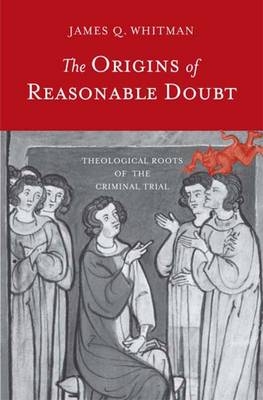
The Origins of Reasonable Doubt
Theological Roots of the Criminal Trial
Seiten
2008
Yale University Press (Verlag)
9780300116007 (ISBN)
Yale University Press (Verlag)
9780300116007 (ISBN)
- Titel ist leider vergriffen;
keine Neuauflage - Artikel merken
To be convicted of a crime in the United States, a person must be proven guilty 'beyond a reasonable doubt'. But what is reasonable doubt? Examining the history of the law, this work reveals that we have lost sight of the original purpose of reasonable doubt. It was not originally a legal rule at all, but a theological one.
To be convicted of a crime in the United States, a person must be proven guilty “beyond a reasonable doubt.” But what is reasonable doubt? Even sophisticated legal experts find this fundamental doctrine difficult to explain. In this accessible book, James Q. Whitman digs deep into the history of the law and discovers that we have lost sight of the original purpose of “reasonable doubt.” It was not originally a legal rule at all, he shows, but a theological one.
The rule as we understand it today is intended to protect the accused. But Whitman traces its history back through centuries of Christian theology and common-law history to reveal that the original concern was to protect the souls of jurors. In Christian tradition, a person who experienced doubt yet convicted an innocent defendant was guilty of a mortal sin. Jurors fearful for their own souls were reassured that they were safe, as long as their doubts were not “reasonable.” Today, the old rule of reasonable doubt survives, but it has been turned to different purposes. The result is confusion for jurors, and a serious moral challenge for our system of justice.
To be convicted of a crime in the United States, a person must be proven guilty “beyond a reasonable doubt.” But what is reasonable doubt? Even sophisticated legal experts find this fundamental doctrine difficult to explain. In this accessible book, James Q. Whitman digs deep into the history of the law and discovers that we have lost sight of the original purpose of “reasonable doubt.” It was not originally a legal rule at all, he shows, but a theological one.
The rule as we understand it today is intended to protect the accused. But Whitman traces its history back through centuries of Christian theology and common-law history to reveal that the original concern was to protect the souls of jurors. In Christian tradition, a person who experienced doubt yet convicted an innocent defendant was guilty of a mortal sin. Jurors fearful for their own souls were reassured that they were safe, as long as their doubts were not “reasonable.” Today, the old rule of reasonable doubt survives, but it has been turned to different purposes. The result is confusion for jurors, and a serious moral challenge for our system of justice.
James Q. Whitman is Ford Foundation Professor of Comparative and Foreign Law, Yale University, and author of the award-winning book Harsh Justice. He lives in New York City, NY.
| Erscheint lt. Verlag | 1.2.2008 |
|---|---|
| Reihe/Serie | Yale Law Library Series in Legal History and Reference |
| Zusatzinfo | 8 b-w illus. |
| Sprache | englisch |
| Maße | 156 x 235 mm |
| Gewicht | 590 g |
| Themenwelt | Recht / Steuern ► Allgemeines / Lexika |
| Recht / Steuern ► EU / Internationales Recht | |
| Recht / Steuern ► Strafrecht ► Kriminologie | |
| ISBN-13 | 9780300116007 / 9780300116007 |
| Zustand | Neuware |
| Informationen gemäß Produktsicherheitsverordnung (GPSR) | |
| Haben Sie eine Frage zum Produkt? |
Mehr entdecken
aus dem Bereich



aus dem Bereich
Mein Leben zwischen Kokain und Waffen
Buch | Softcover (2025)
Piper (Verlag)
CHF 24,90
der berühmte FBI-Profiler über die Fahndung nach Serienmördern und …
Buch | Softcover (2023)
riva (Verlag)
CHF 20,95


