


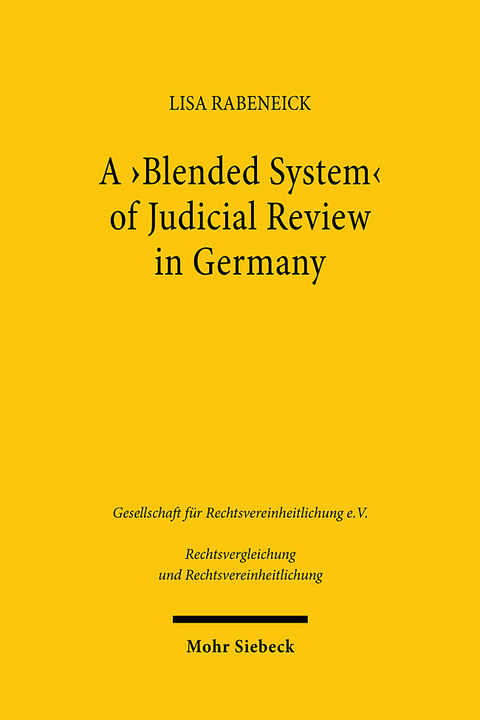
A 'Blended System' of Judicial Review in Germany
The Use of Weak-Form Methods Within a Strong-Form Review System
Seiten
2025
Mohr Siebeck (Verlag)
978-3-16-164665-2 (ISBN)
Mohr Siebeck (Verlag)
978-3-16-164665-2 (ISBN)
Die Grundrechte des Grundgesetzes können von verschiedenen Staatsorganen unterschiedlich, jedoch gleichermaßen vertretbar ausgelegt werden. Lisa Rabeneick vertritt die Auffassung, dass das Bundesverfassungsgericht zuweilen 'Weak-Form Judicial Review' ausüben und davon absehen sollte, seine Grundrechtsauslegung an die Stelle derer des Parlaments zu setzen, wenn dessen Verständnis gleichermaßen plausibel ist.
Weak-form judicial review suggests that empowering courts to exercise rights-based judicial review does not necessarily mean that courts can assert their understanding of guaranteed rights or, where they do - as in Germany - that they always should. Instead, they could be constitutionally required to defer, at times, to another state organ's reasonable rights interpretation. Lisa Rabeneick examines this particular aspect of the broader question of how the German Federal Constitutional Court should exercise its powers of strong-form rights-based judicial review in relation to the Federal Parliament. Specifically, she proposes creating a 'blended system' of reviewing legislation under the Basic Law; to be achieved by the court implementing weak-form review in instances in which it should refrain from asserting its rights understanding in relation to the legislature.
Weak-form judicial review suggests that empowering courts to exercise rights-based judicial review does not necessarily mean that courts can assert their understanding of guaranteed rights or, where they do - as in Germany - that they always should. Instead, they could be constitutionally required to defer, at times, to another state organ's reasonable rights interpretation. Lisa Rabeneick examines this particular aspect of the broader question of how the German Federal Constitutional Court should exercise its powers of strong-form rights-based judicial review in relation to the Federal Parliament. Specifically, she proposes creating a 'blended system' of reviewing legislation under the Basic Law; to be achieved by the court implementing weak-form review in instances in which it should refrain from asserting its rights understanding in relation to the legislature.
Born in 1995; studied law at the University of Münster and the University of Waikato; 2019 First State Examination in Law; research associate at the Institute for Public Law and Politics at the University of Münster; 2024 doctorate after research visits to the University of New South Wales in Sydney, the University of Melbourne, and the Victoria University of Wellington; legal trainee at the Hanseatic Higher Regional Court.
| Erscheinungsdatum | 28.08.2025 |
|---|---|
| Reihe/Serie | Rechtsvergleichung und Rechtsvereinheitlichung |
| Verlagsort | Tübingen |
| Sprache | englisch |
| Maße | 155 x 232 mm |
| Gewicht | 148 g |
| Themenwelt | Recht / Steuern ► Allgemeines / Lexika |
| Recht / Steuern ► Öffentliches Recht | |
| Recht / Steuern ► Privatrecht / Bürgerliches Recht ► Internationales Privatrecht | |
| Schlagworte | German Federal Constitutional Court • judicial self-restraint • new Commonwealth model of constitutionalism • reasonable disagreement about rights • weak-form judicial review |
| ISBN-10 | 3-16-164665-7 / 3161646657 |
| ISBN-13 | 978-3-16-164665-2 / 9783161646652 |
| Zustand | Neuware |
| Informationen gemäß Produktsicherheitsverordnung (GPSR) | |
| Haben Sie eine Frage zum Produkt? |
Mehr entdecken
aus dem Bereich


aus dem Bereich
der Pflichtstoff
Buch | Softcover (2025)
C.H.Beck (Verlag)
CHF 41,70
Buch | Softcover (2025)
C.H.Beck (Verlag)
CHF 48,85
bildende Kunst, Architektur, Design und Fotografie im deutschen und …
Buch | Hardcover (2024)
Mohr Siebeck (Verlag)
CHF 124,60


