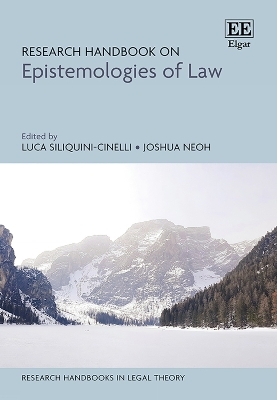
Research Handbook on Epistemologies of Law
Edward Elgar Publishing Ltd (Verlag)
978-1-0353-4799-5 (ISBN)
Filling an important gap in the literature on the topic, expert authors shed light on the uncertain future which awaits law schools and the legal profession, and reconsider the nature, operational dynamics, and remit of the type of knowledge required in the field. Featuring original contributions on key topics, the Handbook provides insights into research methods in law and legal knowledge in theory and practice through philosophical and sociological perspectives. Chapters present theoretical, practical, sociological, comparative, critical, and law and technology approaches and examine analytic jurisprudence to address law reform and legal knowledge of the future.
The Research Handbook on Epistemologies of Law is an essential resource for scholars and students of legal philosophy and legal theory. Additionally, practitioners in legal education will also be interested in its study of the ways in which legal knowledge is produced and transmitted in the age of AI.
Edited by Luca Siliquini-Cinelli, Reader in Law, School of Law and Politics, Cardiff University, UK and Joshua Neoh, Associate Professor of Law, ANU Law School, Australian National University, Australia
Contents
Foreword – legal epistemology: what is its basis and scope? x
Geoffrey Samuel
Research handbook on epistemologies of law: introduction 1
Luca Siliquini-Cinelli and Joshua Neoh
PART A LEGAL KNOWLEDGE IN THEORY: PHILOSOPHICAL PERSPECTIVES
1 Imagination: the neglected dimension of legal thinking 8
Bartosz Brożek and Marek Jakubiec
2 A convergence of legal pluralism and legal realism to expound legal
epistemology 22
Neofytos Sakellaridis Mangouras and Charles Ho Wang Mak
3 Temporalities and the epistemology of historical injustice adjudication 34
Harison Citrawan
4 Rhetoric and epistemology in the legal context 49
Federico Puppo, Serena Tomasi and Silvia Corradi
5 Can contract law be good? When the reasonable person goes to market 61
Renata Grossi
6 The faithful person as the legal person 76
Alex Deagon
PART B LEGAL KNOWLEDGE IN PRACTICE: SOCIOLOGICAL PERSPECTIVES
7 The other side of legal knowledge: the Lacanian discourse as legal
epistemology 92
Dennis Wassouf
8 The paradox of objectivity: objective legal knowledge in a socio-political
context of creation and use 110
Sacha Sydoryk
9 Epistemology of equilibrium 118
Tomáš Havlíček
10 Theories and practices of knowledge and the universal particular in
epistemology 131
Antonios E Platsas
11 The burden of knowing, the joy of ignorance 143
Robert Herian
PART C CONCEPTUAL ANALYSIS OF LEGAL KNOWLEDGE: ANALYTIC
JURISPRUDENCE
12 Intuition as a source of legal knowledge 160
Jonathan Crowe
13 Legal epistemology from a natural perspective: the role of practical
reasoning in thinking like a lawyer 172
Constance Youngwon Lee
14 Is it possible to have legal knowledge without legal inference? 187
David Tan
15 Dworkin’s right answer thesis 201
Liam Sandison and Joshua Neoh
PART D LEGAL KNOWLEDGE ACROSS BORDERS: COMPARATIVE
PERSPECTIVES
16 Disrupting boundaries in legal epistemology: updating modern legal
systems with the rights of nature in a comparative perspective 214
Thiago Burckhart
17 Models as tools of legal cognition 226
Wojciech Graboń
18 A logic of discovery and verification for comparative legal science 241
Davide Gianti
19 Is the expression ‘theory’ problematic? 258
Geoffrey Samuel
PART E REFORM OF LEGAL KNOWLEDGE: LAW REFORM
20 What molluscs tell us about environmental law 277
Maïté Andrade and Loïc Pillard
21 The construction of knowledge in financial regulation 288
David Murphy
22 Who can tell if an offender is truly remorseful? Judges’ use of
psychologists’ and psychiatrists’ evidence of remorse 301
Steven Tudor and Michael Proeve
23 Legal epistemologies: what is going on in the classroom? 314
Molly Bellamy
24 Engendering the rule of law: tautology or trick? 328
Margaret Thornton
PART F LEGAL KNOWLEDGE OF THE FUTURE: LAW AND TECHNOLOGY
25 Learning to think en masse: trading selectivity for comprehensiveness in
the age of databases 342
Camille Bordere
26 Epistemic trustworthiness of AI: (the necessity of) explainable AI in legal
decision-making 355
Andrej Krištofík
27 ‘Emotional facts’ in virtual environments: epistemological and legal status 368
Mario Ricca
28 Legal epistemology and artificial intelligence: can computers (like
students) learn and apply law (and will law faculties become intellectually
irrelevant)? 388
Geoffrey Samuel
29 Why law may very well be computable: the case of the reasonable person 402
Luca Siliquini-Cinelli
Index 420
| Erscheinungsdatum | 13.12.2025 |
|---|---|
| Reihe/Serie | Research Handbooks in Legal Theory series |
| Verlagsort | Cheltenham |
| Sprache | englisch |
| Maße | 169 x 244 mm |
| Themenwelt | Recht / Steuern ► Allgemeines / Lexika |
| Recht / Steuern ► EU / Internationales Recht | |
| Recht / Steuern ► Privatrecht / Bürgerliches Recht ► Berufs-/Gebührenrecht | |
| ISBN-10 | 1-0353-4799-7 / 1035347997 |
| ISBN-13 | 978-1-0353-4799-5 / 9781035347995 |
| Zustand | Neuware |
| Informationen gemäß Produktsicherheitsverordnung (GPSR) | |
| Haben Sie eine Frage zum Produkt? |
aus dem Bereich