


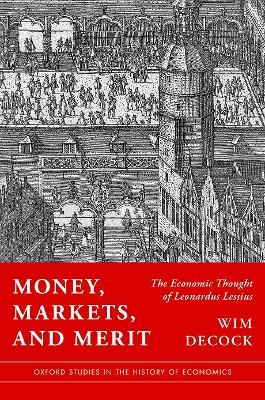
Money, Markets, and Merit
The Economic Thought of Leonardus Lessius
Seiten
2026
Oxford University Press Inc (Verlag)
978-0-19-782731-4 (ISBN)
Oxford University Press Inc (Verlag)
978-0-19-782731-4 (ISBN)
- Lieferbar (Termin unbekannt)
- Versandkostenfrei
- Auch auf Rechnung
- Artikel merken
This book revisits the legacy of one of the protagonists in the history of economic thought: Leonardus Lessius (1554-1623). In a time marked as much by fierce debates on grace and free will as by doubts about the legitimacy of the first global economy, Lessius offers a glimpse into the interconnectedness between 'meritocratic' ideas on spiritual salvation and material prosperity.
To understand the genesis of the modern economy, we must also investigate its normative foundations. More than a century after Max Weber's The Protestant Ethic and the Spirit of Capitalism, the pursuit of this key methodological intuition remains unfinished. This book revisits the legacy of a neglected protagonist in the history of economic thought: Leonardus Lessius (1554-1623). Lessius' work provides unique insight into the normative roots of modern economic thought. In a context characterised by the globalization of trade, the rise of stock exchanges, and profound political and religious upheavals, merchants, bankers, and princes eagerly sought his advice to navigate the New World. Praised by Joseph A. Schumpeter as a 'father of modern economic analysis', Lessius became known in his own time as the 'Oracle of the Netherlands'. His main treatise, 'On Justice and Law', quickly gained the status of a reference work due to the clarity of its economic observations and Lessius' brilliant mastery of legal and moral reasoning. He offered practical solutions to a wide range of cases of conscience related to speculation, insurance, insider trading, subprime debt, interest-taking, abuse of market power, monopolies, public banks, safe investment vehicles, and many other economic and financial issues. It certainly was not his intention to turn the whole world into a competitive market without any limits as Lessius deplored humanity's inclination to succumb to the 'sacred hunger for gold'. However, he did wish to encourage effort, hard work and clever dealings, thus contributing significantly to the normative justification of modern commerce and finance.
In a time marked as much by fierce debates on grace and free will as by doubts about the legitimacy of the first global economy, Lessius offers a glimpse into the interconnectedness between ideas on spiritual salvation and material prosperity.
To understand the genesis of the modern economy, we must also investigate its normative foundations. More than a century after Max Weber's The Protestant Ethic and the Spirit of Capitalism, the pursuit of this key methodological intuition remains unfinished. This book revisits the legacy of a neglected protagonist in the history of economic thought: Leonardus Lessius (1554-1623). Lessius' work provides unique insight into the normative roots of modern economic thought. In a context characterised by the globalization of trade, the rise of stock exchanges, and profound political and religious upheavals, merchants, bankers, and princes eagerly sought his advice to navigate the New World. Praised by Joseph A. Schumpeter as a 'father of modern economic analysis', Lessius became known in his own time as the 'Oracle of the Netherlands'. His main treatise, 'On Justice and Law', quickly gained the status of a reference work due to the clarity of its economic observations and Lessius' brilliant mastery of legal and moral reasoning. He offered practical solutions to a wide range of cases of conscience related to speculation, insurance, insider trading, subprime debt, interest-taking, abuse of market power, monopolies, public banks, safe investment vehicles, and many other economic and financial issues. It certainly was not his intention to turn the whole world into a competitive market without any limits as Lessius deplored humanity's inclination to succumb to the 'sacred hunger for gold'. However, he did wish to encourage effort, hard work and clever dealings, thus contributing significantly to the normative justification of modern commerce and finance.
In a time marked as much by fierce debates on grace and free will as by doubts about the legitimacy of the first global economy, Lessius offers a glimpse into the interconnectedness between ideas on spiritual salvation and material prosperity.
Wim Decock is Professor of Legal History at the Universities of Louvain and Liège in Belgium. From 2012-2014 he led a junior research group at the Max-Planck-Institute for Legal History and Legal Theory in Frankfurt. In 2022, he was the recipient of a Max Planck-Humboldt medal.
Introduction Leonardus Lessius and the History of Economics
1: The "Oracle of the Low Countries"
2: The Shadow of Max Weber
3: Keeping Promises
4: Usury and the Debt Market
5: Information and Speculation
6: Risk, Insurance, and Subprime Debt
7: Monopolies and Industry
8: The Salvation of the Economy
9: The Economy of Salvation
10: Business and Asceticism
| Erscheinungsdatum | 22.10.2025 |
|---|---|
| Reihe/Serie | Oxford Studies in the History of Economics |
| Verlagsort | New York |
| Sprache | englisch |
| Maße | 167 x 239 mm |
| Gewicht | 485 g |
| Themenwelt | Geschichte ► Teilgebiete der Geschichte ► Militärgeschichte |
| Geschichte ► Teilgebiete der Geschichte ► Wirtschaftsgeschichte | |
| Geisteswissenschaften ► Religion / Theologie | |
| Recht / Steuern ► Rechtsgeschichte | |
| ISBN-10 | 0-19-782731-4 / 0197827314 |
| ISBN-13 | 978-0-19-782731-4 / 9780197827314 |
| Zustand | Neuware |
| Informationen gemäß Produktsicherheitsverordnung (GPSR) | |
| Haben Sie eine Frage zum Produkt? |
Mehr entdecken
aus dem Bereich



aus dem Bereich
von der Wiederbewaffnung bis zur Zeitenwende
Buch | Softcover (2025)
C.H.Beck (Verlag)
CHF 16,80
von der Frühen Neuzeit bis zur Gegenwart
Buch | Hardcover (2025)
C.H.Beck (Verlag)
CHF 69,85


