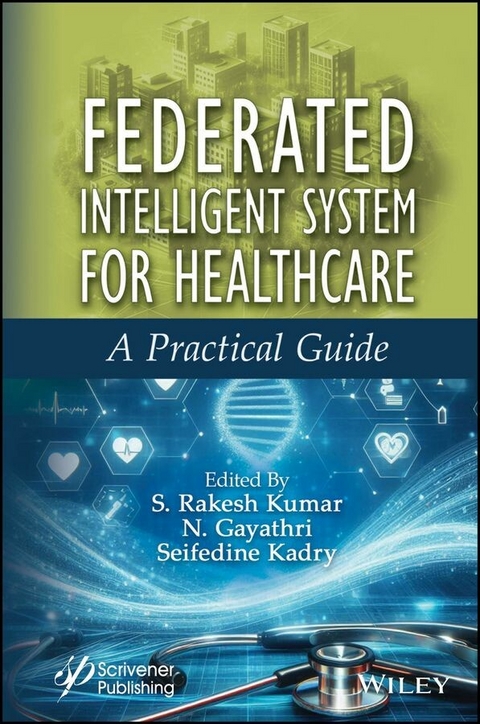
Federated Intelligent System for Healthcare (eBook)
441 Seiten
Wiley-Scrivener (Verlag)
978-1-394-27136-8 (ISBN)

This practical guide gives valuable insights for integrating advanced technologies in healthcare, empowering researchers to effectively navigate and implement federated systems to enhance patient care.
Federated Intelligent Systems for Healthcare: A Practical Guide explores the integration of federated learning and intelligent systems within the healthcare domain. This volume provides an in-depth understanding of how federated systems enhance healthcare practices, detailing their principles, technologies, challenges, and opportunities. Additionally, this book addresses secure and privacy-preserving sharing of medical data, applications of artificial intelligence and machine learning in healthcare, and ethical considerations surrounding the adoption of these advanced technologies. With a focus on practical implementation and real-world use cases, Federated Intelligent Systems for Healthcare: A Practical Guide equips healthcare professionals, researchers, and technology experts with the knowledge needed to navigate the complexities of federated intelligent systems in healthcare and harness their potential to transform patient care and medical advancements.
Readers will find the book:
- Provides cutting-edge research from industry experts to unlock the future of healthcare with innovative insights that embrace federated intelligence and shape the future;
- Presents novel technologies and conceptual and visionary-based scenarios;
- Discusses real-world case studies and implementations that illustrate how federated intelligence is practically applied across various healthcare scenarios, from personalized diagnostics to population-level insights;
- Stands as a pioneer in the exploration of federated intelligent systems in healthcare.
Audience
Data scientists, IT, healthcare and business professionals working towards innovations in the healthcare sector. The book will be especially helpful to students and educators.
S. Rakesh Kumar, PhD, is an assistant professor in the Department of Computer Science and Engineering at the Gandhi Institute of Technology and Management, Visakhapatnam, India. He has published four books and over 50 articles in international journals and conference proceedings. His research interests include artificial intelligence, machine learning, and big data applications.
N. Gayathri, PhD, is an assistant professor in the Department of Computer Science and Engineering at the Gandhi Institute of Technology and Management, Visakhapatnam, India. She has published four books and over 50 articles in international journals and serves as a guest editor and reviewer for several journals of repute. Her research interests include big data analytics, Internet of Things, and machine learning.
Seifedine Kadry, PhD, is a professor in the Department of Applied Data Science at Noroff University and Lebanese American University. He serves as an ABET program evaluator, distinguished speaker of the Institute of Electrical and Electronics Engineers Computer Society, and a fellow of several other international societies. His research focuses on data science, education using technology, system prognostics, stochastic systems, and applied mathematics.
1
Introduction to Federated Intelligent Systems in Healthcare
Naseem Ahmad
Dr. Rehabilitation Psychologist, Amroha, Uttar Pradesh, India
Abstract
Federated learning is an extensive technique that helps organisations protect patients privacy. Training of deep learning model on federated healthcare data has been evaluated through this learning method. Evaluation and transfer of medical data have been justified potentially with the involvement of federated learning techniques. Decentralised training of the deep learning model has been ensured with the involvement of the federated learning technique. The acting of the hospital-to-client model has been ensured with the involvement of the FL technique. While conducting collaboration between different medical institutions secure preservation of patient information has been ensured with the implementation of this method. Enhancement of patient and institutional access to highquality healthcare service has been ensured with better utilisation of federated learning techniques. Great promise for healthcare applications has been ensured due to the presence of the FL method. Improving the quality of data and reducing the risk of incorrect data annotation-related problems are solved successfully with the utilisation of federated learning technique. Data vulnerability and data breach-related problems are also solved successfully with better utilisation of this federated intelligent system. Instrumental and environmental noises are also solved potentially with better implications for federate intelligent systems. This study demonstrates the role of a federated intelligence system in ensuring the standardisation of medical datasets. Data partition-related aspects of the medical industry have been evaluated efficiently with the successful use of federated learning programs in healthcare. Conducting training on the collaborative machine learning model fl helps to create secure pool of information of multiple clients. The intelligence of the healthcare field has been emphasised with the successful implementation of federated learning. Security privacy, stability and reliability of the healthcare industry have been increased potentially with the involvement of federated learning techniques. The development of an entire healthcare management system has been confirmed successfully by evaluating different potential components of federated learning techniques. In addition, comprehensive changes in the operation of the medical field have been ensured with the involvement of federated learning and the internet of medical things that can. The growth and development of healthcare services have been ensured with the involvement of these technologies. Implementation of a federated intelligence system contributes to improving the ability to sense and transmit health updates successfully. Potential biomedical image analysis and security of information have been evaluated authentically due to the presence of IOMT or federated learning method. Distributed learning for the machine learning model of the medical industry has been highlighted due to the presence of federated learning in healthcare.
Keywords: Federated learning, internet of medical things, medical data, machine learning, security privacy, healthcare services, medical dataset and deep learning
1.1 Introduction
Federated learning is used by healthcare federated intelligent systems to train models at the same time across different healthcare data sources, all the while keeping patient information safe. To find out what cooperative learning in medicine can do, where it came from, and what problems it has, we must examine it closely. It is called secondary study when we review and analyze books and research papers that have already been written. The results show that healthcare data can be used to learn useful things for shared smart systems without putting patients’ privacy at risk. Still, there are many ways that data and privacy issues are still a problem. In conclusion, for federated learning to fully realize its promise of personalized patient care, it needs unity between different healthcare sectors, new technology, and strong data governance processes. Healthcare professionals can use Federated Intelligent Systems to make the most cutting-edge decisions based on data. These systems can maintain data privacy and accelerate joint model training across multiple separate data sources by using collaborative learning. Using this method, which keeps patient data safe and secure locally, helps to lower the privacy concerns that come with processing and storing data in one place. Wearable tech and digital health records have made the healthcare business generate more data. In response, more complex statistics and personalized care plans have been created. For example, in healthcare, shared intelligence systems can get useful information from patient data without revealing the patients’ identities. Together, these technologies allow healthcare institutions to create more accurate diagnosis tools and prediction models. Treatment works better, and is of higher quality. Big data is used in healthcare to create shared intelligence systems that keep patient data safe. This piece examines group learning in healthcare by exploring its current state, problems, and potential future developments. Shared learning is a creative way to keep data private while using multiple data sources to train machine learning models. To get the most out of shared learning, our study aims to guide healthcare managers how to optimize data while ensuring and protecting patient privacy. To make shared learning more useful in healthcare, it’s important to know how it can be used in real life. In studies and tests that have led to better patient tracking, sickness prediction, and individual treatment plans, federated learning has been useful. These cases show that strict privacy rules can be followed while shared learning is used to handle complicated and varied healthcare data.
Cancer study centers and hospitals use cooperative learning to make it easier to diagnose cancer. These companies could work together to make models that are more accurate and reliable by sharing changes to models instead of raw patient data. And this allows models to learn from the diverse types of patients and the knowledge of the participants. We can detect and treat cancer faster if we work together, ultimately for the benefit of the people. Scientists are also investigating how joint learning can be utilized to develop programs capable of predicting long-term illnesses [15].
Federated learning can better tell when a patient’s state is about to get worse by mixing data from different healthcare sources, like smart tech and electronic health records. This allows doctors to assist the patient sooner, which could improve their health and lower costs. With the help of AI, shared learning, and the Internet of Things (IoT), the future of healthcare looks bright. By letting computers learn from multiple data sources at the same time, this combination could make medical care more accurate and efficient. Federated learning is a huge step forward in the healthcare business because it lets you use huge amounts of data safely without putting patients’ privacy at risk. The healthcare industry can’t work without strong teamwork, strict obedience to the law, and a steady flow of new ideas. If these problems are fixed, shared learning could make healthcare systems around the world better and personalized treatment even better.
1.2 Evolution and Principles of Federated Learning in Healthcare
Federated learning is a game-changing way to keep private patient data safe when healthcare needs to analyze data together. This new idea strikes a good balance between the strict privacy and data security rules in the healthcare industry and the advantages of big data analytics [16]. The idea behind collaborative learning is decentralized model training. Federated learning saves data close to home, while centralized machine learning uses data from many places to teach a model [1]. Healthcare devices, hospitals, and even clinics use their own data sets to help them learn. These small groups use their own data to train a shared model. They only send the changed model results to a central server, not the original data. There are many good things about this independent model teaching method. First, it makes sure that privacy rules like HIPAA in the US and GDPR in Europe are followed. This makes data breaches much less common. Sensitive patient data probably wouldn’t get out while being stored or transported because raw data never leaves the local area. The only thing that is given to someone is the model choices, which are usually less private and nameless.
Central computers can help you keep track of changes to models. To create changes, it combines locally calculated modifications from several devices or institutions into the global model. The local groups receive this combined model back so they may retrain it using their own data. The world model may learn from many different data sources and improve over time if the data is kept hidden. The healthcare sector may gain greatly from federated learning as it allows models to be trained from a variety of data sources [10]. These differences happen because of the different types of patients, healthcare data sources, and patient groups. Federated learning allows teachers from various schools to work together on model lessons. The models are more useful now that they live longer and show a wider range of illnesses and patient results. With federated learning, it’s also easier to...
| Erscheint lt. Verlag | 28.5.2025 |
|---|---|
| Sprache | englisch |
| Themenwelt | Medizin / Pharmazie |
| Recht / Steuern | |
| ISBN-10 | 1-394-27136-0 / 1394271360 |
| ISBN-13 | 978-1-394-27136-8 / 9781394271368 |
| Informationen gemäß Produktsicherheitsverordnung (GPSR) | |
| Haben Sie eine Frage zum Produkt? |
 EPUB (Adobe DRM)
Kopierschutz: Adobe-DRM
Adobe-DRM ist ein Kopierschutz, der das eBook vor Mißbrauch schützen soll. Dabei wird das eBook bereits beim Download auf Ihre persönliche Adobe-ID autorisiert. Lesen können Sie das eBook dann nur auf den Geräten, welche ebenfalls auf Ihre Adobe-ID registriert sind.
Details zum Adobe-DRM
Dateiformat: EPUB (Electronic Publication)
EPUB ist ein offener Standard für eBooks und eignet sich besonders zur Darstellung von Belletristik und Sachbüchern. Der Fließtext wird dynamisch an die Display- und Schriftgröße angepasst. Auch für mobile Lesegeräte ist EPUB daher gut geeignet.
Systemvoraussetzungen:
PC/Mac: Mit einem PC oder Mac können Sie dieses eBook lesen. Sie benötigen eine
eReader: Dieses eBook kann mit (fast) allen eBook-Readern gelesen werden. Mit dem amazon-Kindle ist es aber nicht kompatibel.
Smartphone/Tablet: Egal ob Apple oder Android, dieses eBook können Sie lesen. Sie benötigen eine
Geräteliste und zusätzliche Hinweise
Buying eBooks from abroad
For tax law reasons we can sell eBooks just within Germany and Switzerland. Regrettably we cannot fulfill eBook-orders from other countries.
aus dem Bereich