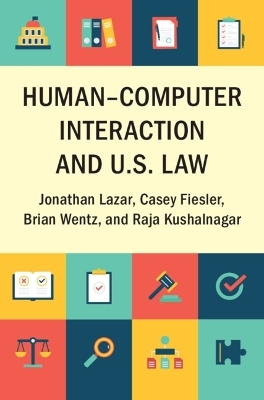
Human–Computer Interaction and U.S. Law
Cambridge University Press (Verlag)
978-1-009-09845-8 (ISBN)
The core topics at the intersection of human-computer interaction (HCI) and US law -- privacy, accessibility, telecommunications, intellectual property, artificial intelligence (AI), dark patterns, human subjects research, and voting -- can be hard to understand without a deep foundation in both law and computing. Every member of the author team of this unique book brings expertise in both law and HCI to provide an in-depth yet understandable treatment of each topic area for professionals, researchers, and graduate students in computing and/or law. Two introductory chapters explaining the core concepts of HCI (for readers with a legal background) and U.S. law (for readers with an HCI background) are followed by in-depth discussions of each topic.
Jonathan Lazar, PhD, LLM, is Professor in the College of Information at the University of Maryland, where he is the executive director of the Maryland Initiative for Digital Accessibility (MIDA) and a faculty member in the Human-Computer Interaction Lab (HCIL). He has been teaching and researching about human–computer interaction (HCI), accessibility, and the intersections between law, policy, and HCI, for over 25 years. He has previously authored or edited 18 books and published over 200 refereed articles in journals, conference proceedings, edited books, and magazines. He has received research funding from the U.S. National Science Foundation, the U.S. National Institute on Disability, Independent Living, and Rehabilitation Research (NIDILRR), Google, and Adobe. He has served as an expert witness in many legal cases, has given legislative testimony at the state and federal level over 20 times, regularly teaches legal research methods to nonlawyers, and is a member of the Disability Rights Bar Association. Casey Fiesler, PhD, JD, is Associate Professor in Information Science at the University of Colorado Boulder, where she is also affiliated with the law school's Silicon Flatirons Center for Law, Technology, and Entrepreneurship. She is a social computing researcher and legal scholar whose research addresses internet law and copyright, online governance, and research ethics. She is also a member of the SIGCHI Research Ethics Committee and the Legal Committee for the Organization for Transformative Works, which helps protect the rights of fan creators. She holds a JD from Vanderbilt Law School and a PhD in Human-Centered Computing from Georgia Tech. Brian Wentz, ScD, MSL, is Professor of Information Systems and Analytics at Shippensburg University, Pennsylvania. His research interests include how the accessibility and usability aspects of human–computer interaction affect business, education, employment, public policy, and societal inclusion. He has been involved in a variety of projects related to web accessibility and usability for people with disabilities, including working as a contractor on the regulatory process for website accessibility under the ADA for the Civil Rights Division of the U.S. Department of Justice. He has published over 40 refereed articles in journals, books, and conference proceedings. Raja Kushalnagar, PhD, JD, LLM, is Professor in the School of Science, Technology, Accessibility, Mathematics and Public Health at Gallaudet University in Washington, DC. With over 20 years of experience in the accessible technology field, he brings a wealth of experiential research in information and communication accessibility for people with diverse hearing abilities. He also advocates for laws and regulations to incorporate accessible computing advances such as automatic captioning/subtitling. He has mentored over 100 students, including over 60 who are deaf or hard of hearing, and has published over 100 articles in collaboration with these students. Raja focuses on increasing the number of people with diverse hearing abilities in the computing pipeline through community involvement. He serves on the NSF-funded AccessComputing Leadership Corps, and as a board member for the New York School for the Deaf, and Computing Research Association Widening Participation (CRA-WP). He earned a PhD in Computer Science and an LLM in Intellectual Property and Information Law from the University of Houston, and a JD from Texas Southern University.
Foreword by Lorrie Cranor; Preface; 1. Introduction to Law for Human Computer Interaction; 2. Introduction to Human Computer Interaction for Law; 3. Accessibility; 4. Privacy; 5. Human Subjects Research Regulation; 6. Intellectual Property; 7. Telecommunications; 8. Artificial Intelligence; 9. Dark Patterns; 10. Voting Interfaces and U.S. Law; 11. International Laws, Treaties, and HCI; Index.
| Erscheinungsdatum | 23.12.2025 |
|---|---|
| Vorwort | Lorrie Cranor |
| Zusatzinfo | Worked examples or Exercises |
| Verlagsort | Cambridge |
| Sprache | englisch |
| Gewicht | 595 g |
| Themenwelt | Informatik ► Software Entwicklung ► User Interfaces (HCI) |
| Recht / Steuern ► Allgemeines / Lexika | |
| Recht / Steuern ► EU / Internationales Recht | |
| Recht / Steuern ► Privatrecht / Bürgerliches Recht ► IT-Recht | |
| ISBN-10 | 1-009-09845-4 / 1009098454 |
| ISBN-13 | 978-1-009-09845-8 / 9781009098458 |
| Zustand | Neuware |
| Informationen gemäß Produktsicherheitsverordnung (GPSR) | |
| Haben Sie eine Frage zum Produkt? |
aus dem Bereich