


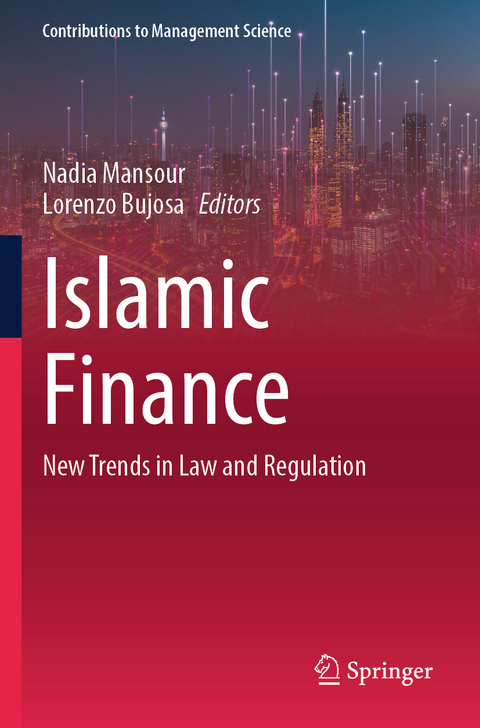
Islamic Finance
Springer International Publishing (Verlag)
978-3-031-48772-9 (ISBN)
This volume discusses the new trends in law and regulation in Islamic finance. Islamic finance is a particular component of the global financial system and is very different from secular finance. To understand the development of Islamic finance, it is important to place it in the context of financial globalization. Islamic finance is a new force in the contemporary world financial system and is present in more than a hundred countries. The current generation of Muslim economic power is crowding into the world's financial currents with trillions in liquidity and is growing at a high rate of 10-15% per year. Islamic finance is coming into focus and is not confined to Islamic countries but is present in every larger Muslim community, which means that it cannot be isolated from the effects of financial globalization. This edited volume discusses the effects of global financial transactions in Islamic finance and how it impacts its law and regulation.
Dr. Nadia Mansour is a trainer at CREACT4MED, an assistant at The University of Sousse-Tunisia, a visiting researcher, and a post-doctor at the University of Salamanca-Spain. Her research interests focus on Finance, Banking, Macroeconomic, DSGE, and Innovation. She is an academic member and ambassador of the Communication Institute of Greece, a committee member of indexed conferences, an editorial board member of Taylor & Francis, IGI GLOBAL, and Springer, a reviewer in IGI Global, Emerald, and Wiley. She has presented various scientific papers in international (France, Morocco, USA, Turkey) and national conferences. She is also a keynote speaker and session chair in several conferences in (Turkey, India, and UAE). She has several published articles in ranked journals and chapters (IGI Global & Palgrave Macmillan) as well as edited books (Taylor & Francis, Springer).
Lorenzo Mateo Bujosa Vadell is a professor of procedural law at the University of Salamanca, Spain. He is a former president of the Ibero-American Institute of Procedural Law, and member of the International Association of Procedural Law and the International Association of Criminal Law. He is the coordinator of the PhD program "Administration, Justice and Finance in the Social State" at the University of Salamanca. He has enjoyed research stays at the Universities of Kansas (USA), Florence (Italy), and Trier (Germany).
Chapter 1. Islamic Entrepreneurship: a Systematic Literature Review.- Chapter 2. Harmonization of Islamic Financial Literacy in Understanding the Islamic Banking Services: the Case in Malaysia.- Chapter 3. A Systematic Review: Challenge of Islamic Microfinance Baitul Maal Wat Tanwil in Indonesia.- Chapter 4. Islamic Peer-to-peer (P2P) Financing as an Alternate Model of MSME Financing in Nigeria.- Chapter 5. The Relationship Between Business Intelligence and Digital Banking Services in Jordanian Islamic Banks.- Chapter 6. The Impact of Islamic Finance on Economic Growth : the Malaysian Experience.- Chapter 7. The Efficiency of Participation Banking Sector in Turkey: A DEA Approach.- Chapter 8. Understanding the Practices and Challenges of Sustainability Reporting in Islamic Banking.- Chapter 9. Are Women a Gender Dividend for Investment - an Empirical Analysis From Indian Working Women Perspective.- Chapter 10. Potential Impact of Metaverse-based Banking on Employment in the BankingSector in India.- Chapter 11. The Impact of Credit Risk Mitigation on the Profits of Investment Deposits in Islamic Banks.- Chapter 12. The Effect of Job Seekers' Perception on the Intention to Apply for Jobs in Islamic Banks in Indonesia.- Chapter 13. Factors Influencing the Adoption of Business Intelligence in Islamic Banks.- Chapter 14. Prospects of a Partnership-based Islamic Microfinance model in Bangladesh: Clients Perspectives.- Chapter 15. Analyzing Islamic Crowdfunding Through Bibliometric and Visualization Approaches.- Chapter 16. Benchmarking as a Mechanism to Measure Reference Efficiency and Improve the Performance of a Group of Banks, Using the DEA Data Envelope.- Chapter 17. A Perspective on the Existence and Development of Islamic Banking in India.- Chapter 18. Women Outreach Exploration; Evidence From Islamic Microfinance in Indonesia.- Chapter 19. The Impact of Necessity on Deposit Guarantee in Islamic Banks an Applied Jurisprudential Study.- Chapter 20. The FinancialImpact of Islamic Banking on Supporting and Developing Small and Medium Enterprises an Assessment of the Reality of Global Bank Al-Salam.- Chapter 21. A Qualitative Evaluation of Narrative Effectiveness Used in the Six and Titanic Films: a Forgotten Minority Perspective.- Chapter 22. Sukuk Blockchain - an Innovation: Opportunities and Challenges.- Chapter 23. Linking Brand Awareness, Influencers and Impulse Buying via Sor Theory: a Conceptual Paper.- Chapter 24. Bibliometric Analysis of Internal Audit Quality of Public Sector Organizations.- Chapter 25. Systematic Literature Review About Examining the Factors Affecting Omans Implementation of E-government.- Chapter 26. Role of Payment Innovation on Bank Performance: What Happens to the Bank if Cash Goes Away?.- Chapter 27. Investigating the Factors Influencing Mobile Commerce Usage of SMES in Hargeisa, Republic of Somaliland: a Review of Literature.- Chapter 28. Breaking Barriers: Exploring the Gender Moderation in Factors Affecting University Choice for Students.- Chapter 29. An in-depth Exploration of the Evolution and Imple-mentation of Halal Pharmaceutical Certification Schemes in Malaysia.- Chapter 30. Examining the Impact of Entrepreneurship Performance on Sustainable Entrepreneurship and Sustainable Development Goals (SDGS).- Chapter 31. The Penta Helix Model in Management of Livestock Compost in Pakisjajar Village Communities.- Chapter 32. Student Performance in Mathematics and Its Impact on Learning Stem Subjects.- Chapter 33. Identifying the Sugarcane Trading System in Indonesia: an Institutional Economics Perspective.- Chapter 34. Going Global in the Digital Age Keeping Up and Staying Ahead in Today's Tech-driven Society.- Chapter 35. The Development of Women's Education Under Local Organizations in Kelantan, 1932-1957.- Chapter 36. Nurturing Student Academic Performance: Unveiling the Impact of Smart Classroom, Perceived Ease of Use, Self-efficacy, and Islamic Spiritual Values.- Chapter 37. The Prospectof
| Erscheint lt. Verlag | 11.4.2025 |
|---|---|
| Reihe/Serie | Contributions to Management Science |
| Zusatzinfo | XI, 1 p. 94 illus., 81 illus. in color. |
| Verlagsort | Cham |
| Sprache | englisch |
| Maße | 155 x 235 mm |
| Themenwelt | Recht / Steuern ► Wirtschaftsrecht |
| Wirtschaft ► Betriebswirtschaft / Management ► Finanzierung | |
| Wirtschaft ► Volkswirtschaftslehre ► Mikroökonomie | |
| Schlagworte | Decentralized Finance • Financial Globalization • Insolvency law • Islamic Finance • Islamic Law • Regulation • Supervision • Takaful |
| ISBN-10 | 3-031-48772-9 / 3031487729 |
| ISBN-13 | 978-3-031-48772-9 / 9783031487729 |
| Zustand | Neuware |
| Informationen gemäß Produktsicherheitsverordnung (GPSR) | |
| Haben Sie eine Frage zum Produkt? |
aus dem Bereich


