


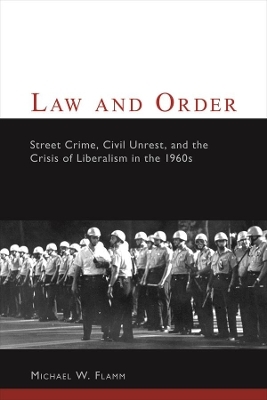
Law and Order
Street Crime, Civil Unrest, and the Crisis of Liberalism in the 1960s
Seiten
2007
Columbia University Press (Verlag)
978-0-231-11513-1 (ISBN)
Columbia University Press (Verlag)
978-0-231-11513-1 (ISBN)
- Lieferbar (Termin unbekannt)
- Versandkostenfrei
- Auch auf Rechnung
- Artikel merken
Offers a study of the political and social history of the 1960s. This book presents an account of how the issues of street crime and civil unrest enhanced the popularity of conservatives, eroded the credibility of liberals, and transformed the landscape of American politics.
Law and Order offers a valuable new study of the political and social history of the 1960s. It presents a sophisticated account of how the issues of street crime and civil unrest enhanced the popularity of conservatives, eroded the credibility of liberals, and transformed the landscape of American politics. Ultimately, the legacy of law and order was a political world in which the grand ambitions of the Great Society gave way to grim expectations. In the mid-1960s, amid a pervasive sense that American society was coming apart at the seams, a new issue known as law and order emerged at the forefront of national politics. First introduced by Barry Goldwater in his ill-fated run for president in 1964, it eventually punished Lyndon Johnson and the Democrats and propelled Richard Nixon and the Republicans to the White House in 1968. In this thought-provoking study, Michael Flamm examines how conservatives successfully blamed liberals for the rapid rise in street crime and then skillfully used law and order to link the understandable fears of white voters to growing unease about changing moral values, the civil rights movement, urban disorder, and antiwar protests.
Flamm documents how conservatives constructed a persuasive message that argued that the civil rights movement had contributed to racial unrest and the Great Society had rewarded rather than punished the perpetrators of violence. The president should, conservatives also contended, promote respect for law and order and contempt for those who violated it, regardless of cause. Liberals, Flamm argues, were by contrast unable to craft a compelling message for anxious voters. Instead, liberals either ignored the crime crisis, claimed that law and order was a racist ruse, or maintained that social programs would solve the "root causes" of civil disorder, which by 1968 seemed increasingly unlikely and contributed to a loss of faith in the ability of the government to do what it was above all sworn to do-protect personal security and private property.
Law and Order offers a valuable new study of the political and social history of the 1960s. It presents a sophisticated account of how the issues of street crime and civil unrest enhanced the popularity of conservatives, eroded the credibility of liberals, and transformed the landscape of American politics. Ultimately, the legacy of law and order was a political world in which the grand ambitions of the Great Society gave way to grim expectations. In the mid-1960s, amid a pervasive sense that American society was coming apart at the seams, a new issue known as law and order emerged at the forefront of national politics. First introduced by Barry Goldwater in his ill-fated run for president in 1964, it eventually punished Lyndon Johnson and the Democrats and propelled Richard Nixon and the Republicans to the White House in 1968. In this thought-provoking study, Michael Flamm examines how conservatives successfully blamed liberals for the rapid rise in street crime and then skillfully used law and order to link the understandable fears of white voters to growing unease about changing moral values, the civil rights movement, urban disorder, and antiwar protests.
Flamm documents how conservatives constructed a persuasive message that argued that the civil rights movement had contributed to racial unrest and the Great Society had rewarded rather than punished the perpetrators of violence. The president should, conservatives also contended, promote respect for law and order and contempt for those who violated it, regardless of cause. Liberals, Flamm argues, were by contrast unable to craft a compelling message for anxious voters. Instead, liberals either ignored the crime crisis, claimed that law and order was a racist ruse, or maintained that social programs would solve the "root causes" of civil disorder, which by 1968 seemed increasingly unlikely and contributed to a loss of faith in the ability of the government to do what it was above all sworn to do-protect personal security and private property.
Michael W. Flamm is associate professor of history at Ohio Wesleyan University and the coauthor of The Chicago Handbook for Teachers and Debating the 1960s. Michael Flamm is Associate Professor of History at Ohio Wesleyan Universtiy. He is co-author of The Chicago Handbook of Teaching (University of Chicago Press, 1999). He received his Ph.D. at Columbia University.
Acknowledgments Introduction 1. Delinquency and Opportunity 2. Law and Order Unleashed 3. The War on Crime 4. The Conservative Tide 5. The Politics of Civil Disorder 6. The Liberal Quagmire 7. The Politics of Safe Streets 8. Death, Disorder, and Debate 9. Law and Order Triumphant Epilogue Bibliography
| Reihe/Serie | Columbia Studies in Contemporary American History |
|---|---|
| Zusatzinfo | 15 photos |
| Verlagsort | New York |
| Sprache | englisch |
| Themenwelt | Geschichte ► Teilgebiete der Geschichte ► Kulturgeschichte |
| Recht / Steuern ► Strafrecht ► Kriminologie | |
| ISBN-10 | 0-231-11513-X / 023111513X |
| ISBN-13 | 978-0-231-11513-1 / 9780231115131 |
| Zustand | Neuware |
| Informationen gemäß Produktsicherheitsverordnung (GPSR) | |
| Haben Sie eine Frage zum Produkt? |
Mehr entdecken
aus dem Bereich

aus dem Bereich
Die Revolution des Gemeinen Mannes
Buch | Softcover (2024)
C.H.Beck (Verlag)
CHF 16,80
Eine Geschichte des Geschmacks
Buch | Hardcover (2025)
C.H.Beck (Verlag)
CHF 49,95
vom Mittelalter bis zur Gegenwart
Buch | Softcover (2024)
C.H.Beck (Verlag)
CHF 16,80


