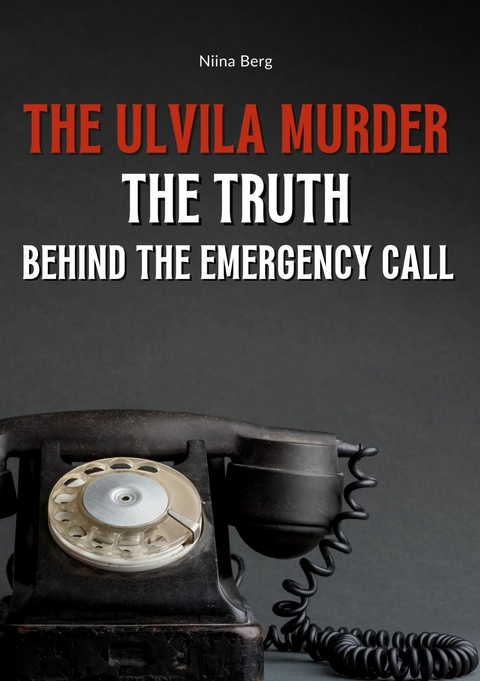
The Ulvila Murder: The Truth Behind the Emergency Call (eBook)
154 Seiten
Books on Demand (Verlag)
978-952-89-1198-2 (ISBN)
Niina Berg is a lawyer and a friend of Anneli Auer.
1. THE ULVILA MURDER
An unusual homicide and its unusual investigation
Jukka Lahti was murdered at his home in the town of Ulvila in Finland during the night of 1 December 2006. He was accompanied by his wife and the four children of the family. The emergency response centre of the Satakunta region received an emergency call at 2.43 a.m. from Anneli Auer, wife of Jukka Lahti, who explained that an unidentified man had forced entry into their home and was attacking her husband with a knife. She had also been stabbed. The emergency call lasted four minutes and 20 seconds, during which time Lahti was killed. Auer left the phone at one point, and during this period the eldest child of the family, Amanda, then a 9-year-old girl, spoke to the emergency services. The police arrived at the scene approximately nine minutes after the beginning of the emergency call, but by then it was too late: Lahti was dead, and the perpetrator had managed to escape. The call was recorded on the system of the emergency response centre, and a copy of the emergency call recording was given to the police for the homicide investigation first thing in the morning.
According to Finland’s national statistical institute Statistics Finland, the percentage of homicides solved in Finland is high every year, close to one hundred per cent, and only a very small number of homicides are left unsolved. In any other type of offence, the percentage solved is nowhere near the same level. This may create the impression that the police would be particularly skilled in solving homicides, but the truth is different – on average, a typical homicide in Finland is solved easily and quickly because the guilty party is often found at the crime scene, or can be named by other people who have been present, or the guilt is otherwise very evident in some other way. A quarter of the guilty turn themselves in to the police.
A typical homicide in Finland is a so-called manslaughter resulting from an argument under the influence, which means the homicide is heavily connected with the use of intoxicants. According to Statistics Finland and the Finnish Institute of Criminology and Legal Policy, in most cases, both parties are socially excluded, middle-aged substance-abusing men, and over 80 per cent of the killers and about 70 per cent of the victims are under the influence of alcohol or some other intoxicant at the time of the criminal act. Homicides are usually committed in private residences among familiar people drinking together using an edged weapon found in the household.
Even though the percentage of homicides solved is high and more effort is put into their investigation than into any other type of offence, a few homicides remain unsolved each year. The murder of Jukka Lahti was not a typical homicide because it was not preceded by the consumption of alcohol with the perpetrator. Instead, the perpetrator forced entry into the house at night with the intention of killing. Furthermore, the perpetrator was not identified and did not turn himself in. The murder of Jukka Lahti is one of over 200 homicides in Finland where the perpetrator remains unknown.
If the murder of Lahti was an unusual homicide, the pre-trial investigation was not quite standard either. To solve the crime, the police consulted a clairvoyant, used hypnosis and conducted a covert operation.
Next, I will recount in more detail a few more of the unusual things related to the pre-trial investigation.
Contamination. A bloody piece of firewood gathered from the murder site contained Lahti’s DNA as well as DNA from the unidentified man, suspected to belong to the murderer. All those who were deemed suspects at the early stages of the investigation were tested, and most were eliminated from the investigation as soon as their DNA results arrived. This element of the investigation included a so-called mass testing of over 700 men, mainly people associated with Lahti’s workplace – in his job, Lahti had participated in the redundancy process of hundreds of people, and initially the motive for the murder was thought to be personal revenge. The investigation soon discovered that Lahti had not been well-liked at his workplace. In addition, relatives told detectives that Lahti had received job-related threats.
When Anneli Auer was prosecuted for murder, another explanation had to be found for the above DNA results, and this is when it was suggested that the DNA could actually belong to anyone and originate from anywhere. According to the investigator in charge, Pauli Kuusiranta, the DNA could be from, for example, a mosquito: ‘If a mosquito that has sucked itself full of blood is killed, it is likely that the place where it was killed will also contain DNA.’
It was not until seven years later that it was revealed that the DNA belonged to a forensic laboratory analyst at the National Bureau of Investigation (NBI, Finland). According to a new laboratory report, DNA contamination took place despite the fact that the analyst in question had not even worked in the laboratory areas where the piece of firewood had been kept and examined – the laboratory report presumed that the DNA had been transferred to the piece of firewood either via the air or the work equipment (e.g. a camera) used by staff collectively.
Humans have DNA in their blood, semen, skin cells, saliva, hair follicles, bones and teeth, as well as small amounts in their faeces and urine. None of these can transfer to another room by air. The piece of firewood examined was in the laboratory in December, which means the DNA could also not be from a mosquito. If the laboratory did indeed have a collectively-used camera, it would be possible that the analyst had sneezed near the camera or somehow accidentally got saliva on it, or that skin cells had been transferred onto it from their hands and remained there. The DNA would then have had to be transferred from the camera to the hands of another analyst who used the camera. Furthermore, this transfer process would then require that the second analyst must have touched the piece of firewood and transferred the DNA from their hands onto that. This sounds unbelievable, but it could also be true. It is possible that the murderer may have been disregarded in the investigation due to this mistake.
Calls to the City of Porvoo Police Station. One of the peculiarities in the case related to the ‘Porvoo branch’ of the investigation. During the murder investigation, it became clear that Lahti had made three phone calls to the extension number of the senior constable of the Porvoo Police Station in May 2006 (on 4, 8 and 10 May). This same number had called Lahti twice (on 19 June and 1 September). During the call Lahti made on 10 May, the username of an investigation secretary had logged into the police information system and conducted searches for information tagged with Lahti’s name and personal identity code. The search terms included the dates 2006-04-29 and 2006-04-30 (in the format used by the police) as well as the codes P101 and 6590. Of these, 6590 is the Porvoo region code but there is no certainty what P101 is, it could even be a code relating to Lahti. On the basis of this, it can be deduced that the system was used for searching for information on a police matter in which Jukka Lahti would have been involved in one way or another which related to the Porvoo Police Station during the time period in question. I do not know the meaning of search code P101, and the police refused to tell it to me because according to them ‘The information belongs to the emergency response centre’s system and is part of the tactical and technical methods used by the police in the same manner as patrol identifiers and location data, which are classified information under section 24, subsection 1, paragraph 5 of the Act on the Openness of Government Activities’.
When asked about the matter (in 2008 and 2010), the senior constable expressed that he did not converse with Lahti or know him. If what he said was noted down correctly, this constable must have a remarkable memory for names – he remembers phone call conversations from years ago with people previously unfamiliar to him. The investigation secretary stated in her hearing (in 2012) that she did not know Lahti and did not remember answering Lahti’s calls. According to the secretary, she had not answered the senior constable’s phone, and she had also not called Lahti from the senior constable’s phone because she had only ever used her own phone.
The police later informed the media that the senior constable whose extension number was called was off duty at the time when the phone calls were made. The question is: was this person actually on duty, nevertheless? The murder investigation material includes lists of police work shifts from the time period in question, and according to these, the senior constable was in fact working on both days when the phone in his personal use was used to call Lahti. A quick look at the work shift list makes it appear that the senior constable had been on leave on 10 May, which is precisely when searches were made into the police information system during Lahti’s call. Upon closer examination of the work shift list, it can actually be seen that the time period marking at the top has been cut off, and that the list does not represent May 2006 but instead February–March 2009. This can be confirmed from the days and dates mentioned, as in 2009 the 28th day of the month is a Saturday and Sunday is the 1st of March. The work shift list had been received by fax from the...
| Erscheint lt. Verlag | 14.5.2025 |
|---|---|
| Sprache | englisch |
| Themenwelt | Recht / Steuern ► Strafrecht |
| Schlagworte | criminal investigation • Criminology • emergency call • murder investigation • True Crime |
| ISBN-10 | 952-89-1198-6 / 9528911986 |
| ISBN-13 | 978-952-89-1198-2 / 9789528911982 |
| Informationen gemäß Produktsicherheitsverordnung (GPSR) | |
| Haben Sie eine Frage zum Produkt? |
 EPUB (Wasserzeichen)
DRM: Digitales Wasserzeichen
Dieses eBook enthält ein digitales Wasserzeichen und ist damit für Sie personalisiert. Bei einer missbräuchlichen Weitergabe des eBooks an Dritte ist eine Rückverfolgung an die Quelle möglich.
Dateiformat: EPUB (Electronic Publication)
EPUB ist ein offener Standard für eBooks und eignet sich besonders zur Darstellung von Belletristik und Sachbüchern. Der Fließtext wird dynamisch an die Display- und Schriftgröße angepasst. Auch für mobile Lesegeräte ist EPUB daher gut geeignet.
Systemvoraussetzungen:
PC/Mac: Mit einem PC oder Mac können Sie dieses eBook lesen. Sie benötigen dafür die kostenlose Software Adobe Digital Editions.
eReader: Dieses eBook kann mit (fast) allen eBook-Readern gelesen werden. Mit dem amazon-Kindle ist es aber nicht kompatibel.
Smartphone/Tablet: Egal ob Apple oder Android, dieses eBook können Sie lesen. Sie benötigen dafür eine kostenlose App.
Geräteliste und zusätzliche Hinweise
Buying eBooks from abroad
For tax law reasons we can sell eBooks just within Germany and Switzerland. Regrettably we cannot fulfill eBook-orders from other countries.
aus dem Bereich