


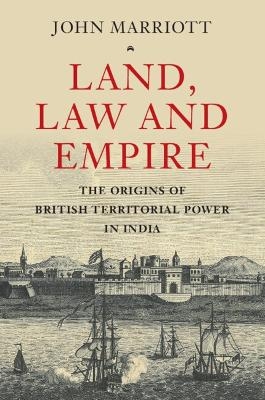
Land, Law and Empire
The Origins of British Territorial Power in India
Seiten
2025
Cambridge University Press (Verlag)
978-1-009-60208-2 (ISBN)
Cambridge University Press (Verlag)
978-1-009-60208-2 (ISBN)
How did the East India Company become a fully-fledged colonial power in India? This innovative exploration of early British rule reveals determined territorial acquisition in the face of opposition from Mughal authorities and rival European powers which, though haphazard, laid the foundations for the huge annexations of land which followed.
In this innovative exploration of British rule in India, John Marriott tackles one of the most significant and unanswered questions surrounding the East India Company's success. How and when was an English joint stock company with trading interests in the East Indies transformed into a fully-fledged colonial power with control over large swathes of the Indian subcontinent? The answer, Marriott argues, is to be found much earlier than traditionally acknowledged, in the territorial acquisitions of the seventeenth century secured by small coteries of English factors. Bringing together aspects of cultural, legal and economic theory, he demonstrates the role played by land in the assembly of sovereign power, and how English discourses of land and judicial authority confronted the traditions of indigenous peoples and rival colonial authorities. By 1700, the Company had established the sites of Madras, Bombay and Calcutta, providing the practical foothold for further expansion.
In this innovative exploration of British rule in India, John Marriott tackles one of the most significant and unanswered questions surrounding the East India Company's success. How and when was an English joint stock company with trading interests in the East Indies transformed into a fully-fledged colonial power with control over large swathes of the Indian subcontinent? The answer, Marriott argues, is to be found much earlier than traditionally acknowledged, in the territorial acquisitions of the seventeenth century secured by small coteries of English factors. Bringing together aspects of cultural, legal and economic theory, he demonstrates the role played by land in the assembly of sovereign power, and how English discourses of land and judicial authority confronted the traditions of indigenous peoples and rival colonial authorities. By 1700, the Company had established the sites of Madras, Bombay and Calcutta, providing the practical foothold for further expansion.
John Marriott is a Visiting Fellow at Kellogg College, Oxford and has published extensively on the nexus between London and India.
Perspectives; 1. Tudor state, chartered companies and colonization; 2. Passage to India; 3. Geopolitics of trade and settlement; 4. Madras; 5. Bombay; 6. Calcutta; Retrospective; Glossary; Index.
| Erscheinungsdatum | 26.07.2025 |
|---|---|
| Zusatzinfo | Worked examples or Exercises; 5 Maps; 15 Halftones, black and white |
| Verlagsort | Cambridge |
| Sprache | englisch |
| Themenwelt | Geisteswissenschaften ► Geschichte ► Regional- / Ländergeschichte |
| Geschichte ► Teilgebiete der Geschichte ► Militärgeschichte | |
| Geschichte ► Teilgebiete der Geschichte ► Wirtschaftsgeschichte | |
| Recht / Steuern ► Rechtsgeschichte | |
| ISBN-10 | 1-009-60208-X / 100960208X |
| ISBN-13 | 978-1-009-60208-2 / 9781009602082 |
| Zustand | Neuware |
| Informationen gemäß Produktsicherheitsverordnung (GPSR) | |
| Haben Sie eine Frage zum Produkt? |
Mehr entdecken
aus dem Bereich


aus dem Bereich
von der Wiederbewaffnung bis zur Zeitenwende
Buch | Softcover (2025)
C.H.Beck (Verlag)
CHF 16,80
Deutschlands großer Volksaufstand
Buch | Softcover (2024)
Propyläen Verlag
CHF 30,80


