


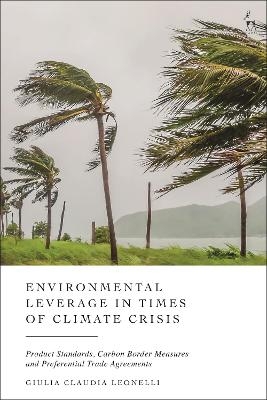
Environmental Leverage in Times of Climate Crisis
Product Standards, Carbon Border Measures and Preferential Trade Agreements
Seiten
2026
Hart Publishing (Verlag)
978-1-5099-7832-8 (ISBN)
Hart Publishing (Verlag)
978-1-5099-7832-8 (ISBN)
- Noch nicht erschienen (ca. Februar 2026)
- Versandkostenfrei
- Auch auf Rechnung
- Artikel merken
A fresh insight into the exercise of environmental ‘leverage’ in times of climate crisis.
This book offers a conceptually informed insight into the rise of ‘environmental leverage’ in times of climate crisis.
The world is fast approaching a two degree Celsius increase in average global temperatures. Against this troubling background, trade-related environmental leverage aims to promote the uptake of more ambitious environmental standards by third countries and market actors involved in transnational supply chains.
Trade-related environmental leverage can help to remedy the failures of environmental multilateralism, reshape the trade agenda to cater to the demands of our time, and entrench greener forms of development and more sustainable production and consumption patterns. Nonetheless, its boundaries must be appropriately circumscribed.
The book assesses different forms of environmental leverage against the normative yardsticks of ‘environmental integrity’ and ‘environmental legitimacy’. Environmental integrity targets ‘green protectionism’ and ‘green discrimination’, drawing a line between the promotion of environmental values and the protection of economic interests. Environmental legitimacy captures ‘eco-imperialism’, addressing the question of the treatment of differently situated countries and developing and least developed countries in particular. The book employs an in-depth analysis of three case studies to operationalise this conceptual framework, articulating the limits to environmental leverage in legal terms.
Combining a close focus on environmental regulations with a rigorous assessment of trade law questions, the book is relevant to anybody working in the fields of environmental law and policy, climate change law, and international trade law.
This book offers a conceptually informed insight into the rise of ‘environmental leverage’ in times of climate crisis.
The world is fast approaching a two degree Celsius increase in average global temperatures. Against this troubling background, trade-related environmental leverage aims to promote the uptake of more ambitious environmental standards by third countries and market actors involved in transnational supply chains.
Trade-related environmental leverage can help to remedy the failures of environmental multilateralism, reshape the trade agenda to cater to the demands of our time, and entrench greener forms of development and more sustainable production and consumption patterns. Nonetheless, its boundaries must be appropriately circumscribed.
The book assesses different forms of environmental leverage against the normative yardsticks of ‘environmental integrity’ and ‘environmental legitimacy’. Environmental integrity targets ‘green protectionism’ and ‘green discrimination’, drawing a line between the promotion of environmental values and the protection of economic interests. Environmental legitimacy captures ‘eco-imperialism’, addressing the question of the treatment of differently situated countries and developing and least developed countries in particular. The book employs an in-depth analysis of three case studies to operationalise this conceptual framework, articulating the limits to environmental leverage in legal terms.
Combining a close focus on environmental regulations with a rigorous assessment of trade law questions, the book is relevant to anybody working in the fields of environmental law and policy, climate change law, and international trade law.
Giulia Claudia Leonelli is Assistant Professor at LSE Law School, UK.
1. Introduction: Trade-Related Environmental Leverage and its Limits
2. Anti-Deforestation Standards: Testing the Chapeau of Article XX GATT Against Integrity and Legitimacy
3. Defensive Carbon Border Measures: The Notion of a Level Playing Field and the Rearticulation of Common but Differentiated Responsibilities and Respective Capabilities
4. Consent-Based Leverage: Integrity and Legitimacy in Preferential Trade Agreements
5. The Future of Environmental Leverage
| Erscheint lt. Verlag | 19.2.2026 |
|---|---|
| Verlagsort | Oxford |
| Sprache | englisch |
| Maße | 156 x 234 mm |
| Themenwelt | Recht / Steuern ► Allgemeines / Lexika |
| Recht / Steuern ► EU / Internationales Recht | |
| Recht / Steuern ► Öffentliches Recht ► Umweltrecht | |
| ISBN-10 | 1-5099-7832-1 / 1509978321 |
| ISBN-13 | 978-1-5099-7832-8 / 9781509978328 |
| Zustand | Neuware |
| Informationen gemäß Produktsicherheitsverordnung (GPSR) | |
| Haben Sie eine Frage zum Produkt? |
Mehr entdecken
aus dem Bereich


aus dem Bereich
Erläuterungen - Änderungen - Rechtstexte
Buch | Softcover (2023)
Beuth (Verlag)
CHF 86,80


