


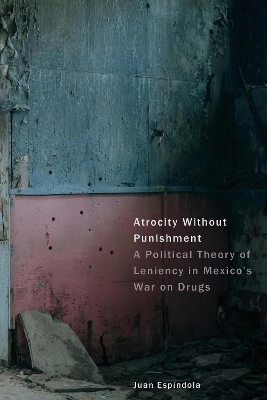
Atrocity Without Punishment
A Political Theory of Leniency in Mexico's War on Drugs
Seiten
2026
|
New edition
Stanford University Press (Verlag)
978-1-5036-4492-2 (ISBN)
Stanford University Press (Verlag)
978-1-5036-4492-2 (ISBN)
Leniency might sometimes be the ethical response to atrocity. However, the more extraordinary an act of violence is, the greater the compulsion to severely punish the offender. The rationale is that the threat of harsh punishment will be more effective at preventing crime. At the same time, the notion that the criminal justice system is corrupt and ineffective has become commonplace. At the center of these conflicting trends is a puzzle that this book sets out to solve: what if punishment should not only be judged by its effectiveness, but also by its morality?
Mexico's War on Drugs has unleashed an endless cycle of violence in the country. The resulting human toll is catastrophic. Atrocity Without Punishment advances ethically compelling reasons to impose lenient sentences on offenders involved in drugtrafficking, including many who commit serious offenses. Juan Espíndola argues that this is in fact a morally permissible, even obligatory, way to hold perpetrators accountable.
From this vantage point, Espíndola problematizes the relationship between punishment and core political values such as legitimacy and justice. By challenging the criminal justice system in this way, he charts a path toward a more just criminal legal system that can muster the support of those who reject abolitionism.
Mexico's War on Drugs has unleashed an endless cycle of violence in the country. The resulting human toll is catastrophic. Atrocity Without Punishment advances ethically compelling reasons to impose lenient sentences on offenders involved in drugtrafficking, including many who commit serious offenses. Juan Espíndola argues that this is in fact a morally permissible, even obligatory, way to hold perpetrators accountable.
From this vantage point, Espíndola problematizes the relationship between punishment and core political values such as legitimacy and justice. By challenging the criminal justice system in this way, he charts a path toward a more just criminal legal system that can muster the support of those who reject abolitionism.
Juan Espíndola is Associate Professor at the Institute for Philosophical Research in the national Autonomous University of Mexico. He is the author of Transitional Justice After German Reunification (2015), and El hombre que lo podía todo (2004).
| Erscheinungsdatum | 06.01.2026 |
|---|---|
| Reihe/Serie | The Cultural Lives of Law |
| Verlagsort | Palo Alto |
| Sprache | englisch |
| Maße | 152 x 229 mm |
| Themenwelt | Recht / Steuern ► EU / Internationales Recht |
| Recht / Steuern ► Strafrecht | |
| Sozialwissenschaften ► Politik / Verwaltung | |
| ISBN-10 | 1-5036-4492-8 / 1503644928 |
| ISBN-13 | 978-1-5036-4492-2 / 9781503644922 |
| Zustand | Neuware |
| Informationen gemäß Produktsicherheitsverordnung (GPSR) | |
| Haben Sie eine Frage zum Produkt? |
Mehr entdecken
aus dem Bereich



aus dem Bereich
Vertrag über die Europäische Union, Vertrag über die Arbeitsweise …
Buch | Softcover (2025)
dtv (Verlag)
CHF 23,65
Gesetz über das Verfahren in Familiensachen und in den …
Buch | Softcover (2025)
dtv Verlagsgesellschaft
CHF 29,25


