Barrister for the Earth (eBook)
304 Seiten
Faber & Faber (Verlag)
978-0-571-38638-3 (ISBN)
Monica Feria-Tinta is a British-Peruvian barrister specialising in Public International Law. She has been called one of 'the most daring, innovative and creative lawyers' in the United Kingdom. She is 'Barrister of the Year' finalist at The Lawyers' Awards 2025 and winner of the Environment junior of the year at Chambers and Partners UK Bar Awards 2023 for her work in addressing climate change and environmental degradation. In 2020, she acted before the Constitutional Court of Ecuador in Los Cedros case, the first 'Rights of Nature' case in the world. In September 2022 her work as Counsel secured a win in the Torres Strait Islanders case, a landmark moment in which the UN Human Rights Committee found a Sovereign state responsible, for the first time in history, for lack of action in addressing climate change.
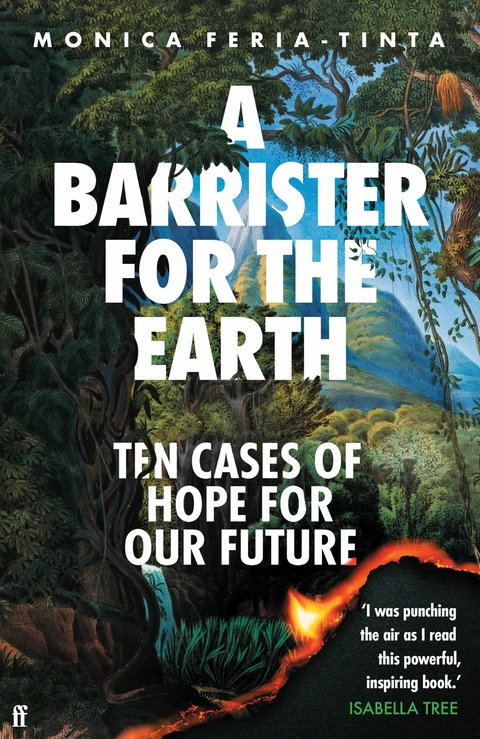
SHORTLISTED FOR THE WESTMINSTER BOOK AWARDS'Inspiring . . . Law could be our planet's greatest hope.'ISABELLA TREE'Fascinating and compelling . . . A vital book for our times.'JULIAN HOFFMAN'A seminal and important book which will become a key part of the gathering movement to protect the rights of nature.'SARAH LANGFORD*Can a planet have legal rights? Could it be defended in a court of law? How do we redefine a 'right to life'?A revolution is taking place. Around the world, ordinary people are turning to courts, seeking justice for environmental wrongs. At the forefront of this movement, pioneering barrister Monica Feria-Tinta advocates not only for people, but also for those who have no voice: for rivers, forests and endangered species. In A Barrister for the Earth, Feria-Tinta takes us behind the scenes of ten real cases as she argues against the destruction of cloud forests and for sovereign states to account for inaction. Each of these are landmarks signalling that we are at an important juncture, in which the law can be a powerful tool for the lasting change.
‘You cannot predict the seasons any longer,’ observed one of my clients, an indigenous Melanesian inhabitant of the Torres Strait Islands. His reality had become dystopic. Life on Boigu Island, the most northerly inhabited island in the Torres Strait, close to Papua New Guinea, had been determined by the seasons since ancestral times. That certainty is now gone. To make matters worse, every year a piece of the island is being ‘eaten’ by the sea. The Torres Strait Islands are sinking, and it’s because of climate change.
It’s not just in the Torres Strait. On the opposite side of the world, on the northernmost peninsula of South America, in a land of water scarcity, waterways are diverted to extract coal from riverbeds, all to power Western civilisation. This is not some kind of ‘magic realism’ – it is happening as I write. In the home of the Wayúu indigenous peoples, in remote Guajira, Colombia, the main waterways have been polluted by open-pit coal extraction and the diversion of rivers is altering the climate. Once reliable, rain patterns have now shifted. But the mine expansion continues regardless and at an unremitting pace. Once a hidden gem of the Northern Caribbean coast, La Guajira is now characterised by cracked parched earth.
But it’s not just the Torres Strait and Colombia. Natural gas is shipped to the UK from the Peruvian Amazon rainforest. This gas project has relentlessly penetrated protected rainforest, home to Amazonian tribes in voluntary isolation. As a result, today those tribes are suffering from mercury poisoning.
‘In fifteen kilometres of river, they want to build three dams,’ I was told by a Mayan Ch’orti’, who was defending the Jupilingo River, near the border with Honduras, from a hydroelectrical project that threatened their ancestral land. And this sort of threat is not unique to Guatemala. A year earlier, I had witnessed Asia’s last free-flowing river, the Salween in Myanmar, face the same predicament.
In yet another part of the world, in the Timor Sea, one of the world’s worst offshore oil rig accidents has taken place. The spill happened in Australian waters, but the harm it has caused respects no boundaries. At least 23 million litres of crude oil has poured into the ocean, destroying the lives and livelihoods of West-Timorese fishermen and seaweed farmers.
Elsewhere, in Colombia, indigenous peoples, such as the Kogi, Arhuaco, Kankuamo and Wiwa, struggle to protect an area in Sierra Nevada de Santa Marta they call the ‘Heart of the Earth’. This area has been identified as being vital for the ecological balance of the world: it is richly biodiverse, with over 700 bird species and 3,000 plant species.
At times there are no human beings directly affected. In Ecuador, in the Los Cedros cloud forest near the equator line, endemic species that cannot be found anywhere else in the world are threatened with extinction by a gold-mine exploration.
These are all snapshots from my practice as a barrister in London.
I found myself acting, first, in cases of indigenous peoples facing uphill, Sisyphus-like battles, which went on to set ground-breaking precedents in law – until one day, I realised that my client was no longer a human being. I found myself pleading directly for the rights of numerous species to simply exist. I had become a barrister for the Earth.
*
Can a planet have legal rights? Could they be defended in a court of law? And who or what are we referring to when we refer to the right to life?
In recent years, a quiet revolution has been taking place. Ordinary people have turned to courts around the world seeking justice for environmental damage: melting glaciers, sinking islands, extinction of species, and more. This is not a marginal development, and the legal cases are not ordinary ones. They prompt a reinterpretation of the law itself, one that is likely to impact the life of every single person around the world. These cases will secure our future. They are landmarks signalling that we are at an important juncture: the beginning of a shift in consciousness, and the dawning of a new era.
I know this well. I started to work on environmental cases when I began my practice as a barrister in 2014, though my experience as a public international law expert goes back to 1997. I have been at the crest of this wave of cases since 2016, when I was invited to consider how, in the absence of an inbuilt legal mechanism, the newly adopted Paris Agreement could be enforced. I attempted to provide a pathway using international law, as it was clear to me that the law was a powerful tool in the battle to redress environmental harm and to fight ecological degradation and climate change.
From that beginning, developing legal arguments in theoretical form, I took these arguments to the courts. In 2018 I took up the case of the Torres Strait Islanders against Australia, litigating from my flat in London all the way to the United Nations Human Rights Committee, in Geneva. In September 2022, the Committee delivered a ground-breaking decision: the first international dictum holding a state responsible for lack of action in addressing climate degradation. This was a momentous decision. It was a concrete demonstration that the law could have a definitive role in protecting the Earth. In 2018 I also pioneered legal arguments to bring a climate case in the International Tribunal for the Law of the Sea, at a time when people thought this was unarguable or not possible. Most thought that climate change was not a matter for courts. Little known and with its headquarters in a white building in Hamburg, this tribunal heard exactly such a case in September 2023, delivering a ground-breaking Advisory Opinion on climate and the protection of the ocean and marine species. When the decision came out, I was ecstatic. All the effort and long hours developing pleadings finally made sense. It was precisely what I had envisaged and hoped for.
In this book, I share that vision about how the law can play a definitive role in protecting the Earth much more widely, and in doing so I would like to demonstrate that we already have the tools to solve the apparently unsolvable crises of our times.
*
In his book Irreplaceable, Julian Hoffman warned readers about those places where the loss of nature is ‘real, visceral and imminent’.1 In recent years I have discovered such places for myself, as a barrister arguing in front of constitutional courts and international organs on the meaning of the word ‘imminent’, and even the meaning of the word ‘life’. These are not topics that have always preoccupied me, however. I grew up in Lima, a grey city that failed to impress Darwin when he visited while on board the Beagle: he described it as a place with a ‘thick drizzling mist, which was sufficient to make the street muddy and one’s clothes damp’.2 My parents had migrated there from the countryside at a young age. I was therefore born in Lima, and lived there happily in a concrete jungle.
I cannot pinpoint precisely when my own consciousness of the natural world properly came into being. It evolved slowly. I survived atrocities in my country of origin and arrived in England as a refugee. There I found healing, sitting in my first garden, observing blue tits coming to bathe in the gutters of an old house. Watching this magical act had an effect no psychologist could have achieved. It reconciled me with the world. In 2001, I saw a documentary called Winged Migration by Jacques Perrin, Jacques Cluzaud and Michel Debats. This film gave me a new insight into my own migration. Compared to the birds, mine had been a relatively uncomplicated experience. From that point on I have looked at birds with great respect. They taught me about resilience and how to be brave.
*
My understanding of the law has always been informed by what reality has taught me. On a trip to Mexico in the early 2000s, I visited a village near Michoacán that no longer had running water. I observed that the only water available was in bottles. The indigenous people told me that, in the past, water from natural springs directly supplied their homes. Then a company had come, bottled the spring water and sold it in plastic bottles to those very same people. The owner of that company was Coca-Cola. This was the first time that I began to realise what was going on with water access around the world, but it would not be the last.
In Gravity and Grace, the philosopher and mystic Simone Weil observed that ‘in the intellectual order, the virtue of humility is nothing more nor less than the power of attention’.3 It is our power of attention, our shift in consciousness, that will ensure the survival of the natural world – and our own. My attention began to sharpen up when, in 2015, at the Middle Temple, I watched the Shakespearean actor Mark Rylance’s re-enactment of the sixteenth-century debate of Bartolomé de las Casas and Juan Ginés de Sepúlveda on whether indigenous peoples have souls. The re-enactment triggered a reflection within me on the relevance of that debate today, when...
| Erscheint lt. Verlag | 22.4.2025 |
|---|---|
| Sprache | englisch |
| Themenwelt | Literatur ► Biografien / Erfahrungsberichte |
| Naturwissenschaften ► Biologie ► Ökologie / Naturschutz | |
| Recht / Steuern ► EU / Internationales Recht | |
| Recht / Steuern ► Öffentliches Recht ► Umweltrecht | |
| Technik | |
| ISBN-10 | 0-571-38638-5 / 0571386385 |
| ISBN-13 | 978-0-571-38638-3 / 9780571386383 |
| Informationen gemäß Produktsicherheitsverordnung (GPSR) | |
| Haben Sie eine Frage zum Produkt? |
 EPUB (Adobe DRM)
Kopierschutz: Adobe-DRM
Adobe-DRM ist ein Kopierschutz, der das eBook vor Mißbrauch schützen soll. Dabei wird das eBook bereits beim Download auf Ihre persönliche Adobe-ID autorisiert. Lesen können Sie das eBook dann nur auf den Geräten, welche ebenfalls auf Ihre Adobe-ID registriert sind.
Details zum Adobe-DRM
Dateiformat: EPUB (Electronic Publication)
EPUB ist ein offener Standard für eBooks und eignet sich besonders zur Darstellung von Belletristik und Sachbüchern. Der Fließtext wird dynamisch an die Display- und Schriftgröße angepasst. Auch für mobile Lesegeräte ist EPUB daher gut geeignet.
Systemvoraussetzungen:
PC/Mac: Mit einem PC oder Mac können Sie dieses eBook lesen. Sie benötigen eine
eReader: Dieses eBook kann mit (fast) allen eBook-Readern gelesen werden. Mit dem amazon-Kindle ist es aber nicht kompatibel.
Smartphone/Tablet: Egal ob Apple oder Android, dieses eBook können Sie lesen. Sie benötigen eine
Geräteliste und zusätzliche Hinweise
Buying eBooks from abroad
For tax law reasons we can sell eBooks just within Germany and Switzerland. Regrettably we cannot fulfill eBook-orders from other countries.
aus dem Bereich