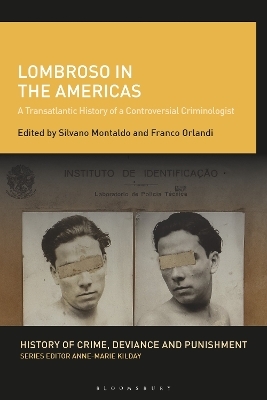
Lombroso in the Americas
Bloomsbury Academic (Verlag)
978-1-350-57121-1 (ISBN)
This volume explores, for the first time, the multifaceted influence and impact of Italian criminologist Cesare Lombroso (1835-1909) in the Americas from the late nineteenth century to the mid-twentieth century.
Through a transatlantic and interdisciplinary lens, Lombroso in the Americas investigates how and why this controversial thinker became the most influential criminologist of his time and a major figure of positivist culture in the American continent.
The volume is divided into four thematic parts. Part one explores the reception and circulation of Lombroso’s theory of atavism and the born criminal in Argentina, Bolivia, Chile, Peru and the USA, highlighting its impact on national cultural debates and criminal justice reforms. Part two examines how his ideas shaped discourses on race and eugenics in Mexico, the USA and Peru in relation to native populations, immigrants, and minority groups such as Italians and Jews. Part three opens up new lines of research in the Lombroso studies, with essays on criminological readings of South American mass culture; the complex relationship between Argentinian anarchism and criminal anthropology; the American photographic collection of the Lombroso Museum; Lombroso’s influence on emerging ethnological interest in Afro-American cultures in Brazil and Cuba. Finally, part four evaluates Lombroso’s enduring legacy in shaping prison and police practices, bio-criminological research as well as gender and racial stereotypes in Cuba, Brazil, the USA and Argentina.#
By charting Lombroso’s influence and impact across North, Central and South America, this volume breaks new ground in the history of criminology. It opens up fresh avenues of inquiry into positivist culture and ideology, and provides rich insight into the transatlantic circulation of his ideas and the development of modern criminology in the Americas.
Silvano Montaldo is Full Professor of Contemporary History and Academic Director of the Cesare Lombroso Museum of Criminal Anthropology at the University of Turin, Italy. Franco Orlandi is a cultural historian and former fellow of the Research Foundation Flanders (FWO), Belgium. He holds a PhD from KU Leuven, Belgium, and the University of Turin, Italy. His research interests centre on the history of criminology, deviance, and the human sciences.
Introduction, Silvano Montaldo and Franco Orlandi (University of Turin, Italy, and KU Leuven, Belgium)
Part I: The Criminal Man in the Americas
1. “Like a Literary Whale”: The First Journeys of Lombrosian Theories in the United States (1870–1895), Silvano Montaldo (University of Turin, Italy)
2. The Long Shadow of Lombroso: A Polyvalent Presence in the Birth of Positivist Criminology in Argentina, Máximo Sozzo (National University of Litoral, Argentina)
3. Criminal Anthropology in Chile: Origin, Trajectory, and Circulations, Marco Antonio León (Universidad del Bío-Bío, Chile)
4. The Impact, Uses and Vicissitudes of Lombroso’s Theories in Bolivia, Francoise Martinez and Pablo Quisbert (Sorbonne Université, France and Sociedad Boliviana de Historia, Bolivia)
5. The Indian as a “Born Criminal”? Lombroso and the Italian School of Positive Anthropology in Peru (1889–1930), Gabriella Chiaramonti (University of Padua, Italy)
Part II: Criminal Anthropology and Racisms
6. How the Median Occipital Fossa Became Aymara, Maria Teresa Milicia (University of Padua, Italy)
7. Prisons, Laboratories, and Museums: Cesare Lombroso and his Presence in Mexico in the Late Nineteenth Century, Laura Cházaro-García and Gerardo García-Rojas (IPN's Centre for Research and Advanced Studies and Cinvestav-IPN, Mexico)
8. Social Sciences, Jewish Public Opinion and the Jewish Race in the United States of the Progressive Era: American Echoes of Cesare Lombroso’s L’antisemitismo 1893–1911, Emanuele D’Antonio (University of Turin, Italy)
9. Imagining Southern Italians as Undesirable Aliens: How North American Social Scientists Adapted, Adopted or Rejected the Views of the “Italian School of Criminology” while Debating Mass Immigration (1890–1924), Alessandra Lorini (University of Florence, Italy)
Part III: Transnational Debates on Art, Prison, Anarchism and Blackness
10. Beautiful Poems and Dirty Literature: Criminological Readings of Mass Culture in South America, Diego Galeano (Pontifical Catholic University of Rio de Janeiro, Brazil)
11. “Exaggerations of the Truth”: Cesare Lombroso, Criminology and Anarchism in Argentina, Martín Albornoz (Universidad de San Martín – Conicet, Argentina)
12. What remains? Finding Losses and Retracing Presences: The Misplaced Photographs by Lewis Hine in the Cesare Lombroso Museum of Criminal Anthropology, Nadia Pugliese (University of Turin, Italy)
13. Raimundo Nina Rodrigues, Aurelino Leal, Cesare Lombroso and the Making of a New Ethnographic Sensibility in Bahia, Brazil (1896–1906), Livio Sansone (Federal University of Bahia, Brazil)
14. Between Social Transgression and Cultural Integration: Following Criminological Traces in the Work of Fernando Ortiz, Mario Valero (The Fashion Institute of Technology (FIT), USA)
Part IV: After Lombroso
15. Israel Castellanos and Lombrosian Criminal Anthropology in Cuba, Franco Orlandi (KU Leuven, Belgium)
16. The Effects of Lombrosian Thought on Daily Life in Brazilian Prisons, Viviane Borges and Fernando Salla (State University of Santa Catarina and Violence Studies Center, Brazil)
17. Lombroso’s Lasting Legacy in the United States: The Criminology of Women, 1910-70, Mary Gibson (City University of New York, USA)
18. Criminal Somatotypes and Ambivalent Lombrosianism in the United States, c. 1940-1960, John Shepherd (Durham University, UK)
19. The Problematic Gravitation of Cesare Lombroso in the Work of José Ingenieros and in the Journal Archives of Psychiatry and Criminology, Alejandra Mailhé (University of La Plata – Conicet, Argentina)
| Erscheinungsdatum | 06.11.2025 |
|---|---|
| Reihe/Serie | History of Crime, Deviance and Punishment |
| Zusatzinfo | 10 bw illus |
| Verlagsort | London |
| Sprache | englisch |
| Maße | 162 x 236 mm |
| Gewicht | 660 g |
| Themenwelt | Geisteswissenschaften ► Geschichte ► Regional- / Ländergeschichte |
| Geschichte ► Teilgebiete der Geschichte ► Militärgeschichte | |
| Recht / Steuern ► Rechtsgeschichte | |
| Recht / Steuern ► Strafrecht ► Kriminologie | |
| ISBN-10 | 1-350-57121-0 / 1350571210 |
| ISBN-13 | 978-1-350-57121-1 / 9781350571211 |
| Zustand | Neuware |
| Informationen gemäß Produktsicherheitsverordnung (GPSR) | |
| Haben Sie eine Frage zum Produkt? |
aus dem Bereich