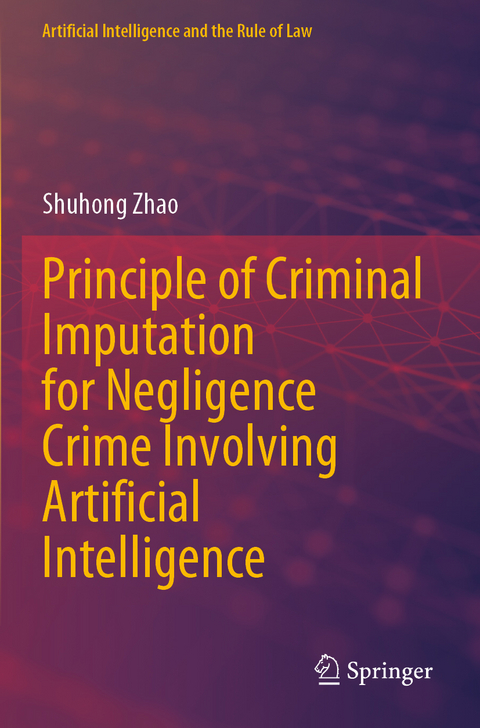
Principle of Criminal Imputation for Negligence Crime Involving Artificial Intelligence
Springer Nature (Verlag)
978-981-97-0724-9 (ISBN)
- Titel nicht im Sortiment
- Artikel merken
This book provides an in-depth discussion of the theoretical and practical issues of criminal imputation for negligence crime involving artificial intelligence. Accordingly, this study combines the imputation challenges brought about by AI with traditional criminal imputation theory and analyses imputation for negligence crime involving AI from three aspects: the basic principles, structure, and results of imputation for negligence crime involving AI. The traditional theory of imputation is discussed in detail. The readership is a group of people interested in this topic, including, in particular, interested laymen, undergraduate students and postgraduate researchers. The highlights of this book are it identifies the imputation challenges bought about by AI, reveals the theoretical and practical gap in the criminal imputation of negligent crimes involving AI, and provides an in-depth and creative ideas of criminal imputation for the negligent crimes involving AI.
Dr Zhao Shuhong is a professor at the College of Criminal Law of Beijing Normal University, China. His research focuses on a wide range of criminal law science, including criminal law, such as corpus delicti and its elements, criminal responsibility, stages of committing a crime, sentencing for serious crimes, and criminology, such as domestic violence and sexual violence. Over the past decade, he has received prestigious research grants, including a grant to study sentencing for serious crimes from the Max Planck Institute for the Study of Crime, Security and Law and the Fritz Thyssen Foundation in Germany. He has published a considerable number of valuable academic articles in various prestigious journals in the field, which have become part of the teaching literature in China.
Preface.- Chapter 1 Challenge of Criminal Imputation for Negligence Crime Involving AI to the Traditional Criminal Imputation Theory.- Chapter 2 Theoretical Preconditions of Criminal Imputation for Negligence Crime Involving AI.- Chapter 3 Imputation System for Negligence Crime Involving AI.- Chapter 4. Main Conclusions and Future Prospects.
| Erscheinungsdatum | 04.04.2025 |
|---|---|
| Reihe/Serie | Artificial Intelligence and the Rule of Law |
| Zusatzinfo | 1 Illustrations, black and white; IX, 115 p. 1 illus. |
| Sprache | englisch |
| Maße | 155 x 235 mm |
| Themenwelt | Recht / Steuern ► Allgemeines / Lexika |
| Recht / Steuern ► EU / Internationales Recht | |
| Recht / Steuern ► Strafrecht | |
| Schlagworte | Admissible Risks under Criminal Law • AI-Related Negligent Crimes • Artificial Intelligence • Criminal Imputation Gap in Crimes involving AI • Criminal Imputation Theory • Criminal Risk caused by AI • Imputation Dilemma for Crimes involving AI • Objective Imputation Theory • Structure of Normative Imputation • Subject of Criminal Responsibility |
| ISBN-10 | 981-97-0724-2 / 9819707242 |
| ISBN-13 | 978-981-97-0724-9 / 9789819707249 |
| Zustand | Neuware |
| Informationen gemäß Produktsicherheitsverordnung (GPSR) | |
| Haben Sie eine Frage zum Produkt? |
aus dem Bereich