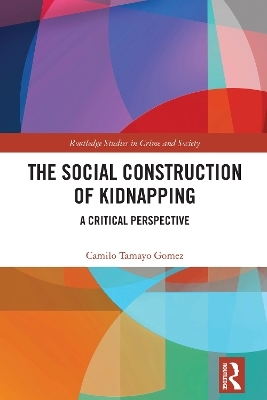
The Social Construction of Kidnapping
Routledge (Verlag)
978-1-032-63323-7 (ISBN)
Kidnapping is a profound violation of human rights that reshapes societies, disrupts governance, and inflicts lasting trauma on individuals and communities. In Colombia, kidnapping became an endemic feature of the armed conflict, leaving tens of thousands of families in a perpetual state of uncertainty and fear. Through an innovative blend of criminology, sociology, transitional justice, surveillance studies, and collective memory epistemologies, this book unpacks kidnapping as a crime of (im)mobility, a strategy of war, and a serious human rights violation. Drawing on fifteen years of research, including statistical analysis, archival work, and interviews with former hostages, ex-combatants, and policymakers, it reveals how kidnapping shaped Colombia’s conflict and its ongoing efforts toward justice, truth, and reconciliation. By exploring its patterns, motivations, and legacies, this book not only sheds light on Colombia’s experience but also contributes to global discussions on transitional justice, collective memory, and the strategies societies adopt to confront mass victimisation.
The Social Construction of Kidnapping is essential reading for scholars and students of criminology, transitional justice, human rights, political violence, and Latin American studies, as well as policymakers, human rights advocates, and anyone seeking a deeper understanding of how societies confront legacies of mass victimisation and forge paths toward accountability and healing.
Camilo Tamayo Gomez is a Senior Lecturer at The University of Huddersfield (UK), a Senior Adviser in Transitional Justice for the United Nations Development Programme (UNDP), and President of the Research Committee on Social Movements, Collective Action and Social Change (RC48) of the International Sociological Association (ISA). Gomez is also the Co-Editor-in-Chief of The International Journal of Transitional Justice (IJTJ).
Introduction. 1. Unpacking kidnapping, a critical approach 2. Dynamics and characterisation of kidnapping in Colombia (1970 – 2024) 3. Political kidnapping and the Colombian armed conflict 4. Analysing mutual surveillance practices during long-term kidnapping situations: the case of jungle kidnapping camps in Colombia 5. From resilience to collective memory: civil society’s responses to the kidnapping phenomenon in Colombia 6. Transitional justice and kidnapping in Colombia: the long road to acknowledgement and recognition 7. Conclusion
| Erscheinungsdatum | 19.07.2025 |
|---|---|
| Reihe/Serie | Routledge Studies in Crime and Society |
| Zusatzinfo | 15 Tables, black and white; 1 Line drawings, black and white; 1 Halftones, black and white; 2 Illustrations, black and white |
| Verlagsort | London |
| Sprache | englisch |
| Maße | 156 x 234 mm |
| Gewicht | 620 g |
| Themenwelt | Recht / Steuern ► EU / Internationales Recht |
| Recht / Steuern ► Strafrecht ► Kriminologie | |
| Sozialwissenschaften ► Ethnologie | |
| Sozialwissenschaften ► Politik / Verwaltung | |
| Sozialwissenschaften ► Soziologie ► Spezielle Soziologien | |
| ISBN-10 | 1-032-63323-9 / 1032633239 |
| ISBN-13 | 978-1-032-63323-7 / 9781032633237 |
| Zustand | Neuware |
| Informationen gemäß Produktsicherheitsverordnung (GPSR) | |
| Haben Sie eine Frage zum Produkt? |
aus dem Bereich