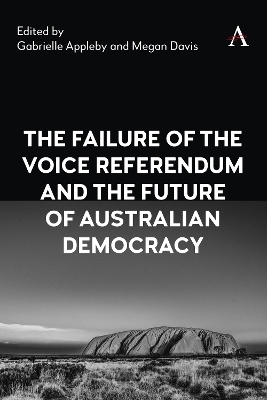
The Failure of the Voice Referendum and the Future of Australian Democracy
Anthem Press (Verlag)
9781839995521 (ISBN)
Australia, and Australians, stood at a crossroads in October 2023. Before them lay a new and more accommodating way to practice democracy, a future in which First Nations people were given a representative voice in political decisions in this country. After months of a referendum campaign, struggling over foundational ideals and questions of national identity, misinformation, disinformation and racism, the proposal was overwhelmingly rejected in every Australian state and nationally. The referendum campaign was Australia’s first since the failed attempt at a republic in 1999. The political and media environment in which the referendum campaign would unfold was fundamentally changed. These changes included the growth of social media, growing distrust of major political parties, and the rise of fake news and populist politics.
This book brings together a diverse set of perspectives to explore the many and complex political, social and historical factors that influenced the conduct of the campaign and led to the loss. It includes contributions from lawyers, political scientists, historians, human rights experts, health policy experts, land rights campaigners and Indigenous affairs policy experts. The contributors in this book include First Nations and non-Indigenous authors, often writing collaboratively. The majority of the views offered, based in expertise and experience, are those of First Nations. Their writings place the referendum loss in the context of political failure and attempts at structural reform, and Australia’s terrible record at amending the Constitution through referendums. The book traces the legal and political development of the draft constitutional provision, and the influence of legal risk on the campaign. A major focus of the book is the impact of misinformation and disinformation, which was rife during the campaign, and media reporting of it. The role that civil society and corporate Australia played in the campaign is considered. The Voice campaign will be placed in the context of Aboriginal and Torres Strait Islander politics and previous attempts at representation. The book will also place the call for Voice in the context of its ongoing relevance and imperative in Aboriginal and Torres Strait Islander affairs, explaining the power of representation, the Voice as an expression of sovereignty, and the need for Voice to pursue other structural reforms such as treaty and to realise the promise of land rights. The book concludes by reflecting on the role that history played in the campaign and the implications of the campaign for the practice of Australian history.
The book holds lessons for future constitutional change, Indigenous recognition, structural reform and Australia’s democracy. It also looks, with constructive pragmatism, at the future direction of First Nations structural reform in Australia and the practice of democracy.
Gabrielle Appleby is a professor of constitutional law at the UNSW Faculty of Law & Justice and is currently a Professorial Research Fellow at the Pro Vice Chancellor Society at UNSW (Sydney). She is the constitutional consultant to the Clerk of the Commonwealth House of Representatives, a Director of the Centre for Public Integrity and was a constitutional advisor to the Regional Dialogues and First Nations Constitutional Convention that delivered the Uluru Statement from the Heart. Megan Davis AC is the Whitlam Fraser Chair at Harvard University and Visiting Professor Harvard Law School (2024–2025) and the Balnaves Chair in Constitutional Law. Megan is a Pro Vice-Chancellor Society at UNSW (Sydney) and a Scientia Professor and Director of the Indigenous Law Centre at UNSW Faculty of Law & Justice. Megan has been the leading constitutional lawyer working on constitutional recognition since 2010. She served on the Prime Minister’s Expert Panel on Constitutional Recognition of Indigenous Australians (2011) and the Prime Minister’s Referendum Council (2015–2017), where she chaired the Indigenous Steering Committee and designed the First Nations Regional Dialogues and the National Constitutional Convention. From 2022 to 2023, Davis served on the Prime Minister’s Referendum Working Group and Referendum Engagement Group and the Attorney General’s Constitutional Expert Group.
Contributors; Foreword; Timeline of Significant Events Leading to the Voice Referendum; The Campaign for the Voice-Gabrielle Appleby and Megan Davis; Political Failure and the Emotions before and after the Referendum-Adrian Little; Referendum Success and Failure after the Voice-Paul Kildea; Section 129: The Legal and Political Dynamics of Constitutional Drafting-Gabrielle Appleby and Megan Davis; Legal Risk and Referendum Campaigns-Scott Stephenson; The Citizens’ Review That Could Have Been-John S. Dryzek, Selen A. Ercan and Ron Levy; What Caused the Failure of Bipartisanship That Led to the Voice Referendum’s Defeat?-Shireen Morris; The Shortsighted Success of Indigenous No Campaigns-Eddie Synot; Misinformation, Disinformation and Electoral Distortion-Lisa Hill, Eden Blazejak and Mahendra Chitrarasu; Misinformation, Disinformation, Balance and the Media-Quentin Dempster; Youth Reflections on the Failed Voice Referendum and the Experience of Misinformation and Disinformation-Allira Davis and Bridget Cama; Civil Society and the Referendum-Andrea Durbach; The Role of Corporates in the Referendum-Yatu Widders Hunt and Nick Harvey-Doyle; Immature Politics: How Australia Failed Aboriginal People and How We Failed Ourselves-Geoffrey Scott; A Lost Opportunity for Gender Equality in Australia: A Reflection on Aboriginal Women, the Right to Self-Determination and the Voice-Megan Davis; Understanding the Voice: Representation as Structural Reform-Sana Nakata and Daniel Bray; Indigenous Sovereignty and the Voice: Structural Reforms to Respect Country-Based Authority-Jason O’Neil; Indigenous Peoples Facing Human Rights Violations and the Necessity of Voice-Hannah McGlade; Native Title, Reform and the Voice-Nolan Hunter; The Hard Work of Treaty and the Necessity of Voice-Jill Gallagher; Truth Listening and the Role of Memory Holders-Narelle Bedford; The Voice Referendum and Competing Claims to History-Shino Konishi; Index
| Erscheinungsdatum | 17.12.2025 |
|---|---|
| Reihe/Serie | Anthem Studies in Australian Politics, Economics and Society |
| Verlagsort | London |
| Sprache | englisch |
| Maße | 153 x 229 mm |
| Themenwelt | Recht / Steuern ► EU / Internationales Recht |
| Recht / Steuern ► Öffentliches Recht | |
| Sozialwissenschaften ► Ethnologie | |
| Sozialwissenschaften ► Politik / Verwaltung ► Staat / Verwaltung | |
| Sozialwissenschaften ► Soziologie | |
| ISBN-13 | 9781839995521 / 9781839995521 |
| Zustand | Neuware |
| Informationen gemäß Produktsicherheitsverordnung (GPSR) | |
| Haben Sie eine Frage zum Produkt? |
aus dem Bereich