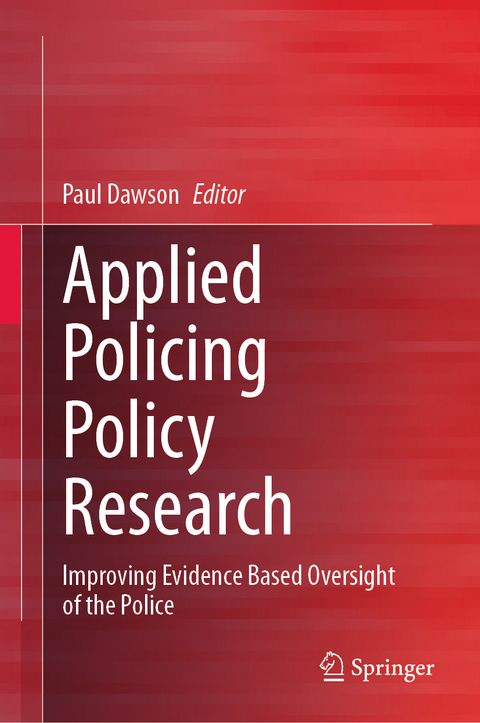
Applied Policing Policy Research
Springer International Publishing (Verlag)
978-3-031-87239-6 (ISBN)
This volume critically examines how the integration of evidence-based research within police governance reshapes accountability, decision-making, and policy development. Focusing on the transition of a well-established police research unit from the Metropolitan Police Service to the London Police and Crime Commissioner s office in 2014, the book explores the broader implications of this move for data-driven oversight and police practice.
Bringing together contributions from experts directly involved in this transition, the chapters combine original research, case studies, and applied analysis to demonstrate how evidence informs policing at both strategic and operational levels. The book introduces the concept of "evidence-based oversight," offering a new framework for understanding the evolving role of research in shaping police governance and accountability structures.
With insights for PCC staff, police professionals, policymakers, and scholars, this volume provides a critical perspective on how empirical research can enhance policing practices, drive reform, and strengthen oversight mechanisms within criminal justice systems.
Dr Paul Dawson is Head of Evidence and Insight in the Mayor s Office for Policing And Crime in London. This team holds a unique position within crime and justice analytics in England & Wales, spanning performance insights, data visualisation, public voice, social research, evaluation, and data science functions all to support MOPAC discharge its statutory responsibility of overseeing the London Metropolitan Police Service. From 2008 to 2014 he was Research Manager within the Metropolitan Police Service. During this time, he co-authored the book: Police Use of Research Evidence: Recommendations for Improvement alongside Professor Betsy Stanko. Between 2003 and 2008 he was a researcher in the UK Home Office where projects included leading the research for the Tackling Gangs Action Programme, and the evaluation of the Prolific and other Priority Offenders scheme. Between 2000 and 2003 he held two roles within the National Health Service working in secure forensic psychiatric units therapeutically with mentally disordered of-fenders as well as conducting national surveys. He holds a PhD in Psychology from the University of Birmingham investigating the empirical contribution of weapon-use within the analysis of serious sexual offending and is an Honorary Senior Research Fellow at the University College London Department of Security and Crime Science.
Chapter 1. An Introduction.- Chapter 2. The History of the PCC Office and New Opportunities for Evidence .- Chapter 3. Supporting PCCs and their Offices to Engage with Data the Role of the Association of Police and Crime Commissioners.- Chapter 4. A transition From Evidence-Based Policing Towards Something New.- Chapter 5. Measuring the Things That Matter the Power of Performance.- Chapter 6. Charting the Growth of Evidence-Based Over-sight From Policing Plans to Public Scrutiny .- Chapter 7. Hiding in Plain Sight The Systematic Coding of Police Data and Insights into Vulnerability.- Chapter 8. Systems Under Scrutiny: The Role of Evidence and Advocacy in Driving Change for Victims.- Chapter 9. MOPAC s Tools to Capture the Voice of Londoners.- Chapter 10. Trust and Confidence: Learning (and Lessons) from London.- Chapter 11. Exploring the Decline in Victim Satisfaction Within London Analytics to Oversight .- Chapter 12. Embedding and Stretching a Systematic Approach to Evaluation in the PCC and Beyond.- Chapter 13. Evaluating Technological Innovation Through the Alcohol Abstinence Monitoring Requirement: From Local Proof of Concept Pilot to National Rollout.- Chapter 14. Implementation Continued Evaluating the Lighthouse, the Largest CSA/E Service in the UK.- Chapter 15. Innovation in Impact Evaluation Devising a Novel Quasi-Experimental Approach to Understanding the Impact of the London Gangs Matrix .- Chapter 16. Police Research Inside/Outside the Academy: The Institute for Global City Policing .- Chapter 17. Infusing Cutting-edge Computing Algorithms with Crime Data for Policy Evidence through Partnership with King s College London.- Chapter 18. The Collaborative Path to Evidence-Based Policing.- Chapter 19. Cost of Living and Crime in London: Lessons from an Empirical and Collaborative Study.- Chapter 20. Final Thoughts.
| Erscheinungsdatum | 11.06.2025 |
|---|---|
| Zusatzinfo | XXIII, 275 p. 20 illus., 18 illus. in color. |
| Verlagsort | Cham |
| Sprache | englisch |
| Maße | 155 x 235 mm |
| Themenwelt | Recht / Steuern ► Strafrecht ► Kriminologie |
| Schlagworte | Evaluation • evidence based policing • evidence based policy • police learning • Translational Criminology |
| ISBN-10 | 3-031-87239-8 / 3031872398 |
| ISBN-13 | 978-3-031-87239-6 / 9783031872396 |
| Zustand | Neuware |
| Informationen gemäß Produktsicherheitsverordnung (GPSR) | |
| Haben Sie eine Frage zum Produkt? |
aus dem Bereich