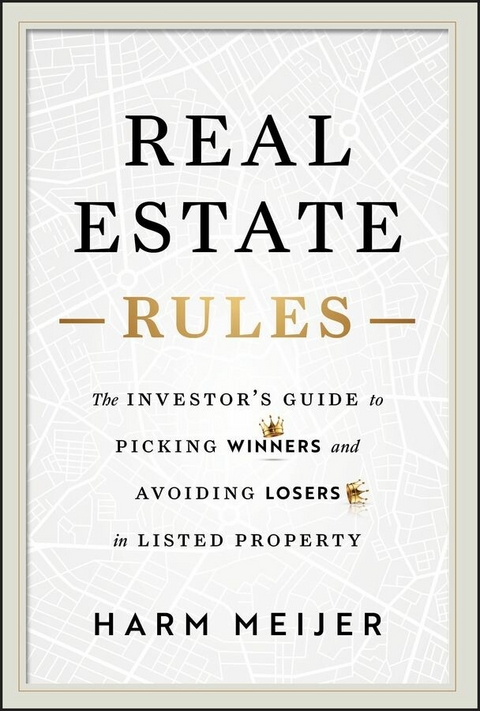
Real Estate Rules (eBook)
310 Seiten
Wiley (Verlag)
978-1-394-32486-6 (ISBN)
The incisive guide of how to effectively invest in real estate and REITs
In Real Estate Rules: The Investor's Guide to Picking Winners, Avoiding Losers in Listed Property, celebrated real estate investor Harm Meijer delivers a startlingly insightful and eye-opening roadmap to successful property investment. This book explains the golden rules of investing in European real estate companies, including Real Estate Investment Trusts (REITs). It's full of real-world examples and anecdotes drawn from the author's long and storied career in the industry.
Real Estate Rules contains:
- Robust tools for making informed investment decisions and staying clear of the 'vicious downward spiral of doom'
- Understanding market cycles and mastering the art of acting contrarian during downturns to maximize your investment
- How macro drivers, central bank moves and government stimuli can be game changers for real estate markets
- Techniques for assessing the management's value creation and its alignment with shareholders
- Insights to ensure a solid capital structure and avoid leverage traps in downturns
- Advice on how to navigate the European stock markets with its unique challenges for Real Estate Investment Trusts
- Real-world case studies illustrating these principles in action, highlighting key lessons for investors
You'll also learn why acting on conviction, thorough research, strong relationships, and most importantly, trust are key to achieving lasting success.
Perfect for Real Estate Investment Trust investors, people interested in investing directly in individual properties, and other market participants, Real Estate Rules is also a must-read for anyone involved in the real estate industry looking for an insightful investor perspective on the sector.
HARM MEIJER is a Founding Partner of the real estate fund manager ICAMAP, with a strong track record in listed real estate. Before ICAMAP, he worked as a real estate analyst at JP Morgan, during which time he was ranked number one six times by Institutional Investor and five times by Extel. He has also held board memberships, contributed to EPRA, and is a frequent industry speaker.
The incisive guide of how to effectively invest in real estate and REITs In Real Estate Rules: The Investor's Guide to Picking Winners, Avoiding Losers in Listed Property, celebrated real estate investor Harm Meijer delivers a startlingly insightful and eye-opening roadmap to successful property investment. This book explains the golden rules of investing in European real estate companies, including Real Estate Investment Trusts (REITs). It's full of real-world examples and anecdotes drawn from the author's long and storied career in the industry. Real Estate Rules contains: Robust tools for making informed investment decisions and staying clear of the "e;vicious downward spiral of doom"e; Understanding market cycles and mastering the art of acting contrarian during downturns to maximize your investment How macro drivers, central bank moves and government stimuli can be game changers for real estate markets Techniques for assessing the management's value creation and its alignment with shareholders Insights to ensure a solid capital structure and avoid leverage traps in downturns Advice on how to navigate the European stock markets with its unique challenges for Real Estate Investment Trusts Real-world case studies illustrating these principles in action, highlighting key lessons for investors You'll also learn why acting on conviction, thorough research, strong relationships, and most importantly, trust are key to achieving lasting success. Perfect for Real Estate Investment Trust investors, people interested in investing directly in individual properties, and other market participants, Real Estate Rules is also a must-read for anyone involved in the real estate industry looking for an insightful investor perspective on the sector.
Introduction – A Sector Not To Be Ignored
Real Estate Is an Important Asset Class
$380 Trillion Market
Real estate is an important investment class as it provides for both living and economic activity. Besides, it is the largest investment class globally, surpassing publicly traded equities and debt securities, with values of $380 trillion, $99 trillion and $130 trillion, respectively. According to Savills (Figure I.1), residential real estate accounts for the majority of this global value at $288 trillion (76%), followed by commercial real estate at $51 trillion (13%) and agricultural land at $41 trillion (11%). Based on the global GDP in 2022 of $101 trillion, this total value equates to 3.8× GDP. Europe makes up about 20–25% of the global real estate market, with the largest markets being Germany ($17 trillion, 4% of global), the UK ($12 trillion, 3%) and France ($11 trillion, 3%).
Figure I.1 Total value of global real estate in 2022
Source: Adapted from Savills (2023) ‘Global real estate universe in comparison, 2022’. https://www.savills.com/impacts/market-trends/the-total-value-of-global-real-estate-property-remains-the-worlds-biggest-store-of-wealth.html.
Wide Range of Investors
Approximately 26% of European commercial property is held as an investment (see Figure I.2), while 74% is in the hands of owner‐occupiers. The largest investors are non‐listed funds, holding 35% of the market, followed by other professional investors, such as high net worth individuals and alternative investment managers, with 30%, and listed property companies with 19%. Listed companies are real estate vehicles that are publicly traded on a stock exchange. Most of them have the real estate investment trust (REIT) status, which generally means they pay no tax on rental profit and capital gains but must distribute the majority of their recurring earnings as dividends, on which tax is due. Institutional investors account for approximately 8% of the investment in European real estate, though they also hold significant amounts in non‐listed and listed vehicles. This is similar for non‐EU institutions and sovereign wealth funds, estimated at 7%, but in reality, their share, including their stakes in vehicles, is much higher. Indeed, global investment has increasingly become an important source of capital in the European real estate market.
Figure I.2 Commercial real estate holdings by investor type in 2023 – EU and UK
*HNW – high net worth individuals; AIM – Alternative Investment Managers.
Source: RHL Strategic Solutions estimates using data from Eurostat, ECB, EPRA, INREV, OECD, ONS and MSCI, 2023.
Attractive Long‐Term Returns
Investors in property benefit from rental income and changes in the building's value over time. The sector has provided superior returns. For example, over the period from 2001 to 2023 (the longest period for which INREV1 direct fund data are available), listed real estate companies performed best with an annual return of 5.8%, followed by direct real estate funds with 4.8%, equities with 4.6% and bonds with 3.3% (Figure I.3).
In the long term, real estate stocks, i.e. listed property companies, have delivered between 9% and 10% per annum, which is an excellent return for the asset class compared to alternatives. For instance, a real estate index for listed UK property stocks has generated an annualised return of 9.7% since 1965. Its 50‐year moving average has been between 8% and 12% (Figure I.4).
Figure I.3 Annualised total return, Europe, 2001–2023
Notes: Listed Real Estate represented by EPRA Europe Index; Direct Property represented by INREV Index; Stocks represented by STOXX Europe 600 Index; Bonds represented by the Bloomberg Europe Aggregate Index.
Source: Data from Factset, except for INREV data: https://www.inrev.org/market‐information/indices/inrev‐index#Latestpublications.
Real Estate Enhances the Risk/Return Profile of Investment Portfolios
There is no debate: the addition of real estate improves the risk/reward profile of investment portfolios compared to equities, bonds and other alternative investments. However, there is more discussion about the exact allocation. Whilst research continuously shows that the optimal portion of real estate in an investment portfolio is between circa 9% (e.g. Kallberg and Liu, 1996)2 and 15–20% (e.g. Amédée‐Manesme et al., 2019),3 in reality the allocation of institutional investors tends to be on the low side of this range at around 7–10%. For example, McKinsey found target allocations for institutional investors ranged 9–10% between 2011 and 2015.4 Based on my experience and the cyclical nature of the asset class, I believe an average allocation of circa 15% is ideal with a range of 10–20% depending on the stage of the cycle. Given real estate's illiquid and rather opaque features (see next section), I recommend allocating circa half of the real estate portion to listed real estate companies or REITs.
Figure I.4 UK Listed Property Index, annual total return – 50‐year rolling
Source: Author's estimates based on historical stock statistics and EPRA.
Two Undesirable Features of Real Estate
However, there are two undesirable features of investing in real estate: it is illiquid and opaque.
Illiquid
The biggest issue is that real estate itself is an illiquid investment. It takes time to buy or sell a property. Potential buyer pools can be significantly smaller for larger assets or during downturns when liquidity can dry up completely. Additionally, there is a risk of buying an asset that turns out to be a poor investment, e.g. due to changing tenant demand, in which case repositioning the property could be extremely costly. As Evert Jan van Garderen, CEO of Eurocommercial Properties, said to me: ‘It is not difficult to buy a property, but to sell it is’.
Opaque
Although sector transparency has increased over the years, real estate is an opaque asset class, e.g. in terms of pricing, valuation, ownership and actors in the space. Real estate markets frequently depend greatly on local knowledge and insider information.
Gladly, there are ways to invest in the space with increased liquidity and transparency.
Listed Real Estate Has Attractive Features
There are different ways to invest in real estate: directly, through a fund structure or via other methods such as a club‐deal or joint venture, but we will focus on the first two. The most common types of funds are closed‐ended non‐listed, closed‐ended listed and open‐ended non‐listed funds.
Non‐listed closed‐ended funds are not listed on a stock exchange and have a fixed maturity date, typically around 10 years. Although participations can sometimes be traded on the secondary market, this is usually at a significant valuation discount. Listed closed‐ended funds or REITs are traded on a stock exchange and have a perpetual structure, meaning the fund has no set end date. Non‐listed open‐ended funds are not listed on a stock exchange and aim to provide liquidity to investors by maintaining a cash reserve or disposing of assets for redemptions.
Table I.1 displays my assessment of investing in real estate directly or via one of these fund structures. Every structure has its pros and cons, but in my view, listed real estate has the most attractive characteristics, although it is not perfect. Careful analysis of assets, the balance sheet and management is essential for every investment vehicle.
Table I.1 Investor considerations (score 1 to 3 with 3 being best)
| Investor Considerations (Score 1 to 3 with 3 Best) |
| Direct | Closed‐ended (non‐listed) | Closed‐ended (listed) | Open‐ended |
| Portfolio diversification | 1 | 2 | 3 | 2 |
| Liquidity | 2 | 1 | 3 | 1.5 |
| Return volatility | 3 | 3 | 1 | 2 |
| ESG | 1 | 2 | 3 | 2 |
| Financing | 1 | 2 | 3 | 2 |
| Management intensity | 1 | 3 | 3 | 3 |
| Alignment management –... |
| Erscheint lt. Verlag | 10.2.2025 |
|---|---|
| Sprache | englisch |
| Themenwelt | Recht / Steuern ► Wirtschaftsrecht |
| Wirtschaft ► Betriebswirtschaft / Management | |
| Schlagworte | Commercial Real Estate • European Real estate • European real estate investing • European real estate investment • listed property investing • listed property investment • real estate investing • Real Estate Investment • Real Estate Investment Trust • Reit |
| ISBN-10 | 1-394-32486-3 / 1394324863 |
| ISBN-13 | 978-1-394-32486-6 / 9781394324866 |
| Informationen gemäß Produktsicherheitsverordnung (GPSR) | |
| Haben Sie eine Frage zum Produkt? |
 EPUB (Adobe DRM)
Kopierschutz: Adobe-DRM
Adobe-DRM ist ein Kopierschutz, der das eBook vor Mißbrauch schützen soll. Dabei wird das eBook bereits beim Download auf Ihre persönliche Adobe-ID autorisiert. Lesen können Sie das eBook dann nur auf den Geräten, welche ebenfalls auf Ihre Adobe-ID registriert sind.
Details zum Adobe-DRM
Dateiformat: EPUB (Electronic Publication)
EPUB ist ein offener Standard für eBooks und eignet sich besonders zur Darstellung von Belletristik und Sachbüchern. Der Fließtext wird dynamisch an die Display- und Schriftgröße angepasst. Auch für mobile Lesegeräte ist EPUB daher gut geeignet.
Systemvoraussetzungen:
PC/Mac: Mit einem PC oder Mac können Sie dieses eBook lesen. Sie benötigen eine
eReader: Dieses eBook kann mit (fast) allen eBook-Readern gelesen werden. Mit dem amazon-Kindle ist es aber nicht kompatibel.
Smartphone/Tablet: Egal ob Apple oder Android, dieses eBook können Sie lesen. Sie benötigen eine
Geräteliste und zusätzliche Hinweise
Buying eBooks from abroad
For tax law reasons we can sell eBooks just within Germany and Switzerland. Regrettably we cannot fulfill eBook-orders from other countries.
aus dem Bereich