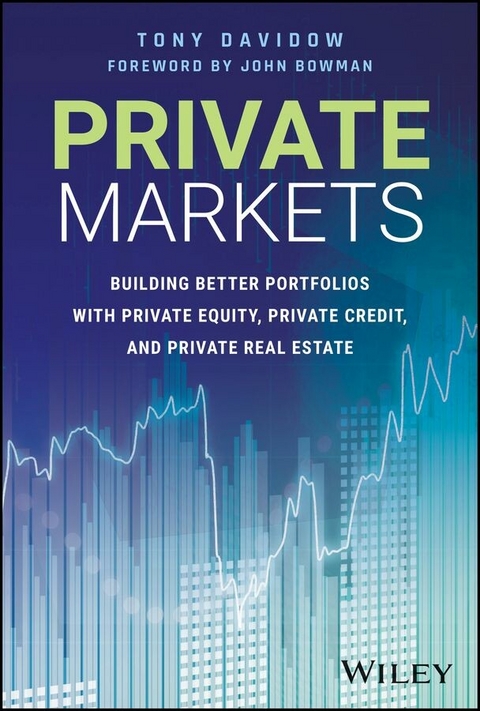
Private Markets (eBook)
305 Seiten
Wiley (Verlag)
978-1-394-31310-5 (ISBN)
Comprehensive guide to the private market, covering allocating capital, portfolio construction, product evolution, and more
Written in accessible language, Private Markets: Building Better Portfolios with Private Equity, Private Credit, and Private Real Estate addresses the challenges and opportunities with investing in the private markets, including understanding the merits of the asset classes-private equity, private credit, and private real estate-product evolution, and the structural tradeoffs, and how to incorporate these versatile and valuable tools in client portfolios.
This book leverages Tony Davidow's 40 years of experience working directly with advisors and high-net-worth families/ ultra-high-net-worth families. Davidow is an award-winning author and has also been recognized for building Franklin Templeton's alternative education program (2023 recipient of the 'Wealthie'). Topics discussed in this book include:
- How private markets can be used to increase the likelihood of achieving client goals?
- Examining the historical risk and return characteristics of the private markets relative to their public market equivalents.
- Exploring the benefits of private markets including the potential for higher returns, an alternative source of income, diversification, and hedging against the impact of inflation.
Now that private markets are available to a broader group of investors outside of institutions and family offices, Private Markets: Building Better Portfolios with Private Equity, Private Credit, and Private Real Estate is an essential resource for all financial advisors and individual investors who are considering allocating capital to these once elusive investments.
TONY DAVIDOW is a Senior Alternative Investment Strategist for the Franklin Templeton Institute, the research arm of Franklin Templeton. He's the host of the Alternative Allocations podcast series and he has over 35 years' experience in the financial services industry. Davidow is the author of Goals-Based Investing: A Visionary Framework for Wealth Management.
Comprehensive guide to the private market, covering allocating capital, portfolio construction, product evolution, and more Written in accessible language, Private Markets: Building Better Portfolios with Private Equity, Private Credit, and Private Real Estate addresses the challenges and opportunities with investing in the private markets, including understanding the merits of the asset classes private equity, private credit, and private real estate product evolution, and the structural tradeoffs, and how to incorporate these versatile and valuable tools in client portfolios. This book leverages Tony Davidow's 40 years of experience working directly with advisors and high-net-worth families/ ultra-high-net-worth families. Davidow is an award-winning author and has also been recognized for building Franklin Templeton's alternative education program (2023 recipient of the Wealthie ). Topics discussed in this book include: How private markets can be used to increase the likelihood of achieving client goals? Examining the historical risk and return characteristics of the private markets relative to their public market equivalents. Exploring the benefits of private markets including the potential for higher returns, an alternative source of income, diversification, and hedging against the impact of inflation. Now that private markets are available to a broader group of investors outside of institutions and family offices, Private Markets: Building Better Portfolios with Private Equity, Private Credit, and Private Real Estate is an essential resource for all financial advisors and individual investors who are considering allocating capital to these once elusive investments.
Introduction
Private Markets: Building Better Portfolios with Private Equity, Private Credit, and Private Real Estate.
“If a man empties his purse into his head, no man can take it away from him. An investment in knowledge always pays the best interest.”
—Benjamin Franklin
I began my career working for a New York–based family office. It was an incredible learning experience and shaped the way that I think about investing. Working with internal and external advisors, we allocated capital for the various family members, charitable foundations, and trusts set up for the children and grandchildren. The family made significant investments in private equity and private real estate – although terms like family offices and private equity had not been defined yet.
We invested in startup companies (private equity) in the hopes that their innovative technology, product, or service would become wildly successful, and the family would reap the benefits when the company went public or was acquired by a larger competitor. We understood that not all the investments would pan out, but the winners would more than offset the losers. And we understood that the returns would likely be much higher than those achieved in the stock market.
We were also big investors in real estate. We recognized the long‐term value of owning office buildings, industrial warehouses, hotels, and other commercial properties. The family knew that we could achieve significant growth and income from these investments over time. Real estate represented a big part of the family's portfolio.
The family also had significant art, ownership in a horse‐racing stable, and other long‐term investments. We were truly patient investors, willing to allocate capital for a decade or more if we believed that we would be compensated for our patience.
Later in my career, I moved to Morgan Stanley, where I built and managed the firm's Institutional Consulting business, helping pension plans, public funds, endowments, and foundations in allocating capital. These institutions were focused on achieving goals and outcomes – meeting pension liabilities, funding charities, and making grants. They knew that private markets could help them in generating higher returns, providing an alternative source of income and dampening portfolio volatility.
I was later charged with building and integrating a multifamily office that the firm had recently acquired with an expertise in alternative investments (Graystone) into our Private Wealth Management (PWM) division. Graystone's primary differentiation was conducting due diligence and providing access to third‐party alternative investments, thus the acquisition provided the “open architecture” our clients demanded. PWM was focused on ultra‐high‐net‐worth (UHNW) families ($20 million or more in investable assets), and those clients expected to get access to private markets. Many of the families that I worked directly with had $100 million or more in investable capital; several had $1 billion or more.
PWM clients were often entrepreneurs who recently sold their business or were handsomely rewarded by bringing their company public via an initial public offering (IPO). They understood the value of taking risks and often had 30–50% allocations to alternative investments. Part of the reason they selected Morgan Stanley was our expertise and depth in alternatives.
While at PWM, I was also a member of the firm's Client Strategy Group, a group of elite resources designed to help the firm's largest clients, many of whom were investment banking clients. I was the Asset Allocation and Alternative Investment Strategist and worked directly with dozens of founders and senior executives in allocating capital.
Since many of the founders made their wealth from private companies, they were very comfortable in allocating to private equity and understood the value and freedom of not having to answer to shareholders and meet quarterly demands. They could manage their companies and focus on achieving long‐term goals. Many of these successful founders would go on to start other private companies.
My last role at Morgan Stanley was running sales and training for the Consulting Services Group, supporting the institutional, private wealth, and retail investor channels. At that point in time, the retail investor had no direct access to private markets due to the accredited investor standards and high minimums. The first generation of private markets products were structured as limited partnerships and were only available to qualified purchasers ($5 million or more of investable assets excluding their home) at high minimums (typically $5 million).
Based on my experience working with UHNW families, I was charged with teaching advisors about the nuances of working with wealthy families and leveraging firm resources to solve their needs. However, there were big differences between the client segments, including the depth and breadth of resources, the menu of investment options, and some of the unique complexities of wealth (taxes, trust and estate issues, charitable giving, dealing with concentrated positions, etc.).
Inspired by my time working with founders and feeling that entrepreneurial bug, I left Morgan Stanley to join a startup firm in 2008. I learned very quickly that the success and failure of many startups is as much about the people as the product. You need partners with a singular focus and an alignment of values and vision.
The startup had private equity backing, with a seat on the board and active participation in making introductions, leveraging their network, and scrutinizing our results. They had a vested interest in our success and wanted to see a return on their investment. The company was eventually sold to a large asset manager, providing a healthy return for the founders, private equity firm, and its investors – a couple of whom I brought in.
Based on my experiences, I see the opportunities in private markets through several lenses. Having a front‐row seat during my years working at a family office, I see the opportunity to generate superior returns by allocating capital to the private markets versus the public markets. Working with dozens of founders and senior executives, I see the advantages of managing a private company and the ability to execute their long‐term strategy. Working for a private‐equity‐backed startup, I see the value of private equity firms in providing capital, guidance, and discipline to achieve the company's potential.
MY CURRENT ROLE
In my current role, as senior alternative investment strategist for the Franklin Templeton Institute, I provide independent research and analysis designed to help advisors make better‐informed decisions about allocating to alternative investments. I write white papers and blogs, speak at client events and conferences, conduct webinars, and host a podcast series. While the firm has a broad array of products, my role is to help advisors, so I never discuss our products to maintain my independence.
In my travels, it has become abundantly clear that there is a need for a book like Private Markets: Building Better Portfolios with Private Equity, Private Credit, and Private Real Estate. Advisors are seeking guidance on how to use these once‐elusive investments. They don't need a product push – they need someone to walk through the merits of the asset classes and the features and benefits of the various structures. They need help in their portfolio construction process and incorporating private markets across their practices. Advisors also need help in discussing these issues with their clients.
Private Markets is designed to address these challenges in one place. It provides the historical data of the various asset classes, which is difficult for advisors to source. It shares industry research regarding advisor adoption, challenges and opportunities, and how the industry is adapting. In this book, I discuss how the industry has evolved over the last several years and speculate how it will continue to evolve to meet the demands of the wealth management channel.
Increasingly, advisors will ask me to meet with their clients to discuss the merits of private markets. They are often looking for that objective voice to reinforce their positioning. This book will benefit investors as well. I have tried to use examples and case studies to make things more relatable. Ultimately, we want investors to understand and feel comfortable in allocating capital to the private markets, especially because these investments are long‐term in nature.
PRIVATE MARKETS
In this book, I will attempt to demystify these elusive investments and use case studies to help readers understand how to use these tools effectively. I will focus on the opportunities and risks in a fair and balanced fashion. I will try and avoid industry jargon and break down these concepts in a plain‐speak manner.
The book can be divided into four parts. The first part of the book describes private markets and the current environment (Chapters 1 and 2). The second part of the book breaks down the private market's opportunities and investment merits (Chapters 3–7). The third part of the book focuses on portfolio construction (Chapters 8 and 9), and in the last part, I peer into the future considering where we will be in the next decade...
| Erscheint lt. Verlag | 4.2.2025 |
|---|---|
| Sprache | englisch |
| Themenwelt | Recht / Steuern ► Wirtschaftsrecht |
| Wirtschaft ► Betriebswirtschaft / Management | |
| Schlagworte | alternative allocations • Asset Allocation • Commercial Real Estate • drawdown funds • financial advisor • franklin templeton • high net worth investors • interval funds • Portfolio Construction • private credit • Private Equity • private markets • real estate investing • registered funds • tender offer funds |
| ISBN-10 | 1-394-31310-1 / 1394313101 |
| ISBN-13 | 978-1-394-31310-5 / 9781394313105 |
| Informationen gemäß Produktsicherheitsverordnung (GPSR) | |
| Haben Sie eine Frage zum Produkt? |
 EPUB (Adobe DRM)
Kopierschutz: Adobe-DRM
Adobe-DRM ist ein Kopierschutz, der das eBook vor Mißbrauch schützen soll. Dabei wird das eBook bereits beim Download auf Ihre persönliche Adobe-ID autorisiert. Lesen können Sie das eBook dann nur auf den Geräten, welche ebenfalls auf Ihre Adobe-ID registriert sind.
Details zum Adobe-DRM
Dateiformat: EPUB (Electronic Publication)
EPUB ist ein offener Standard für eBooks und eignet sich besonders zur Darstellung von Belletristik und Sachbüchern. Der Fließtext wird dynamisch an die Display- und Schriftgröße angepasst. Auch für mobile Lesegeräte ist EPUB daher gut geeignet.
Systemvoraussetzungen:
PC/Mac: Mit einem PC oder Mac können Sie dieses eBook lesen. Sie benötigen eine
eReader: Dieses eBook kann mit (fast) allen eBook-Readern gelesen werden. Mit dem amazon-Kindle ist es aber nicht kompatibel.
Smartphone/Tablet: Egal ob Apple oder Android, dieses eBook können Sie lesen. Sie benötigen eine
Geräteliste und zusätzliche Hinweise
Buying eBooks from abroad
For tax law reasons we can sell eBooks just within Germany and Switzerland. Regrettably we cannot fulfill eBook-orders from other countries.
aus dem Bereich