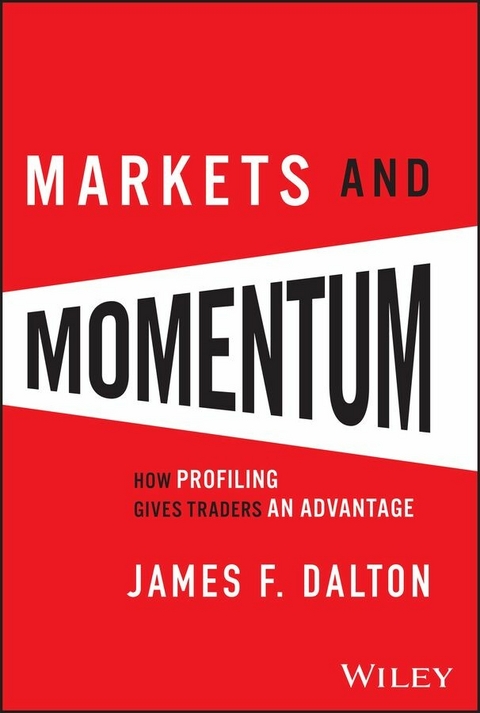
Markets and Momentum (eBook)
281 Seiten
Wiley (Verlag)
978-1-394-31881-0 (ISBN)
Elevate your trading strategy with actionable market insights from an industry pioneer
In Markets & Momentum: How Profiling Gives Traders an Advantage, James F. Dalton and co-author Robert B. Dalton dramatically expand on their revolutionary first book, Markets in Profile. Summarizing a lifetime of experience-from formative memberships on the CBOE and CBOT to his role as UBS Director of Hedge Fund Research-Jim challenges traders to recognize that market-understanding must be balanced with self-understanding. Jim's deep market savvy is complimented by Rob's engaging prose that adds a wealth of insight about the powerful influence of unexamined emotions, impulses, and habits on your trading success.
Jim promotes trader education through Jim Dalton Trading (jimdaltontrading.com), along with his partners Jennifer Loh and Raghu Rajput, driven by the knowledge that the only reliable, objective, actionable information is market-generated. This information is scientifically organized via the Market Profile, which is simply a contextual organization of time, price, and volume-the core components of any financial transaction.
Markets & Momentum offers:
- Deep dives into issues that lead more than 90% of day traders to lose money, including fading trend days, FOMO, doubling down on losing trades, and failing to let profits run.
- Strategies for minimizing the influence of news hype and analysis overload in order to remain focused on the only information that matters.
- Techniques for understanding your own emotional and intuitive reactions, and learning to avoid making impulsive decisions.
This book is ideal for day and short-term traders, and for longer-term investors seeking to improve trade entries and exits. Jim Dalton's trading insights are supported by six decades of learning directly from the markets, as well as from his wide base of educational clients.
Markets & Momentum is a must-read for traders looking for guidance on developing the insights and skills necessary for conquering the short-term market.
JAMES F. DALTON is a trading pioneer. He has four decades' experience at the intersection of markets and human behavior. He is a former Senior Executive Vice President of the Chicago Board Options Exchange and former Director of Hedge Fund Research for UBS Financial Services. He is also the author of Mind Over Markets and Markets in Profile and the founder of Jim Dalton Trading.
Elevate your trading strategy with actionable market insights from an industry pioneer In Markets & Momentum: How Profiling Gives Traders an Advantage, James F. Dalton and co-author Robert B. Dalton dramatically expand on their revolutionary first book, Markets in Profile. Summarizing a lifetime of experience from formative memberships on the CBOE and CBOT to his role as UBS Director of Hedge Fund Research Jim challenges traders to recognize that market-understanding must be balanced with self-understanding. Jim s deep market savvy is complimented by Rob s engaging prose that adds a wealth of insight about the powerful influence of unexamined emotions, impulses, and habits on your trading success. Jim promotes trader education through Jim Dalton Trading (jimdaltontrading.com), along with his partners Jennifer Loh and Raghu Rajput, driven by the knowledge that the only reliable, objective, actionable information is market-generated. This information is scientifically organized via the Market Profile, which is simply a contextual organization of time, price, and volume the core components of any financial transaction. Markets & Momentum offers: Deep dives into issues that lead more than 90% of day traders to lose money, including fading trend days, FOMO, doubling down on losing trades, and failing to let profits run. Strategies for minimizing the influence of news hype and analysis overload in order to remain focused on the only information that matters. Techniques for understanding your own emotional and intuitive reactions, and learning to avoid making impulsive decisions. This book is ideal for day and short-term traders, and for longer-term investors seeking to improve trade entries and exits. Jim Dalton s trading insights are supported by six decades of learning directly from the markets, as well as from his wide base of educational clients. Markets & Momentum is a must-read for traders looking for guidance on developing the insights and skills necessary for conquering the short-term market.
INTRODUCTION
Over the years, I have purchased multiple copies of Shel Silverstein's timeless book, Where the Sidewalk Ends. The poem below is one of my favorites.
“Hector the Collector”
Hector the Collector
Collected bits of string,
Collected dolls with broken heads
And rusty bells that would not ring. Bent-up nails and ice-cream sticks,
Twists of wires, worn-out tires,
Paper bags and broken bricks.
Old chipped vases, half shoelaces,
Gatlin' guns that wouldn't shoot,
Leaky boats that wouldn't float
And stopped-up horns that wouldn't toot. Butter knives that had no handles,
Copper keys that fit no locks
Rings that were too small for fingers,
Dried-up leaves and patched-up socks.
Worn-out belts that had no buckles,
‘Lectric trains that had no tracks,
Airplane models, broken bottles,
Three-legged chairs and cups with cracks.
Hector the Collector
Loved these things with all his soul –
Loved them more then shining diamonds,
Loved them more then glistenin' gold.
Hector called to all the people,
“Come and share my treasure trunk!”
And all the silly sightless people
Came and looked … and called it junk.
BRIEF BACKGROUND ON THE AUTHOR
In 1972, I held memberships on both the Chicago Board of Trade (CBOT) and the Chicago Board Options Exchange (CBOE). You could say Hector was active in this chapter of my trading career.
Hector was sidelined a few years later when I became Senior Executive Vice President of the CBOE during its formative years. But after I left the exchange in 1979, he became active again.
It wasn't until the late 1980s that I attempted to shut down Hector once and for all when I collaborated with Eric Jones and my son, Rob Dalton, on my first book, Mind Over Markets; I stopped collecting every indicator and signal available.
As I read more and more about human behavior, neuroscience, and trading psychology, it became increasingly clear to me that “less is more” – successful trading is about leveraging the right information, not the most information.
When I became manager of a UBS institutional options trading desk, I began to systematically remove from our quote equipment many of the studies and indicators I had previously accumulated, just like Hector. After some initial pushback, we established a powerful trading desk, and many of my traders went on to enjoy notable careers.
The final confirmation of my anti-Hector philosophy emerged from Josh Waitzkin's book, The Art of Learning. Waitzkin was an international chess champion who also achieved fame in the martial arts, and one of his primary tenets was simple: “Depth beats breadth every time.” (More on Waitzkin in the “Reading List” in Appendix B.)
In my last incarnation at UBS Financial Services as Director of Hedge Fund Research, I discovered that interacting with multiple hedge funds solidified the “depth beats breadth” observation, changing my trading philosophy forever.
In 2017, I founded Jim Dalton Trading (jimdaltontrading.com), dedicated to advanced trading, mentoring, and education with my partners Jennifer Loh and Raghu Rajput (RJ). Our immersive trading courses and mentoring programs are widely recognized for their breadth and depth. Numerous experienced traders have credited our courses for propelling them to new levels, providing them with a competitive edge by honing their instinct for what motivates their competition, and what drives ever-changing markets. We focus on teaching traders how to cut through the noise – not with magical theories, but by applying a potent combination of observation and practical application to influence probability-based trading decisions, free of biases and bad habits.
My lifelong pursuit of understanding the power of market-generated information (MGI) has been an ongoing labor of love, encompassing many of the chapters shared. That pursuit will continue as long as I'm able to continue to observe the beguiling, often bewildering ebb and flow of price, time, and volume.
HOW THIS BOOK IS DIFFERENT
I wrote Mind over Markets more than three decades ago in an attempt to examine and codify my burgeoning understanding of the power of MGI.
When you write, you're engaging in both external storage and encoding. You're “storing” important information, making it easier to review, while at the same time improving the encoding process that secures ideas in long-term memory. In other words, what you write down has a much greater chance of being recalled again.
If you can't write about it clearly, you don't understand it.
—Shane Parrish
Writing Mind over Markets and the follow-up Markets in Profile helped solidify and codify my trading philosophy, centered around the visual tool of the Market Profile.
In my early years running a trading desk, when a trade went bad, I handed the trader a yellow pad and asked them to write down their rationale for the trade. If the trader couldn't clearly describe the situation quickly and easily, I knew they didn't understand the trade and I'd give it to someone else on the desk.
At that time, I often spoke about “self-understanding” being a vital component for success, but I must admit that I was painfully light in that area back then. My first two books reveal this dearth, in that there is next to nothing written about how to develop that all-important component of successful trading.
Since those early years, I've done a lot of thinking, reading, and most importantly, experiencing. So, while this book has much in common with Mind Over Markets and Markets in Profile, it represents the culmination of a career spent studying the way humans influence market behavior, and just as importantly, how markets (and the constant noise of the modern world) influence human behavior.
Importantly, we've eliminated strategies that I've since learned aren't viable. Concepts like “initial balance” and “range extension” – which I once investigated closely – have proven to be misleading and relatively unhelpful. Similarly, I used to detail the various types of market openings, which people loved because they seem programmatic… but they're simply not valid indicators.
I've weeded out those elements.
I was in Vegas speaking at “Traders for a Cause,” and a young trader asked how markets have changed. I replied that volume has grown exponentially and hedge funds and large firms now buy order flow, giving them a fractional head start by shaving nanoseconds in order to pocket billions of dollars.
Institutions have always attempted to keep their orders private. Dark pools, which are private exchanges for trading securities, have continued to expand. With the advancement of technology, almost all orders – from single lots to large institutional orders – are entered via algorithms.
Another meaningful change occurred in March 2020 in response to the COVID-19 pandemic, when fiscal and monetary policy led to extreme liquidity. Charles Schwab reported that approximately 15% of its 30 million+ customers arrived in 2020. These inexperienced clients changed the market, contributing to increased volatility. I believe this increased liquidity has been siphoned off by more experienced traders.
But really, the basic components have not changed at all: time, price, and volume are still the fundamental mechanisms of any transaction.
What also hasn't changed – and this is amazing to me – is the continuing dependence on momentum trading, which is based solely on price. But a single dimension can never account for the necessary depth of understanding. The Market Profile opened the door to more readily recognizing MGI. When it was first introduced, I struggled with the relationship between MGI and momentum. I now recognize that they're complementary – momentum is simply the leading indicator, and MGI is the lagging indicator.
MGI PUTS MOMENTUM IN ACTIONABLE CONTEXT
When I wrote Mind Over Markets, we were dealing with a novel technology; the Market Profile was a new tool for parsing real-time market activity, and as with any new technology, adjustments, refinements, and a deeper understanding of how best to employ that tool have developed over time.
Equally relevant, Mind Over Markets and Markets in Profile were both written before I had experience teaching traders how to use the Market Profile. I have dedicated the last three decades to mentoring and teaching traders how to understand indicators like momentum through the context of the Profile's constantly evolving distribution curve. This process has been a two-way street, as my extensive client interactions have educated me about the unique challenges that traders face, as well as the best methods for teaching them the fundamentals of market understanding.
In writing Markets & Momentum, we've culled both books, eliminating factors that have proven to be irrelevant. We've whittled it down to what is most important, adding depth around self-understanding, which can only be developed through consistent effort over...
| Erscheint lt. Verlag | 5.2.2025 |
|---|---|
| Sprache | englisch |
| Themenwelt | Recht / Steuern ► Wirtschaftsrecht |
| Wirtschaft ► Betriebswirtschaft / Management | |
| Schlagworte | Day Trading • Day Trading Book • day trading manual • day trading strategies • Day Trading Techniques • day trading tips • market profile investing • market profile strategy • market profile technique • market profiling • price momentum trading |
| ISBN-10 | 1-394-31881-2 / 1394318812 |
| ISBN-13 | 978-1-394-31881-0 / 9781394318810 |
| Informationen gemäß Produktsicherheitsverordnung (GPSR) | |
| Haben Sie eine Frage zum Produkt? |
 EPUB (Adobe DRM)
Kopierschutz: Adobe-DRM
Adobe-DRM ist ein Kopierschutz, der das eBook vor Mißbrauch schützen soll. Dabei wird das eBook bereits beim Download auf Ihre persönliche Adobe-ID autorisiert. Lesen können Sie das eBook dann nur auf den Geräten, welche ebenfalls auf Ihre Adobe-ID registriert sind.
Details zum Adobe-DRM
Dateiformat: EPUB (Electronic Publication)
EPUB ist ein offener Standard für eBooks und eignet sich besonders zur Darstellung von Belletristik und Sachbüchern. Der Fließtext wird dynamisch an die Display- und Schriftgröße angepasst. Auch für mobile Lesegeräte ist EPUB daher gut geeignet.
Systemvoraussetzungen:
PC/Mac: Mit einem PC oder Mac können Sie dieses eBook lesen. Sie benötigen eine
eReader: Dieses eBook kann mit (fast) allen eBook-Readern gelesen werden. Mit dem amazon-Kindle ist es aber nicht kompatibel.
Smartphone/Tablet: Egal ob Apple oder Android, dieses eBook können Sie lesen. Sie benötigen eine
Geräteliste und zusätzliche Hinweise
Buying eBooks from abroad
For tax law reasons we can sell eBooks just within Germany and Switzerland. Regrettably we cannot fulfill eBook-orders from other countries.
aus dem Bereich