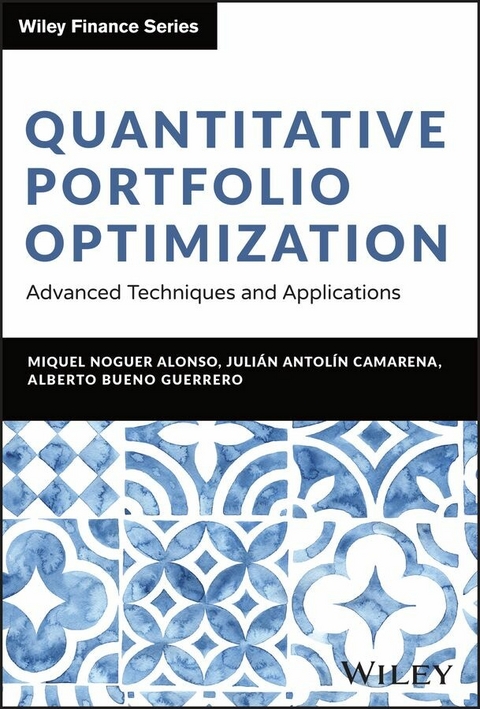
Quantitative Portfolio Optimization (eBook)
603 Seiten
Wiley (Verlag)
978-1-394-28132-9 (ISBN)
Expert guidance on implementing quantitative portfolio optimization techniques
In Quantitative Portfolio Optimization: Theory and Practice, renowned financial practitioner Miquel Noguer, alongside physicists Alberto Bueno Guerrero and Julian Antolin Camarena, who possess excellent knowledge in finance, delve into advanced mathematical techniques for portfolio optimization. The book covers a range of topics including mean-variance optimization, the Black-Litterman Model, risk parity and hierarchical risk parity, factor investing, methods based on moments, and robust optimization as well as machine learning and reinforcement technique. These techniques enable readers to develop a systematic, objective, and repeatable approach to investment decision-making, particularly in complex financial markets.
Readers will gain insights into the associated mathematical models, statistical analyses, and computational algorithms for each method, allowing them to put these techniques into practice and identify the best possible mix of assets to maximize returns while minimizing risk. Topics explored in this book include:
- Specific drivers of return across asset classes
- Personal risk tolerance and it#s impact on ideal asses allocation
- The importance of weekly and monthly variance in the returns of specific securities
Serving as a blueprint for solving portfolio optimization problems, Quantitative Portfolio Optimization: Theory and Practice is an essential resource for finance practitioners and individual investors It helps them stay on the cutting edge of modern portfolio theory and achieve the best returns on investments for themselves, their clients, and their organizations.
MIQUEL NOGUER ALONSO is a financial markets practitioner with 25+ years of experience in asset management. He is the Founder of the Artificial Intelligence Finance Institute and serves as Head of Development at Global AI. He is also the co-editor of the Journal of Machine Learning in Finance.
JULIÁN ANTOLÍN CAMARENA holds a Bachelor's, Master's and a PhD in physics. For his Master's he worked on the foundations of quantum mechanics examining alternative quantization schemes and their application to exotic atoms to discover new physics. His PhD dissertation work was on computational and theoretical optics, electromagnetic scattering from random surfaces, and nonlinear optimization. He then went on to a postdoctoral stint with the U.S. Army Research Laboratory working on inverse reinforcement learning for human-autonomy teaming.
ALBERTO BUENO GUERRERO has two Bachelor's degrees in physics and economics, and a PhD in banking and finance. Since he got his doctorate, he has dedicated himself to research in mathematical finance. His work has been presented at various international conferences and published in journals such as Quantitative Finance, Journal of Derivatives, Journal of Mathematics, and Chaos, Solitons and Fractals. His article 'Bond Market Completeness Under Stochastic Strings with Distribution-Valued Strategies' has been considered a feature article in Quantitative Finance.
Expert guidance on implementing quantitative portfolio optimization techniques In Quantitative Portfolio Optimization: Theory and Practice, renowned financial practitioner Miquel Noguer, alongside physicists Alberto Bueno Guerrero and Julian Antolin Camarena, who possess excellent knowledge in finance, delve into advanced mathematical techniques for portfolio optimization. The book covers a range of topics including mean-variance optimization, the Black-Litterman Model, risk parity and hierarchical risk parity, factor investing, methods based on moments, and robust optimization as well as machine learning and reinforcement technique. These techniques enable readers to develop a systematic, objective, and repeatable approach to investment decision-making, particularly in complex financial markets. Readers will gain insights into the associated mathematical models, statistical analyses, and computational algorithms for each method, allowing them to put these techniques into practice and identify the best possible mix of assets to maximize returns while minimizing risk. Topics explored in this book include: Specific drivers of return across asset classes Personal risk tolerance and it#s impact on ideal asses allocation The importance of weekly and monthly variance in the returns of specific securities Serving as a blueprint for solving portfolio optimization problems, Quantitative Portfolio Optimization: Theory and Practice is an essential resource for finance practitioners and individual investors It helps them stay on the cutting edge of modern portfolio theory and achieve the best returns on investments for themselves, their clients, and their organizations.
Chapter 1
Introduction
1.1 Evolution of Portfolio Optimization
Portfolio optimization has undergone significant transformation since its inception. Initially, the focus was on maximizing returns without much regard for risk. This changed with the introduction of Modern Portfolio Theory (MPT) by Harry Markowitz in the 1950s, which introduced the concept of balancing risk and return. Markowitz’s mean-variance optimization laid the groundwork for the systematic assessment of portfolio risk and diversification.
Over the years, portfolio optimization has evolved to incorporate various advanced techniques and models. These include the Capital Asset Pricing Model (CAPM), Arbitrage Pricing Theory (APT), and more sophisticated approaches like the Black-Litterman model, risk parity, and hierarchical risk parity. Recently, machine learning methods have also been integrated into portfolio optimization, providing new ways to manage complex data and uncover hidden patterns in financial markets. Moreover, the integration of reinforcement learning, and graph-based methods has opened new avenues for dynamic and complex portfolio strategies. Sensitivity-based portfolios, which focus on the sensitivity of portfolio returns to changes in underlying factors, have also become an important aspect of modern portfolio management.
1.2 Role of Quantitative Techniques
Quantitative techniques play a crucial role in modern portfolio optimization. These techniques allow for the systematic analysis and management of risk, the development of models to predict asset returns, and the optimization of portfolios to achieve desired outcomes. Key quantitative methods used in portfolio optimization include:
- Mean-Variance Optimization: This foundational technique balances expected return against risk, measured as the variance of returns. It involves calculating the expected returns and covariances of all assets, then solving for the weights that minimize portfolio variance subject to a desired return. The efficient frontier is derived from this process, representing the set of optimal portfolios.
- Factor Models: These models, such as the CAPM and multifactor models, explain asset returns based on various macroeconomic factors or firm-specific factors. The CAPM, for example, relates an asset’s return to the return of the market portfolio, adjusted for the asset’s sensitivity to market movements.
- Bayesian Methods: Bayesian techniques incorporate prior beliefs and observed data to update the estimation of expected returns and risks. The Black-Litterman model is a popular application in portfolio optimization, combining market equilibrium with investor views to produce more stable and diversified portfolios. Bayesian methods are particularly useful for handling parameter uncertainty and incorporating subjective views.
- Machine Learning: Machine learning algorithms are used to identify patterns in large datasets, making them valuable for predictive modeling in portfolio optimization. Techniques like neural networks, decision trees, and generative models can uncover complex relationships between asset returns and various predictors. These methods can enhance the forecasting of returns and risks as well as optimize trading strategies.
- Neural Networks: These are used to model nonlinear relationships between inputs and outputs. In portfolio optimization, they can predict asset returns based on historical data and other variables.
- Decision Trees: These algorithms split the data into subsets based on feature values, creating a tree-like model of decisions. They are useful for capturing the nonlinear relationships in financial data and can be used to identify important variables influencing asset returns.
- Generative Models: These models, such as Generative Adversarial Networks (GANs) and Variational Autoencoders (VAEs), are used to generate new data samples that are like the training data. In portfolio optimization, generative models can be used to simulate realistic market scenarios and generate synthetic data for stress testing and risk management.
- Reinforcement Learning (RL): RL involves training algorithms to make sequences of decisions by rewarding desirable actions and penalizing undesirable ones. In portfolio optimization, RL can dynamically adjust the asset allocation based on market conditions and investment goals. An RL agent learns a policy that maximizes cumulative rewards, which can correspond to returns in a portfolio context. Techniques like Q-learning and policy gradients are commonly used in RL for portfolio management.
- Q-learning: This algorithm learns the value of actions in different states and aims to maximize the expected reward over time. It updates its estimates using the Bellman equation.
- Policy Gradients: These methods optimize the policy directly by computing gradients of the expected reward with respect to the policy parameters.
- Graph-based Methods: These methods use graph theory to represent and analyze the relationships between assets. Graphs can model the dependencies and correlations among assets, aiding in the construction of diversified and robust portfolios.
- Graph Theory: This involves studying graphs, which are mathematical structures used to model pairwise relations between objects. In portfolio optimization, nodes can represent assets, and edges can represent the correlations or co-movements between them.
- Hierarchical Risk Parity (HRP): This approach uses clustering and tree structures to construct portfolios. It aims to distribute risk more evenly across different clusters of assets, improving diversification.
- Sensitivity-based Portfolios: These portfolios focus on the sensitivity of portfolio returns to changes in underlying factors, such as economic variables or market indices. By analyzing how small changes in these factors impact on the portfolio, managers can better understand and manage risk.
- Sensitivity Analysis: This involves examining how the variation in the output of a model can be attributed to different variations in the inputs. In portfolio optimization, sensitivity analysis helps in understanding the impact of changes in asset returns and other factors on the portfolio performance.
- Partial Differential Equations (PDEs): PDEs can be used to model the dynamics of portfolio values over time, considering factors like interest rates and asset prices. Solving these equations provides insights into the optimal portfolio allocation under different market conditions.
- Risk Measures and Management: Techniques like Value-at-Risk (VaR) and Conditional Value-at-Risk (CVaR) are used to quantify the risk of loss in a portfolio. These measures are essential for understanding potential downside risks and making informed decisions about risk mitigation strategies. Advanced risk measures also consider tail risks and the distribution of returns.
- Optimization Algorithms: Several optimization algorithms are employed to solve portfolio optimization problems. These include:
- Quadratic Programming: Used in mean-variance optimization to find the optimal asset weights that minimize portfolio variance for a given return.
- Monte Carlo Simulation: Used to model the probability of different outcomes in a process that cannot easily be predicted due to the intervention of random variables. In portfolio optimization, it is used to simulate the performance of different portfolio strategies under various market conditions.
- Genetic Algorithms: These algorithms mimic natural selection processes to generate high-quality solutions for optimization problems. They are particularly useful in finding optimal portfolios in large, complex investment universes.
- Dynamic Programming: Applied in multi-period portfolio optimization to make decisions that consider the evolution of the portfolio over time.
1.3 Organization of the Book
This book is structured to provide a comprehensive understanding of quantitative portfolio optimization techniques, from foundational theories to advanced applications. The chapters are organized as the list describes:
- Chapter 2: History of Portfolio Optimization: A review of the key developments in portfolio optimization, from early theories to modern advancements.
- Chapter 3: Modern Portfolio Theory: A detailed study of mean-variance analysis, the CAPM, and APT, including their applications and limitations. We introduce a new framework Mean Variance with CVAR constraints.
- Chapter 4: Bayesian Methods in Portfolio Optimization: An exploration of Bayesian techniques and their application to portfolio optimization.
- Chapter 5: Risk Models and Measures: A discussion on various risk measures, including Value-at-Risk (VaR) and Conditional Value-at-Risk (CVaR), and their estimation methods.
- Chapter 6: Factor Models and Factor Investing: Examination of single and multifactor models, factor risk, and performance attribution.
- Chapter 7: Market Impact, Transaction Costs, and Liquidity: Insights into market impact, transaction costs, and liquidity considerations in portfolio optimization.
- Chapter 8: Optimal Control: Coverage of dynamic programming, optimal control, and their applications in portfolio optimization.
- Chapter 9: Markov Decision Processes: Discussion on fully...
| Erscheint lt. Verlag | 22.1.2025 |
|---|---|
| Reihe/Serie | Wiley Finance |
| Sprache | englisch |
| Themenwelt | Recht / Steuern ► Wirtschaftsrecht |
| Wirtschaft ► Betriebswirtschaft / Management | |
| Schlagworte | Black-Litterman model • Factor Investing • hierarchical risk parity • investment moments • machine learning models investing • mean-variance optimization • Modern Portfolio Theory • portfolio optimization • Risk Parity • robust optimization |
| ISBN-10 | 1-394-28132-3 / 1394281323 |
| ISBN-13 | 978-1-394-28132-9 / 9781394281329 |
| Informationen gemäß Produktsicherheitsverordnung (GPSR) | |
| Haben Sie eine Frage zum Produkt? |
 EPUB (Adobe DRM)
Kopierschutz: Adobe-DRM
Adobe-DRM ist ein Kopierschutz, der das eBook vor Mißbrauch schützen soll. Dabei wird das eBook bereits beim Download auf Ihre persönliche Adobe-ID autorisiert. Lesen können Sie das eBook dann nur auf den Geräten, welche ebenfalls auf Ihre Adobe-ID registriert sind.
Details zum Adobe-DRM
Dateiformat: EPUB (Electronic Publication)
EPUB ist ein offener Standard für eBooks und eignet sich besonders zur Darstellung von Belletristik und Sachbüchern. Der Fließtext wird dynamisch an die Display- und Schriftgröße angepasst. Auch für mobile Lesegeräte ist EPUB daher gut geeignet.
Systemvoraussetzungen:
PC/Mac: Mit einem PC oder Mac können Sie dieses eBook lesen. Sie benötigen eine
eReader: Dieses eBook kann mit (fast) allen eBook-Readern gelesen werden. Mit dem amazon-Kindle ist es aber nicht kompatibel.
Smartphone/Tablet: Egal ob Apple oder Android, dieses eBook können Sie lesen. Sie benötigen eine
Geräteliste und zusätzliche Hinweise
Buying eBooks from abroad
For tax law reasons we can sell eBooks just within Germany and Switzerland. Regrettably we cannot fulfill eBook-orders from other countries.
aus dem Bereich