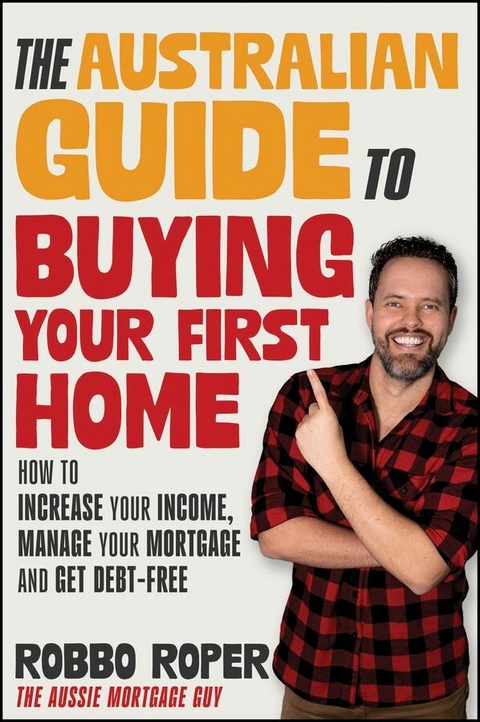
The Australian Guide to Buying Your First Home (eBook)
262 Seiten
Wiley (Verlag)
978-1-394-26835-1 (ISBN)
Discover how to achieve financial flexibility with this blueprint for homeownership and worry-free living
Robbo Roper (aka the Aussie Mortgage Guy) is here to show you how to get out of the rental trap, get your finances sorted and buy your first (or next!) home. The Australian Guide to Buying Your First Home is not a step-by-step guide to living in a beachside mansion with a $15-million property portfolio. Instead, it is an essential real-world companion for taking control and getting into your new home faster. You'll learn how to increase your income (and borrowing power) and buy the ideal property for whatever stage of life you're in. Better still, you'll get valuable advice on how to manage and pay off your mortgage sooner.
Owning your own home creates a safe haven for you and your family. Your home is not only a valuable financial investment that builds long-term wealth. It's also a place to make cherished memories and truly flourish. A home is about creating stability and a lasting legacy for you and your loved ones. At the end of the day, finding your own home is about building a happy, balanced life.
Inside, Robbo brings together the advice that has made him Australia's most-followed financial content creator. You'll discover how to:
- Set your goals, reduce your expenses and boost your income so you can get into your first home faster
- Determine your borrowing power and create an action plan for savings, loans and schemes, and taxes
- Find a home that balances what you need with what you can afford
- Pay off your mortgage and become debt-free sooner
Learn from everyday Aussie success stories and get the strategies you need to reach your goal of home ownership sooner. The Australian Guide to Buying Your First Home is an indispensable handbook for assessing affordability, setting realistic goals and taking control of your future.
ROBBO ROPER (aka the Aussie Mortgage Guy) helps others take control of their income and buy their first home. A former mortgage broker, he is Australia's most-followed financial content creator. Follow him at @trusted.finance.
Discover how to achieve financial flexibility with this blueprint for homeownership and worry-free living Robbo Roper (aka the Aussie Mortgage Guy) is here to show you how to get out of the rental trap, get your finances sorted and buy your first (or next!) home. The Australian Guide to Buying Your First Home is not a step-by-step guide to living in a beachside mansion with a $15-million property portfolio. Instead, it is an essential real-world companion for taking control and getting into your new home faster. You'll learn how to increase your income (and borrowing power) and buy the ideal property for whatever stage of life you're in. Better still, you'll get valuable advice on how to manage and pay off your mortgage sooner. Owning your own home creates a safe haven for you and your family. Your home is not only a valuable financial investment that builds long-term wealth. It's also a place to make cherished memories and truly flourish. A home is about creating stability and a lasting legacy for you and your loved ones. At the end of the day, finding your own home is about building a happy, balanced life. Inside, Robbo brings together the advice that has made him Australia's most-followed financial content creator. You'll discover how to: Set your goals, reduce your expenses and boost your income so you can get into your first home faster Determine your borrowing power and create an action plan for savings, loans and schemes, and taxes Find a home that balances what you need with what you can afford Pay off your mortgage and become debt-free sooner Learn from everyday Aussie success stories and get the strategies you need to reach your goal of home ownership sooner. The Australian Guide to Buying Your First Home is an indispensable handbook for assessing affordability, setting realistic goals and taking control of your future.
INTRODUCTION
In my 20s I put myself in a shitload of debt. It led to the biggest breakdown of my life.
Here’s what happened.
In 2014, my wife and I bought a home that pushed us to the limit of what we could afford. We had the dream of renovating a run-down, 1960s home into our very own version of a ‘Block-worthy’ dream house. If you’re an avid The Block viewer like we are, you’ll understand where we were coming from.
Our strategy was simple. As we continued to climb the corporate ladder in our respective careers, our incomes were expected to increase. Then, once our home went up in value, we would increase our mortgage to release the funds required to complete the renovation. Plan sorted!
However, after a year of living in the house we had a grim moment of realisation. House prices across Perth, Western Australia, had declined. In our suburb, in particular, house prices were down over 5 per cent. Since we bought the house with only a 5 per cent deposit, we now owned a home valued the same as our outstanding mortgage. In the eyes of the bank, our loan-to-value ratio (LVR) was above their ‘maximum lending guidelines’. Our refinance plans were no longer viable.
Learning from my mistakes
I became obsessed with television shows like Grand Designs, Fixer Upper and House Hunters. These shows fuelled my desire to renovate. A daily reminder to keep up with the Joneses.
We must have been talking about it nonstop because one day my wife’s parents made us an offer we couldn’t refuse. They were willing to increase the mortgage on their own home to fund our renovation as long as we could afford the increase in repayments on their home loan. (I know what you’re thinking, and yes, I felt very fortunate to have such generous in-laws.)
We accepted their offer, but with variable home loan interest rates sitting at around 5.5 per cent per annum, and the fact we now had two mortgages on the one property, we elected for the ‘renovation mortgage’ to be interest only (IO). This strategy reduced our monthly repayments, maximising our cash flow, but it meant the mortgage balance would not decrease over time. We were clinging onto the hope that we could refinance our own mortgage based on the increased value of our renovated home and pay my in-laws back the renovation mortgage in full.
We pushed ourselves to the brink of what we could afford. Every single cent mattered. Then, just like in any home building show you’ve ever seen, the renovation went over budget. The only way to continue the renovation was to borrow more money from my in-laws. This pushed us beyond what we could afford and, to rub salt into the wound, house prices in Perth continued to plummet. The debt was suffocating. Questions kept circling around in my head:
- What if we can’t finish the renovation?
- What if it’s worth even less than when we started?
- What if the bank won’t let us refinance?
- What if property values keep going down?
- How am I going to pay back my in-laws?
- What will they think of me?
- Do we cut our losses, scrap the rest of the renovation and try to sell what we have — walking away with a debt while being forced back into the rental market — or do we brainstorm a way to create additional income?
You get the gist. It was make or break.
My turning point
The thought of losing our home was debilitating. As this feeling grew, it became harder for us to come up with a way to generate any additional income. We felt trapped.
I was working fulltime as a high-school teacher and one afternoon, after all the students left, I sat in my classroom and sobbed. I had just calculated that we would be left with a debt of over $200 000 if we tried to sell our home. At that exact moment I received an email from a parent of one of my students wondering if I could tutor their older sibling.
Out of the blue, a viable side hustle had crystalised. It meant working after hours, but in addition to our full-time jobs, it might just be enough to get us over the line. I started marketing my services in local community groups on Facebook. One student turned into two, then three, then suddenly I was tutoring 10 students per week.
I was now working more than 50 hours a week, but that debilitating feeling had dissipated. I could see the light at the end of the tunnel. We were able to finish the renovations and achieved a bank valuation of our property above what we expected. This meant we were able to refinance our mortgage and pay back my in-laws in full.
But I hadn’t anticipated the dramatic increase in repayments now that we were forced to pay principal and interest (P&I) on our home loan.
That feeling of suffocation was rearing its ugly head again. But this time it wasn’t debilitating. I had already proven to myself I knew how to take control of my income. This made me rethink my tutoring side hustle:
How could I generate even more income?
By restructuring how I delivered the tuition, my business quadrupled in size, growing to over 40 students. Life was good. For the first time in years, our income was paying our expenses and leaving us with some savings.
To add to our happiness, one day after work, my wife announced she was pregnant.
After feeling pure joy for a few days, that familiar feeling returned. I felt choked by the thought that our income was going to be almost halved once my wife’s paid maternity period finished. We were finally comfortable and now this beautiful, but also completely unknown, variable was turning our financial stability upside down.
If you’re about to start a family, these are the questions you need to be asking yourself before you make any massive financial decisions:
- How will you continue to afford this life if you have kids?
- What will your life look like? How long will you be living on one salary? How expensive is day care?
- What will this mean in terms of your happiness?
During our renovation, it was questions like these that collided to create a tornado of self-doubt, anxiety and depression. But that financial pressure cooker of a situation forced me to adopt a different mindset. In Rich Dad Poor Dad, Robert Kiyosaki explains that he forbids himself from saying, ‘I can’t afford this’.
He replaces this statement with, ‘How can I afford this?’
I know it sounds simple. I remember standing in Big W reading the first few pages of Kiyosaki’s book, thinking there’s no way something so simple could have an impact. But this strategy completely reshaped my mindset. When I ask myself this question, rather than make a statement, it opens and challenges my mind. Like a seedling growing every day, looking for the light, I’m constantly trying to find a viable solution to my problems. (Try it for yourself — it’s powerful.)
I had 9 months to figure things out. So, while I was still working fulltime as a teacher, I took our tutoring business to the next level. I leased an office space and employed my first staff member. Over the next year our team grew to six teachers tutoring over 90 students a week. Between the business and my full-time job, we were doing so well that my wife didn’t need to return to work after her maternity leave.
But there was a hard pill to swallow: I was working over 65 hours a week. I was tired. The only thing keeping me going was knowing that our son had his mum by his side 100 per cent of the time — which, in my opinion, was worth every working second.
As the business grew to 15 teachers and over 180 students, it was finally time to reduce my workload. At the start of 2020, I scaled down to around 30 hours a week, and only teaching one day a week. Then, 3 weeks later, we found out baby number two was on the way. But this time I felt prepared. Everything was already in place to handle another little rugrat.
Then COVID happened.
My breakdown
The impact that COVID had on our tutoring business was devastating. Our income was reduced by 90 per cent due to the lockdown procedures forcing us to shut our doors. It all happened so fast. One week I was able to fully support my family, the next I couldn’t even make the mortgage repayment. This prompted my first ever breakdown.
I felt hollow.
The weight of all those years spent working over 60 hours a week to pay for the financial decisions we made in our 20s came crashing down on me all at once.
How long is life going to be like this?
How long can we survive?
I can’t afford this!
I was stuck, deep down in that dark hole again. Struggling to see a way out. Weeks went by and the feeling of desperation only grew. But this time my wife was the one holding the torch.
‘You’ve done this before, and you can do it again,’ she said.
‘How can we afford this?’ I asked myself.
Trusting that she believed in my ability to provide for our family, regardless of what was going on in the world, was empowering. Her confidence gave me the resilience I needed to push through and find a solution.
COVID completely rewired me. I was now focused on wrapping my family’s lifestyle in a suit of armour. Luckily, due to Western Australia’s prompt border closure (which reduced the initial outbreak of COVID in 2020, allowing...
| Erscheint lt. Verlag | 22.1.2025 |
|---|---|
| Sprache | englisch |
| Themenwelt | Recht / Steuern ► Wirtschaftsrecht |
| Betriebswirtschaft / Management ► Spezielle Betriebswirtschaftslehre ► Immobilienwirtschaft | |
| Schlagworte | Australia • Australian real estate • average income • average worth • borrowing capacity • Budgeting • buy a home • buy a home in Australia • buy interstate • buy regional • debt • Deposit • earn more • Equity • Expenses • Financial Flexibility • financial freedom • financial independence • financial planning for homebuyers • first home guarantee • First Home Owner Grant • fixed interest • get a loan • guarantor • hidden costs • homebuying process • home loan options • Home loans • homeownership guide • Housing affordability • housing market trends • How much can I borrow • how to budget • How to buy a home • Incentives • Income Tax • interest rates • invest in property • Investment Property • lifestyle creep • loan application • loan repayments • make more money • mortgage advice • mortgage interest • mortgage repayments • Mortgage strategy • Passive income • personal finance • preapproval • property book • property guide • property investing • property location • property taxes • property value • real estate book • real estate guide • Refinancing • Rentvesting • Retirement • roadmap • save a deposit • savings target • Self-Help • side hustle • Stamp duty • trusted finance • up-front costs • variable interest |
| ISBN-10 | 1-394-26835-1 / 1394268351 |
| ISBN-13 | 978-1-394-26835-1 / 9781394268351 |
| Informationen gemäß Produktsicherheitsverordnung (GPSR) | |
| Haben Sie eine Frage zum Produkt? |
 EPUB (Adobe DRM)
Kopierschutz: Adobe-DRM
Adobe-DRM ist ein Kopierschutz, der das eBook vor Mißbrauch schützen soll. Dabei wird das eBook bereits beim Download auf Ihre persönliche Adobe-ID autorisiert. Lesen können Sie das eBook dann nur auf den Geräten, welche ebenfalls auf Ihre Adobe-ID registriert sind.
Details zum Adobe-DRM
Dateiformat: EPUB (Electronic Publication)
EPUB ist ein offener Standard für eBooks und eignet sich besonders zur Darstellung von Belletristik und Sachbüchern. Der Fließtext wird dynamisch an die Display- und Schriftgröße angepasst. Auch für mobile Lesegeräte ist EPUB daher gut geeignet.
Systemvoraussetzungen:
PC/Mac: Mit einem PC oder Mac können Sie dieses eBook lesen. Sie benötigen eine
eReader: Dieses eBook kann mit (fast) allen eBook-Readern gelesen werden. Mit dem amazon-Kindle ist es aber nicht kompatibel.
Smartphone/Tablet: Egal ob Apple oder Android, dieses eBook können Sie lesen. Sie benötigen eine
Geräteliste und zusätzliche Hinweise
Buying eBooks from abroad
For tax law reasons we can sell eBooks just within Germany and Switzerland. Regrettably we cannot fulfill eBook-orders from other countries.
aus dem Bereich