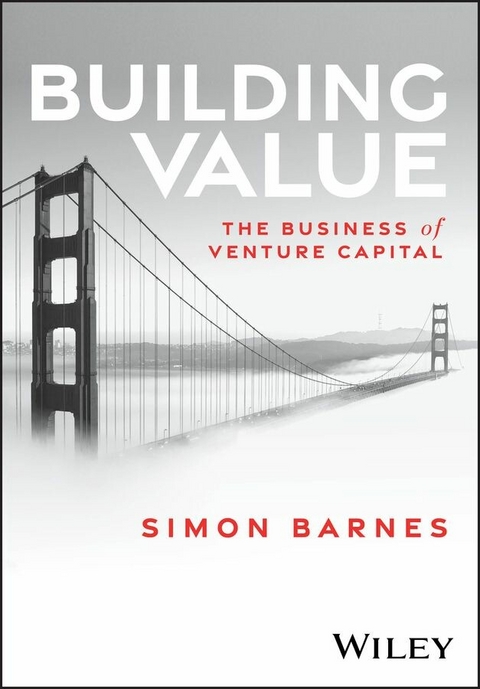
Building Value (eBook)
445 Seiten
Wiley (Verlag)
978-1-394-23190-4 (ISBN)
Learn the venture capital process and industry from the inside-out
In Building Value: The Business of Venture Capital, renowned professor and venture capital (VC) firm partner Simon Barnes delivers an easy-to-read guide to the often-mysterious world of venture capital and how entrepreneurs and venture capitalists should engage with each other to arrive at constructive start-up investment deals. In the book, you'll discover why successful entrepreneurial finance is more about behaviour than it is about numbers. You'll learn why VC is a people business, first and foremost, and why effectively aligning the interests of funders and entrepreneurs is so important.
You'll also find:
- Insights drawn from the author's 25 years' experience backing and building start-ups in the UK, EU, and US
- A holistic view of the venture capital industry that focuses on building value
- A comprehensive discussion of the entire VC process, from negotiating the deal to helping build a successful venture-backed business
Perfect for students in MBA programs, Building Value is also a can't-miss resource for venture capitalists, entrepreneurs raising capital for the first time, professional fund managers, and professionals and entrepreneurs participating in incubator or accelerator programmes.
SIMON BARNES has over 25 years of experience in and around the venture capital industry, backing start-ups in the US, UK and EU. He is a Professor at Warwick Business School where he teaches and writes on the venture capital industry.
Learn the venture capital process and industry from the inside-out In Building Value: The Business of Venture Capital, renowned professor and venture capital (VC) firm partner Simon Barnes delivers an easy-to-read guide to the often-mysterious world of venture capital and how entrepreneurs and venture capitalists should engage with each other to arrive at constructive start-up investment deals. In the book, you'll discover why successful entrepreneurial finance is more about behaviour than it is about numbers. You'll learn why VC is a people business, first and foremost, and why effectively aligning the interests of funders and entrepreneurs is so important. You'll also find: Insights drawn from the author's 25 years' experience backing and building start-ups in the UK, EU, and US A holistic view of the venture capital industry that focuses on building value A comprehensive discussion of the entire VC process, from negotiating the deal to helping build a successful venture-backed business Perfect for students in MBA programs, Building Value is also a can't-miss resource for venture capitalists, entrepreneurs raising capital for the first time, professional fund managers, and professionals and entrepreneurs participating in incubator or accelerator programmes.
Chapter 1
Why Do Start-ups Raise Capital?
It might seem a strange question to ask at the beginning of a book about venture capital, where so much of the culture of the start-up industry appears to focus on ‘doing the next raise’. Of course, start-ups raise capital, that’s what they do, isn’t it? We are sometimes led to believe that the only goal for entrepreneurs or start-up CEOs is to raise money from venture capitalists (VCs). But ask yourself a fundamental question: Why? In the old days, entrepreneurs didn’t always do that, so why now? In the early part of the 20th century, companies which started small ended up being global corporations without huge amounts of capital being injected into them. With a sometimes limited number of informal backers, their management teams reinvested cash generated from hard-won sales to build companies step by step, often failing and restarting along the way. Was there a different entrepreneurial mentality necessitated by the scarcity of resources? Can we learn something important from the old ways? Reading even a small amount of literature on the history of business can be illuminating when seeking an answer to these questions.
The Ford Motor Company was a start-up once. Henry Ford began small with a few investors to form the Detroit Automobile Company. The company failed. The assets were bought out of administration by some of the investors, who allowed Ford to carry on as the Henry Ford Company. The company failed for a second time. For Henry Ford it was a case of third time lucky; the Ford Motor Company was formed with investments totalling $28,000 in 1903. The early investors in the Ford Motor Company included a successful Detroit coal merchant and the director of a well-regarded bank. These individuals were not professional VCs, they were private investors with a sense of adventure and a vision of the future. The company operated with very little resource; Henry Ford himself didn’t take a salary and was adept at persuading others to work for very little. This approach, raising money where he could and stretching very limited resources, eventually led to the successful global corporation we know today. The early investments into Ford’s various attempts to launch were not from modern-style venture capital funds, but piecemeal investments from a group of business owners and managers who took a chance and eventually made remarkable returns (Brinkley 2004). Tight financial control and careful business practices were the secret to Ford’s early success, before the exponential growth of the Model-T powered the business to profit.
Countless other early 20th-century success stories took decades to become the global corporations they are now. Throughout history, ‘start-ups’ (before they were really called that) often grew slowly and organically, and sometimes independent of a financing industry that was simpler and more limited in scope than it is today.
By injecting substantial amounts of external funding, the modern venture capital industry confers upon start-ups the ability for time travel, accelerating through the difficult early years of product development and business model experimentation. It affords start-ups the ability to try designs and test markets and business models via trial and error or the scientific method now termed ‘lean start-up’, and build world-class management teams to execute aggressive growth plans, including the acquisition of smaller competitors or suppliers. Technology means that the pace of innovation is quicker than it was in Henry Ford’s day, and the race to conquer unique business opportunities before others is conducted at break-neck speed. The venture capital industry provides the fuel to grow fast…
Asset Parsimony
In a 1984 academic paper, Donald Hambrick and Ian MacMillan coined the term asset parsimony, namely ‘skill at deploying the minimum assets needed to achieve the desired business results’ (Hambrick and MacMillan 1984). Their paper focused on return on investment (ROI) and pointed out that investing heavily in assets upfront, without understanding the risks and the payoff, can rapidly pave the way to the bankruptcy court. This is not a complicated concept, and most will agree that it is intuitive to most experienced managers, but it is surprising how few entrepreneurs (and VCs) adhere to this business philosophy today.
Raising finance for start-ups is a time-consuming and expensive process. More favourable conditions for raising finance are best achieved by having a compelling investment opportunity, supported by evidence of technical progress and a scalable business model, before approaching investors. Demonstrating an ability to make sales, strike deals or at least generate interest from potential customers (often referred to as ‘traction’) is a key aspect of convincing investors that this is more than ‘an idea’. In other words, it’s ‘best foot forward’ before attempting to raise capital. Entrepreneurs should go as far as they can before attempting to raise money for the first time; maximise the utility of assets at hand; and beg, borrow and salvage until the business is ready and sufficiently attractive to raise investment on the most favourable terms.
This thought process should be nailed to the wall of every fledgling start-up business – achieve as much as you can and deliver tangible value before engaging with the investment community as this will enable you to raise more capital, on better terms and with less time and energy.
In recent years, asset parsimony seems to have been forgotten by entrepreneurs. The culture within the technology-based entrepreneurial community seems to have been the opposite – raise as much money as you can, as fast as you can, on as little progress as possible and invest heavily upfront. This has been possible for some entrepreneurs in the tech industry as venture capital markets have been awash with capital for extended periods between 2012 and 2022 – technology markets have been hot and venture capital funds swollen by historically low global interest rates. This is discussed in more detail later in the book, but for now the key lesson is that during times of plentiful venture capital, the ‘culture’ of start-ups shifts to fashionably large funding rounds and away from the grit of the hard-bitten entrepreneur who understands what it means to survive tough times.
The Best Time to Raise Money is When You Don’t Need To
Seemingly paradoxical to the concept of asset parsimony, experienced entrepreneurs know that the best time to raise money is when you don’t need to. The asset parsimony approach has one flaw: it assumes a steady supply of investment capital on constant, stable terms that do not change. For start-ups especially, this is not true. Market conditions in general can change overnight, but sentiment towards a particular sector in venture capital can disappear even faster – in the blink of an eye. There is no point frugally and methodically working to achieve proof of concept, and then going out to raise capital just as the financing climate turns sour.
Getting the timing right, therefore, plays a huge role in raising capital. Experienced entrepreneurs are constantly alert to the possibility of external investment, because the most favourable terms are achieved when they don’t really need the money. When the bank balance is healthy, entrepreneurs have the luxury of walking away from an investment offer, and that makes investors more eager to invest, driving up the price of the deal. It is easier to negotiate price when you don’t need investment urgently…
Putting aside negotiation tactics, experienced entrepreneurs usually think very carefully before turning down investment offers, even when they are not looking for funding. They are also open to accepting more investment than they are asking for in their business plan or pitch. It is usually the case that early-stage ventures run into delays – be they technical challenges or commercial hurdles – and having a cash buffer for unforeseen events can be a life saver for the company.
In conclusion, the seemingly paradoxical ‘go as far as you can on as little as possible’ and ‘raise money when you don’t need it’ is not a paradox at all. Entrepreneurs need to respect asset parsimony with the knowledge that many a failed entrepreneur has turned down external investment for fear of dilution, and then gone bust when the climate changes. Balancing these twin pressures of making progress in a changing financing climate is a core skill for entrepreneurs. There is no universal solution to balancing this risk, just an awareness of the issue and an acknowledgement of one fundamental truth – a company that runs out of cash is bankrupt. So, the overriding force in all of this is making sure the company is funded and sometimes that means raising investment when you can.
Take money when you can get it, but respect asset parsimony.
Crossing the Valleys of Death
Revisiting our initial question, ‘Why do start-ups raise capital?’, it is reasonable to assume that new ventures generally spend money before they earn it. Investment in research and development, hiring personnel and embarking on expensive marketing campaigns all occur before the company has generated revenue. These activities result in cash flowing out of the company, sometimes for an extended period, before the first revenues are generated.
If we view this as a...
| Erscheint lt. Verlag | 22.1.2025 |
|---|---|
| Sprache | englisch |
| Themenwelt | Recht / Steuern ► Wirtschaftsrecht |
| Wirtschaft ► Betriebswirtschaft / Management | |
| Schlagworte | business investment • business value creation • funding a start-up • negotiating funding • Start-up investment • VC funding • VC Investment • Venture Capital Funding • venture capital investment • venture capital negotiation • venture capital process |
| ISBN-10 | 1-394-23190-3 / 1394231903 |
| ISBN-13 | 978-1-394-23190-4 / 9781394231904 |
| Informationen gemäß Produktsicherheitsverordnung (GPSR) | |
| Haben Sie eine Frage zum Produkt? |
 EPUB (Adobe DRM)
Kopierschutz: Adobe-DRM
Adobe-DRM ist ein Kopierschutz, der das eBook vor Mißbrauch schützen soll. Dabei wird das eBook bereits beim Download auf Ihre persönliche Adobe-ID autorisiert. Lesen können Sie das eBook dann nur auf den Geräten, welche ebenfalls auf Ihre Adobe-ID registriert sind.
Details zum Adobe-DRM
Dateiformat: EPUB (Electronic Publication)
EPUB ist ein offener Standard für eBooks und eignet sich besonders zur Darstellung von Belletristik und Sachbüchern. Der Fließtext wird dynamisch an die Display- und Schriftgröße angepasst. Auch für mobile Lesegeräte ist EPUB daher gut geeignet.
Systemvoraussetzungen:
PC/Mac: Mit einem PC oder Mac können Sie dieses eBook lesen. Sie benötigen eine
eReader: Dieses eBook kann mit (fast) allen eBook-Readern gelesen werden. Mit dem amazon-Kindle ist es aber nicht kompatibel.
Smartphone/Tablet: Egal ob Apple oder Android, dieses eBook können Sie lesen. Sie benötigen eine
Geräteliste und zusätzliche Hinweise
Buying eBooks from abroad
For tax law reasons we can sell eBooks just within Germany and Switzerland. Regrettably we cannot fulfill eBook-orders from other countries.
aus dem Bereich