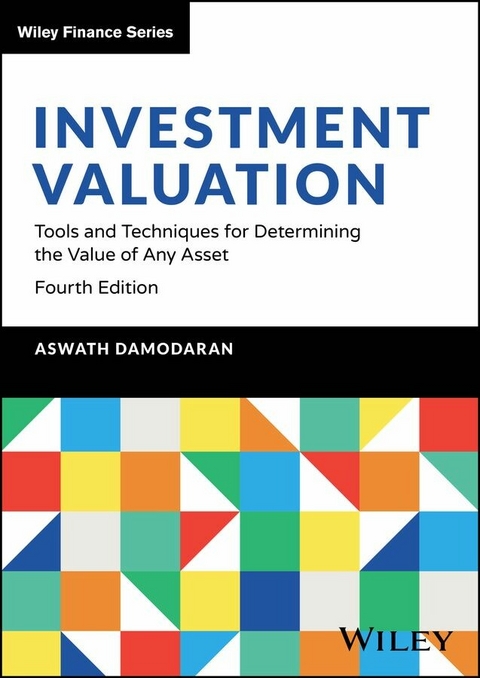
Investment Valuation (eBook)
2248 Seiten
Wiley (Verlag)
978-1-394-25461-3 (ISBN)

Updated edition of the definitive guide to investment valuation tools and techniques
Investment Valuation: Tools and Techniques for Determining the Value of Any Asset delves into valuation techniques for a variety of different asset classes, including real options, start-up firms, unconventional assets, distressed companies and private equity, real estate, and many more, and explains how to choose the right model for any given asset valuation scenario. The models are presented with real-world examples so as to capture some of the problems inherent in applying these models, with discussion of differences and common elements between the models to provide readers with a holistic understanding of the subject matter.
Written by a professor of finance who is widely regarded as one of the best educators and thinkers on the topic of investment valuation, this newly revised and updated Fourth Edition explores topics including:
- Understanding financial statements, the basics of risk, and tests and evidence for market efficiency
- Estimating risk parameters and costs of financing, terminal value, and equity value per share
- Using scenario analysis, decision trees, and simulations for probabilistic approaches in valuation
Investment Valuation: Tools and Techniques for Determining the Value of Any Asset is an essential resource for all investors and students of financial markets seeking an all-in-one guide to expand their valuation knowledge and make better investment decisions.
ASWATH DAMODARAN is Professor of Finance at New York University's Leonard N. Stern School of Business. He teaches corporate finance and valuation at leading investment banks. He has been the recipient of numerous awards for outstanding teaching, including the NYU Distinguished Teaching Award, and was named one of the nation's top business school teachers by BusinessWeek. His publications include Damodaran on Valuation, Applied Corporate Finance, The Little Book of Valuation, Investment Philosophies, and The Dark Side of Valuation.
Updated edition of the definitive guide to investment valuation tools and techniques Investment Valuation: Tools and Techniques for Determining the Value of Any Asset delves into valuation techniques for a variety of different asset classes, including real options, start-up firms, unconventional assets, distressed companies and private equity, real estate, and many more, and explains how to choose the right model for any given asset valuation scenario. The models are presented with real-world examples so as to capture some of the problems inherent in applying these models, with discussion of differences and common elements between the models to provide readers with a holistic understanding of the subject matter. Written by a professor of finance who is widely regarded as one of the best educators and thinkers on the topic of investment valuation, this newly revised and updated Fourth Edition explores topics including: Understanding financial statements, the basics of risk, and tests and evidence for market efficiency Estimating risk parameters and costs of financing, terminal value, and equity value per share Using scenario analysis, decision trees, and simulations for probabilistic approaches in valuation Investment Valuation: Tools and Techniques for Determining the Value of Any Asset is an essential resource for all investors and students of financial markets seeking an all-in-one guide to expand their valuation knowledge and make better investment decisions.
Chapter 1
Introduction to Valuation
Every asset, financial as well as real, that is expected to generate cash flows in the future, has a value. The key to successfully investing in and managing these assets lies in understanding not only what the value is, but the sources of the value. It is undeniable that some assets are easier to value than others, and the details of valuation will vary from case to case. Thus, valuing of a real estate property will require different information and follow a different format than valuing a publicly traded stock. What is surprising, however, is not the differences in techniques across assets, but the degree of similarity in the basic principles of valuation.
This chapter lays out a philosophical basis for valuation, together with a discussion of how valuation is or can be used in a variety of frameworks, from portfolio management to corporate finance.
A Philosophical Basis for Valuation
It was Oscar Wilde who described a cynic as one who “knows the price of everything, but the value of nothing”. He could very well have been describing some analysts and many investors, a surprising number of whom subscribe to the “bigger fool” theory of investing, which argues that the value of an asset is irrelevant as long as there is a “bigger fool” around willing to buy the asset from them. While this may provide a basis for some profits, it is a dangerous game to play, since there is no guarantee that such an investor will still be around when the time to sell comes.
A postulate of sound investing is that an investor does not pay more for an asset than it’s worth. This statement may seem logical and obvious, but it is forgotten and rediscovered at some time in every generation and in every market. There are many who argue that value is in the eye of the beholder, and that any price can be justified if there are other investors willing to pay that price. That is dangerous, at least as an investment starting point. Perceptions may be all that matter when the investment is a painting or sculpture, but investors do not (and should not) buy most assets for aesthetic or emotional reasons; financial assets are acquired for the cash flows expected on them. Consequently, perceptions of value have to be backed up by reality, which implies that the price paid for any asset should reflect the cash flows it is expected to generate. The models of valuation described in this book attempt to relate value to the level and expected growth of these cash flows.
Pricing Versus Valuation
Financial academics and practitioners use the words “price” and “value” interchangeably, with the former perhaps swayed by their early beliefs in efficient markets, where the two are expected to converge, and the latter by an assumption that these words measure the same things. In Figure 1.1, we draw a distinction between valuation and pricing, and argue that value and price are not only determined by different factors but require different tools. As the book’s title indicates, we will examine the details of how to value assets, and we will also look at how best to price those assets in later chapters.
Figure 1.1 Value versus Price—The Difference
It is true that large numbers of market participants, perhaps even most, are not investors, but instead choose to play the “pricing” game. In that game, winning is defined as buying at a low price and selling at a higher one, taking advantage of shifts in market mood and momentum, with value playing little or no role. Throughout this book, we will classify these participants as traders, and we will hope that they, too, will be able to find use for the pricing portions of this book.
As a final note, we will argue that no matter which side of the investing/pricing divide you fall on, you will benefit by understanding how the other side works. Thus, if you are a true believer in intrinsic value, you will find yourself become better at valuation, if you understand how traders price assets. Conversely, if you are a trader, focused on the pricing process, you will become a better trader, if you learn more about how investors think and value companies.
The Bermuda Triangle of Valuation
Like all analytical disciplines, valuation has developed its own set of myths over time. This section examines and debunks some of those myths and argues that the biggest challenges to valuation are not technical or mechanical, but come from the way we, as human beings, bring bias into out analyses and deal with uncertainty about the future and from the complexity that has been a by-product of access to data and powerful tools.
Bias: The Power of Your Priors
Valuation is neither the science that some of its proponents make it out to be nor the objective search for true value that idealists would like it to become. The models that we use in valuation may be quantitative, but the inputs leave plenty of room for subjective judgments. Thus, the final value that we obtain from these models is colored by the bias that we bring into the process. In fact, in many valuations, the price gets set first and the valuation follows.
The obvious solution is to eliminate all bias before starting on a valuation, but this is easier said than done. Given the exposure we have to external information, analyses, and opinions about a firm, it is unlikely that we embark on most valuations without some bias. In fact, a great deal of bias is subconscious. An investor who picks a company to value almost never does so with a blank slate, since that pick was probably triggered by something he or she heard about the company or read about it. In some cases, the bias can come from what you think about a company’s products or its managers. If, like me, you have been an Apple products user for four decades, you will be biased to finding Apple undervalued and Microsoft overvalued before you even look at either company’s numbers. Similarly, if you are an investor valuing Tesla in early 2024, it would be impossible for you to separate your views on Tesla from your views on Elon Musk, a man who evokes strong positive and negative reactions.
Can you avoid being biased? We don’t think so, but you can be open about these biases, at least with yourself, since that may allow you to counter them, when you estimate numbers for the future. You can also avoid taking strong public positions on the value of a firm before the valuation is complete. In far too many cases, the decision on whether a firm is under- or overvalued precedes the actual valuation,1 leading to seriously biased analyses. The second is to minimize, prior to the valuation, the stake we have in whether the firm is under- or overvalued.
Institutional concerns play a role in determining the extent of bias in valuation. For instance, it is an acknowledged fact that equity research analysts are more likely to issue buy rather than sell recommendations2, i.e., they are more likely to find firms to be undervalued than overvalued. This can be traced partly to the difficulties analysts face in obtaining access and collecting information on firms that they have issued sell recommendations on, and partly to pressure that they face from portfolio managers, some whom might have large positions in the stock. In some cases, this trend is exacerbated by the pressure on equity research analysts to deliver investment banking business. Similarly, when bankers are asked to value target companies for mergers and acquisitions, the fact that banking compensation is tied to whether the deal is done and not to whether the deal is favorably priced, will cause target company valuations to be biased upwards. Again, if you do work for these institutions, it may be difficult, if not impossible, to counter those biases, but being aware that they exist is the first step to dealing with them.
As consumers of other people’s valuations, the lesson of this section is that when using a valuation done by a third party, the biases of the analyst(s) should be considered before decisions are made on its basis. For instance, a self-valuation done by a target firm in a takeover is likely to be positively biased. While this does not make the valuation worthless, it suggests that the analysis should be viewed with skepticism.
BIAS IN EQUITY RESEARCH
The lines between equity research and salesmanship blur most in periods that are characterized by “irrational exuberance”. In the late 1990s, the extraordinary surge of market values in the companies that comprised the new economy saw many equity research analysts, especially on the sell side, step out of their roles as analysts and become cheerleaders for these stocks. While these analysts might have been well-meaning in their recommendations, the fact that the investment banks that they worked for were leading the charge on initial public offerings from these firms exposed them to charges of bias and worse.
In 2001, the crash in the market values of dot-com stocks and the anguished cries of investors who had lost wealth in the crash created a firestorm of controversy. There were congressional hearings where legislators demanded to know what analysts knew about the companies they recommended and when they knew it, statements from the Securities and Exchange Commission (SEC) about the need for impartiality in equity research, and decisions taken by some investment banks to create at least the appearance of objectivity. Investment banks reinforced created Chinese walls to separate their investment bankers from their equity research...
| Erscheint lt. Verlag | 19.12.2024 |
|---|---|
| Reihe/Serie | Wiley Finance |
| Sprache | englisch |
| Themenwelt | Recht / Steuern ► Wirtschaftsrecht |
| Wirtschaft ► Betriebswirtschaft / Management | |
| Schlagworte | acquisition valuation • bonds evaluation • Equity Value • firm evaluation • futures evaluation • options evaluation • real assets evaluation • Relative Valuation • startup valuation • stocks valuation • unconventional valuations |
| ISBN-10 | 1-394-25461-X / 139425461X |
| ISBN-13 | 978-1-394-25461-3 / 9781394254613 |
| Informationen gemäß Produktsicherheitsverordnung (GPSR) | |
| Haben Sie eine Frage zum Produkt? |
 EPUB (Adobe DRM)
Kopierschutz: Adobe-DRM
Adobe-DRM ist ein Kopierschutz, der das eBook vor Mißbrauch schützen soll. Dabei wird das eBook bereits beim Download auf Ihre persönliche Adobe-ID autorisiert. Lesen können Sie das eBook dann nur auf den Geräten, welche ebenfalls auf Ihre Adobe-ID registriert sind.
Details zum Adobe-DRM
Dateiformat: EPUB (Electronic Publication)
EPUB ist ein offener Standard für eBooks und eignet sich besonders zur Darstellung von Belletristik und Sachbüchern. Der Fließtext wird dynamisch an die Display- und Schriftgröße angepasst. Auch für mobile Lesegeräte ist EPUB daher gut geeignet.
Systemvoraussetzungen:
PC/Mac: Mit einem PC oder Mac können Sie dieses eBook lesen. Sie benötigen eine
eReader: Dieses eBook kann mit (fast) allen eBook-Readern gelesen werden. Mit dem amazon-Kindle ist es aber nicht kompatibel.
Smartphone/Tablet: Egal ob Apple oder Android, dieses eBook können Sie lesen. Sie benötigen eine
Geräteliste und zusätzliche Hinweise
Buying eBooks from abroad
For tax law reasons we can sell eBooks just within Germany and Switzerland. Regrettably we cannot fulfill eBook-orders from other countries.
aus dem Bereich