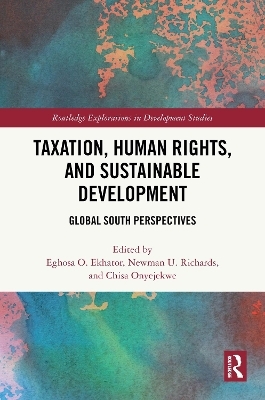
Taxation, Human Rights, and Sustainable Development
Routledge (Verlag)
978-1-032-55913-1 (ISBN)
Drawing on cases from across the Global South, the book demonstrates the benefits of embedding human rights into tax policies and legislation. The authors not only highlight the role of legislative measures and other human rights regulations in the realisation of international treaty rights but also argue that it creates an environment whereby individuals feel duty-bound to pay taxes, when necessary, thereby securing a sustainable revenue source for the state to meet their socio-economic responsibilities. The book investigates key topics such as compliance, redistribution, e-commerce, tax havens, and the role of key stakeholders.
This book will be useful for researchers from across the fields of law, human rights, taxation, and sustainable development.
Eghosa O. Ekhator is Associate Professor of International Environmental Law at the University of Derby, United Kingdom. His main research areas include International Environmental Law, African International Legal History, and Natural Resources Governance. Dr Ekhator has published extensively on his research areas and his academic papers have been cited by a plethora of public and international agencies including the U.K. Parliament's International Trade Committee and the United Nations Refugee Council. Dr Ekhator is also the Chair Committee on the Teaching of International Law and the SDGs, International Law Association (Nigerian Branch) and Senior Fellow Environmental Law and Sustainable Development – Institute for Oil, Gas, Energy, Environment and Sustainable Development (OGEES Institute) Afe Babalola University Nigeria. Newman U. Richards is a Senior Lecturer in Law at the University of Nigeria, Enugu Campus, Enugu, Nigeria. His research interest includes Tax Laws and Policies, Sustainable Development Goals and Cybercrimes. Most of his works examine how tax policies can catalyse domestic resource mobilisation. Some of his works also looked at how taxation could bridge the funding gap in the actualization of the SDGs in developing countries. He has presented papers at several international and local seminars, workshops, and law conferences in his areas of interest. Chisa Onyejekwe is an academic and Associate Director at Bristol Law School, University of the West of England (UWE). She is an accomplished scholar with research expertise in Human Rights and economic development in Africa. Her work critically engages with key issues shaping the African continent, including regional integration, the role of the African Union, taxation systems, and the advancement of Human Rights. In the field of taxation, Dr Onyejekwe investigates how fiscal policies and legal structures impact economic justice and development. Her work often intersects with human rights, emphasising the need for equitable systems that uplift marginalised populations while fostering national and regional growth. Beyond her research, Dr Onyejekwe is dedicated to teaching and mentoring the next generation of legal professionals and scholars. Her role as Associate Director at UWE reflects her leadership and commitment to advancing academic excellence and fostering a culture of innovation and critical thinking within the legal field.
1. Introduction Part A: Conceptualisation and evolution: Role of Human Rights in Taxation 2. What normativity for international tax? Towards alignment with human rights and the Sustainable Development Goals 3. Human Rights as a normative tool to promote fiscal justice in Africa 4. Taxation and the Realisation of Socioeconomic Rights in Africa: What Role for International Cooperation? Part B. Role of Stakeholders in Taxation 5. Supporting infrastructure development initiatives using tax frameworks in emerging economies 6. Unpacking The Mobile Money Tax Conundrum: Insights from Case Studies of Kenya, Uganda and Tanzania 7. The South African Revenue Service’s role in providing access to justice to Taxpayers 8. Refuting its “Tax Haven” Characterisation: The BVI’s Offshore Financial Services Industry and its Right to Economic Self-Determination 9. IMF, World Bank and Fossil Fuel Subsidies Part C: Tax Compliance and Development 10. Digital taxation: Sustainable use of digitalization and tax justice in Africa 11. Tax Implications of Fiscal Social Contract on Sustainable Development in Nigeria
| Erscheinungsdatum | 16.05.2025 |
|---|---|
| Reihe/Serie | Routledge Explorations in Development Studies |
| Zusatzinfo | 1 Tables, black and white; 5 Line drawings, black and white; 5 Illustrations, black and white |
| Verlagsort | London |
| Sprache | englisch |
| Maße | 156 x 234 mm |
| Gewicht | 630 g |
| Themenwelt | Recht / Steuern ► EU / Internationales Recht |
| Recht / Steuern ► Öffentliches Recht ► Völkerrecht | |
| Sozialwissenschaften ► Politik / Verwaltung ► Staat / Verwaltung | |
| Sozialwissenschaften ► Soziologie ► Spezielle Soziologien | |
| ISBN-10 | 1-032-55913-6 / 1032559136 |
| ISBN-13 | 978-1-032-55913-1 / 9781032559131 |
| Zustand | Neuware |
| Informationen gemäß Produktsicherheitsverordnung (GPSR) | |
| Haben Sie eine Frage zum Produkt? |
aus dem Bereich