


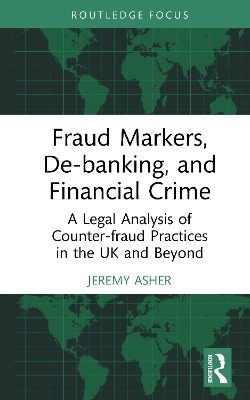
Fraud Markers, De-banking, and Financial Crime
A Legal Analysis of Counter-fraud Practices in the UK and Beyond
Seiten
2025
Routledge (Verlag)
978-1-032-96205-4 (ISBN)
Routledge (Verlag)
978-1-032-96205-4 (ISBN)
This book explores how the financial sector in the UK operates fraud databases to help combat fraud, and to explain the phenomenon of ‘debanking’. It offers a practical slant to the theory behind the secretive counter-fraud and money-laundering investigation techniques, technology, and practices employed by financial organisations.
This book enlightens the reader as to how the financial sector in the UK operates fraud databases to help combat fraud and explains the phenomenon of ‘debanking’. It considers the unique confluence of necessity, a flexible regulatory framework, and recent history of collaboration that now places fraud databases and data-sharing at the heart of the UK’s multi-agency counter-fraud strategy. It offers a practical slant to the theory behind the secretive counter-fraud and money-laundering investigation techniques, technology, and practices employed by financial organisations to disrupt fraud and money laundering. The work explains how and why the UK leads the world in this field, what progress is being made internationally to replicate these systems, and the legislative hurdles that need to be overcome to enable the level of data sharing required to make fraud databases operationally successful. It also explores the worrying trends and practices in the systems used which have adversely impacted on both innocent parties and the victims of fraud. Drawing on real-life examples, the book explores the benefits of transparency and whether the databases and the organisations that utilise them can better build fairness into their systems. It will be an invaluable resource for researchers, practitioners and policy-makers working in the areas of counter-fraud and anti-money laundering.
This book enlightens the reader as to how the financial sector in the UK operates fraud databases to help combat fraud and explains the phenomenon of ‘debanking’. It considers the unique confluence of necessity, a flexible regulatory framework, and recent history of collaboration that now places fraud databases and data-sharing at the heart of the UK’s multi-agency counter-fraud strategy. It offers a practical slant to the theory behind the secretive counter-fraud and money-laundering investigation techniques, technology, and practices employed by financial organisations to disrupt fraud and money laundering. The work explains how and why the UK leads the world in this field, what progress is being made internationally to replicate these systems, and the legislative hurdles that need to be overcome to enable the level of data sharing required to make fraud databases operationally successful. It also explores the worrying trends and practices in the systems used which have adversely impacted on both innocent parties and the victims of fraud. Drawing on real-life examples, the book explores the benefits of transparency and whether the databases and the organisations that utilise them can better build fairness into their systems. It will be an invaluable resource for researchers, practitioners and policy-makers working in the areas of counter-fraud and anti-money laundering.
Jeremy Asher is a practising solicitor who has specialised in criminal and regulatory law for more than 25 years. Since 2020 he has developed a practice in challenging fraud markers that have been unfairly or erroneously loaded against individuals by banks and other financial organisations. He is also Founder and Chairman of the Financial Fraud Awareness Campaign and is a director of the community interest company that manages it.
Foreword; Acknowledgements; Abbreviations; 1. An Introduction to the Fraud Databases; 2. The Money Mule Problem; 3. Fraud; 4. The International Reach of Fraud Databases; 5. Justice and Transparency – A Fair Balance?
| Erscheinungsdatum | 30.01.2025 |
|---|---|
| Reihe/Serie | The Law of Financial Crime |
| Verlagsort | London |
| Sprache | englisch |
| Maße | 138 x 216 mm |
| Gewicht | 360 g |
| Themenwelt | Recht / Steuern ► EU / Internationales Recht |
| Recht / Steuern ► Wirtschaftsrecht ► Bank- und Kapitalmarktrecht | |
| Recht / Steuern ► Wirtschaftsrecht ► Gesellschaftsrecht | |
| Wirtschaft ► Betriebswirtschaft / Management ► Finanzierung | |
| Betriebswirtschaft / Management ► Spezielle Betriebswirtschaftslehre ► Bankbetriebslehre | |
| ISBN-10 | 1-032-96205-4 / 1032962054 |
| ISBN-13 | 978-1-032-96205-4 / 9781032962054 |
| Zustand | Neuware |
| Informationen gemäß Produktsicherheitsverordnung (GPSR) | |
| Haben Sie eine Frage zum Produkt? |
Mehr entdecken
aus dem Bereich


aus dem Bereich
Warum unser Geld stirbt und wie Sie davon profitieren. Der …
Buch | Hardcover (2024)
FinanzBuch Verlag
CHF 41,95
Praxisnahe Einführung mit zahlreichen Fallbeispielen börsennotierter …
Buch | Softcover (2020)
Vahlen (Verlag)
CHF 34,85
denken und handeln wie ein professioneller Trader
Buch | Softcover (2023)
Vahlen, Franz (Verlag)
CHF 51,65


