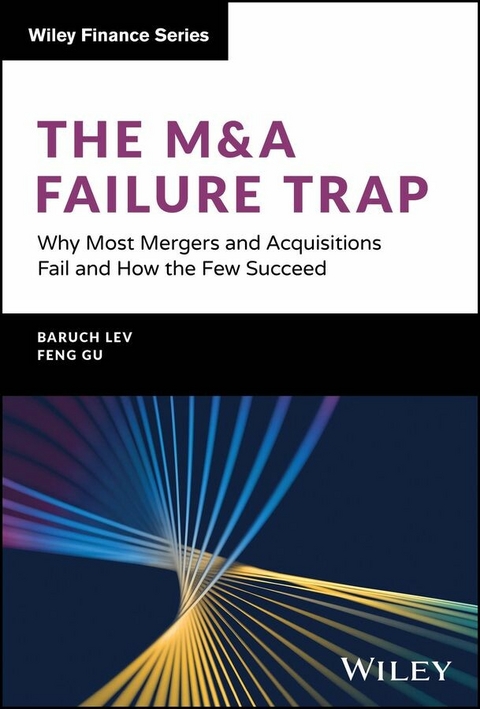
The M&A Failure Trap (eBook)
355 Seiten
Wiley (Verlag)
978-1-394-20477-9 (ISBN)
An essential read about M&A for executives and investors who make critical decisions when M&A events and opportunities happen.
In The M&A Failure Trap: Why Most Mergers and Acquisitions Fail and How the Few Succeed, a distinguished team of finance and accounting researchers and practitioners delivers a practical and up-to-date exploration of the shortcomings of managerial mergers and acquisitions decisions. In the book, you'll discover:
- Why 70-75% of all corporate acquisitions fail
- How to substantially improve acquisition decisions
- How to predict a specific merger outcome
All the lessons and advice provided in this book are fact-based-derived from a sample of 40,000 real-life merger cases around the world which are thoroughly analyzed and provide the foundations for our findings and recommendations.
The authors offer keen insights into the most important predictors of mergers and acquisitions failure and success and show you how to identify the potential warning signs of a problematic transaction. The book also provides insights into the human element of M&As: what happens to executives and employees of failed acquisitions. You will also find in the book a comprehensive review of the state-of-the-art research on M&As and numerous analyses of successful and unsuccessful real-life mergers.
Perfect for executives and directors contemplating a major M&A decision or currently engaged in such a transaction, The M&A Failure Trap will also earn a place in the libraries of students of business and economics, as well as investors faced with decisions impacted by a merger or acquisition, and shareholders expected to vote on an upcoming transaction.
BARUCH LEV is New York University's Accounting and Finance Professor (emeritus), formerly at Tel Aviv University, UC Berkeley and the University of Chicago. He worked in accounting and investment banking, and did research and consulting in finance, accounting and corporate valuations. Lev wrote 7 books and 125 research studies which were cited more than 62,000 times (Google Scholar).
FENG GU is Professor and Chair of Accounting and Law at the University at Buffalo School of Management. He has published research focusing on analysis of financial information, relevance of corporate accounting reports, and valuation of intangible assets.
An essential read about M&A for executives and investors who make critical decisions when M&A events and opportunities happen. In The M&A Failure Trap: Why Most Mergers and Acquisitions Fail and How the Few Succeed, a distinguished team of finance and accounting researchers and practitioners delivers a practical and up-to-date exploration of the shortcomings of managerial mergers and acquisitions decisions. In the book, you'll discover: Why 70-75% of all corporate acquisitions fail How to substantially improve acquisition decisions How to predict a specific merger outcome All the lessons and advice provided in this book are fact-based derived from a sample of 40,000 real-life merger cases around the world which are thoroughly analyzed and provide the foundations for our findings and recommendations. The authors offer keen insights into the most important predictors of mergers and acquisitions failure and success and show you how to identify the potential warning signs of a problematic transaction. The book also provides insights into the human element of M&As: what happens to executives and employees of failed acquisitions. You will also find in the book a comprehensive review of the state-of-the-art research on M&As and numerous analyses of successful and unsuccessful real-life mergers. Perfect for executives and directors contemplating a major M&A decision or currently engaged in such a transaction, The M&A Failure Trap will also earn a place in the libraries of students of business and economics, as well as investors faced with decisions impacted by a merger or acquisition, and shareholders expected to vote on an upcoming transaction.
Preamble: Why Should You Read This Book?
You probably believe that mergers and acquisitions (M&As) – often the largest investments companies make: think Exxon, paying $60B for Pioneer Natural Resources in October 2023, for example – are a boon for investors and employees, leading to new revenue and profit growth for the buying enterprise. How wrong. In fact, research shows that an astounding 70–75% of all acquisitions fail to live up to expectations, at shareholders’ expense, of course. Sprint, the third largest U.S. wireless carrier, acquired Nextel, the fifth largest carrier, for $35B in February 2005. Executives of both companies waxed lyrical about the merger. Timothy Donahue, Nextel’s chief executive officer (CEO), declared, “The new powerhouse company has the spectrum, infrastructure, distribution, superb and differentiated product portfolio that will drive our continued success.” Cost savings of $12B were predicted from the merger. Alas, a mere three years later, Sprint wrote off – declared a loss of – $30B (86% of Nextel’s acquisition price). This wasn’t an aberration. It was more of the norm.
P.1 THE M&A FAILURE TRAP
A few are aware of this carnage. Warren Buffett, who knows a thing or two about corporate acquisitions, having done them all his professional life, declared metaphorically:
Many managers apparently were overexposed in impressionable childhood years to the story in which the imprisoned handsome prince is released from a toad’s body by a kiss from a beautiful princess. Consequently they are certain their managerial kiss will do wonders for the profitability of the company’s [acquisition target]… . We have observed many kisses but very few miracles. Nevertheless, many managerial princesses remain serenely confident about the future potency of their kisses – even after their corporate backyards are knee-deep in unresponsive toads.1
The valuation guru Aswath Damodaran (New York University) concurs: “If you look at the collective evidence across acquisitions, this is the most value-destructive action a company can take.”2 Harvard’s late Clayton Christensen, of the “disruptive innovation” fame, reported that studies have documented an unbelievable M&A failure rate of 70–80%, while KPMG, a leading accounting firm, estimated more precisely the M&A failure rate at 83%.3
That “not acquiring” is often better than “acquiring” companies was demonstrated empirically by a clever academic study of contested (multibidder) acquisitions, where the successful corporate buyers were compared with the other, nonsuccessful bidders for the same targets. The researchers reported that the presumed “losers” – bidders that failed to buy the target – outperformed the “winners” by a substantial 25–30% risk-adjusted stock returns, over a three-year post-acquisition period. The researchers aptly titled their paper “Winning by Losing.”4
The dismal performance of M&As, both in the United States and abroad, whether measured by buyers’ post-acquisition sales and earnings growth or by their stock performance, did not go unnoticed by investors. In fact, in recent decades, a company’s public announcement of a planned acquisition generally triggers a significant stock price drop, reflecting investors’ dour expectations from the proposed acquisition. Thus, for example, on May 23, 2022, Broadcom announced its intention to acquire VMware for $60B and saw its stock price fall by 3% on the announcement day. Similarly, the stock price of Tapestry, which owns Coach, Kate Spade, and Stuart Weitzman brands, dropped by 15% on August 10, 2023, when it announced the acquisition of Capri Holdings, owner of Michael Kors, Versace, and Jimmy Choo, thereby reflecting deep investor concerns about the prudence of the acquisition and its terms.
Despite all that negativity, the pace of M&As does not abate; in fact, as we show in Chapter 3, it grows. And the architects of the mergers – CEOs of the buyers and targets – are as enthusiastic as ever about the mergers’ prospects, uniformly predicting enticing synergies (cost savings) and fabulous revenue and earnings growth resulting from the mergers. How can this be? What’s the basis for managers’ continued trust in M&As, despite their dismal, proven record? Optimism in the face of destruction? That’s one of the major questions we ask and answer in this book, which is fully evidence-based, using a sample of more than 40,000 actual acquisitions, analyzed by advanced statistical techniques. The answers will highly surprise you.
But we do much more in this book. We identify the major reasons for the success or failure of corporate acquisitions, many of which have not been highlighted or discussed in the vast extant literature and advice available on M&As. To top it all off, we develop in Chapter 15 of this book a unique, numerical M&A scorecard, aimed at assessing (predicting) the potential success of a specific acquisition, for the use of executives considering a merger proposal, corporate directors overseeing managers’ decisions, and investors, who are sometimes asked to vote on a proposed merger or who want to make investment decisions regarding the merger partners.
Addressing these three major issues – explaining the persistence of the M&A phenomenon in spite of its harsh failure rate, identifying the major factors determining an acquisition’s success, and developing a predictive numerical scorecard assessing merger consequences – should be of major interest to every businessperson, corporate manager, director, investor, economist, and business student, given the centrality of M&As in the economy and corporate success. Intriguingly, the urgency to address the merger growth conundrum is even greater, given our following finding that acquisition consequences deteriorate over time – a matter that is reported here for the first time.
P.2 M&A DECISIONS ARE GETTING WORSE
Do executives learn at least from their failures? The Wall Street Journal thinks so, quoting merger advisers: “Companies can get better at doing successful mergers and acquisitions.”5 Perhaps they can, but they do not. M&As defy the universal learning curve rule: rather than benefiting from experience and improving their M&A decisions and consequences, executives’ acquisition decisions are in fact getting worse over time. They are “unlearning,” rather than learning. Using likely the largest sample assembled for M&A research – more than 40,000 deals conducted over 40 years6—along with a comprehensive merger success measure that we developed, reflecting both the financial (sales and gross margin growth) and market (stock returns) dimensions of acquisition success, we found that the M&A success rate over the past 40 years was roughly one out of three, falling recently to one out of four, largely in line with previous research.7
What we find startling, however, is the “reverse learning” (forgetting?) phenomenon exhibited in Figure 1,8 which portrays the average annual failure rate of M&As. The figure shows clearly that the merger failure rate is trending upward. From typical 50–60% acquisitions failure rates in the 1980s and 1990s, the failure rate (buyers’ post-acquisition financial and stock market performance lagging pre-acquisition performance) rose to 60–75% in the 2000s (for the sake of conservatism we eliminated from the figure the financial crisis years, 2006 and 2007, due to unusually high acquisition failure rate of 85–90% in those years). The regression trend line in the figure, reflecting the overall failure pattern, is significantly upward-sloping, indicating the decreasing quality of corporate M&A decisions over time. A slight improvement occurred in the post financial crisis years.
FIGURE 1 The Increasing M&A Failure Rate Over Time (The dots reflect average annual M&A failure rate for the period 1980–2018, excluding 2006–2007, plus a regression trend line.)
And yet, one hears from time to time, particularly from investment bankers and M&A consultants, that corporate acquisition decisions have been improved over the past decade or two.9 So here is out of the mouths of (not babes, but) corporate managers their view of the quality of the M&A decisions they have made in the past 20 years. Figure 2 presents both the number and total volume of annual “goodwill write-off” (impairments) declared during 2003–2022. A goodwill write-off (fully explained and demonstrated in Chapter 9) is a usually very large income statement expense and asset value decrease, reflecting a total or partial loss of a company’s past investment in a business acquisition. In other words, it’s managers’ public admission that an acquisition failed.10 Figure 2, derived from public companies’ financial statements, shows anything but an improvement of corporate acquisitions: from 10% of all companies with goodwill on their balance sheet (practically every corporate acquisition generates a substantial amount of goodwill on the buyer’s balance sheet)...
| Erscheint lt. Verlag | 4.11.2024 |
|---|---|
| Reihe/Serie | Wiley Finance |
| Sprache | englisch |
| Themenwelt | Recht / Steuern ► Wirtschaftsrecht |
| Wirtschaft ► Betriebswirtschaft / Management ► Finanzierung | |
| Schlagworte | Business Restructuring • business restructuring transaction • m&a analysis • m&a decision-making • m&a decisions • m&a financial analysis • m&a financial data • m&a industry • M&A Transaction • mergers and acquisitions transaction • restructuring transaction |
| ISBN-10 | 1-394-20477-9 / 1394204779 |
| ISBN-13 | 978-1-394-20477-9 / 9781394204779 |
| Informationen gemäß Produktsicherheitsverordnung (GPSR) | |
| Haben Sie eine Frage zum Produkt? |
 EPUB (Adobe DRM)
Kopierschutz: Adobe-DRM
Adobe-DRM ist ein Kopierschutz, der das eBook vor Mißbrauch schützen soll. Dabei wird das eBook bereits beim Download auf Ihre persönliche Adobe-ID autorisiert. Lesen können Sie das eBook dann nur auf den Geräten, welche ebenfalls auf Ihre Adobe-ID registriert sind.
Details zum Adobe-DRM
Dateiformat: EPUB (Electronic Publication)
EPUB ist ein offener Standard für eBooks und eignet sich besonders zur Darstellung von Belletristik und Sachbüchern. Der Fließtext wird dynamisch an die Display- und Schriftgröße angepasst. Auch für mobile Lesegeräte ist EPUB daher gut geeignet.
Systemvoraussetzungen:
PC/Mac: Mit einem PC oder Mac können Sie dieses eBook lesen. Sie benötigen eine
eReader: Dieses eBook kann mit (fast) allen eBook-Readern gelesen werden. Mit dem amazon-Kindle ist es aber nicht kompatibel.
Smartphone/Tablet: Egal ob Apple oder Android, dieses eBook können Sie lesen. Sie benötigen eine
Geräteliste und zusätzliche Hinweise
Buying eBooks from abroad
For tax law reasons we can sell eBooks just within Germany and Switzerland. Regrettably we cannot fulfill eBook-orders from other countries.
aus dem Bereich