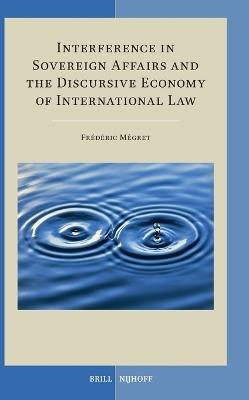
Interference in Sovereign Affairs and the Discursive Economy of International Law
Martinus Nijhoff (Verlag)
978-90-04-53272-4 (ISBN)
Interference in sovereign affairs is seemingly everywhere but nowhere at the same time. Whether it is pressure on or corruption of public officials, conditionality in development assistance, criticism of one’s human rights record, psychological or propaganda operations, instrumentalization of diasporas, international organization supervision or meddling diplomats, the phenomenon is as amorphous as it is diffuse. But what if it was the lens that we use to capture interference that was the problem? How do the tools we use in international law blind us to the reality of certain phenomena? The urgency of understanding interference on its terms has never been greater, and it requires nothing less than a reimagining of the sort of discursive investments on which international law rests.
Frédéric Mégret is a Full Professor and holds the Hans & Tamar Oppenheimer Chair in Public International Law at the Faculty of Law, McGill University. His work lies at the intersection of international law, legal theory and history, and human rights.
Acknowledgement
Introduction: The World-Making Character of Interference and Non-interference
1 What It Means to ‘Constitute’
2 The Rule of Non-intervention, the Practice of Interference
3 The ‘New Interference’ and International Law
Part 1
Interference and Non-interference: A Short History
1 Non-interference’s Conditions of Possibility
2 Non-interference and State Building
3 Historicizing Interference and Non-interference
1 The Emergence of Non-interference as a Norm in International Law
1 Introduction
1.1 The Relative Early Irrelevance of Non-intervention
1.2 The Rise of Non-intervention as a Concern
1.3 Recognitions of Insurgency, Belligerency, Governments and New States
2 Interference within Non-interference and the Paradoxical Logic of Spheres
2.1 From the Monroe Doctrine to the Roosevelt Corollary
2.2 The Brezhnev Doctrine and Socialist Internationalism
2.3 An International Normalization?
3 Deprovincializing Non-interference? Cosmopolitanization and the Role of Human Rights
3.1 The Helsinki Conference as Formative Episode
3.2 Between Humanitarianism and droits-de-l’hommisme
3.3 A Droit d’Ingérence?
4 Push-Back: The Third-World Attempt at Sanctification of Non-interference
4.1 From the Americas to the United Nations
4.2 The Emerging International Legal Formalization of Non-interference
4.3 The Continuing Fate of Non-interference
2 The Rise of the ‘New’ Interference
1 Introduction
2 The End of the Cold War and the Uncertain Fate of Interference
2.1 Renewed Interference?
2.2 Renewed Pushback?
2.3 The Rise of the Anti-Interference State
3 Blowback: Revenge of the South?
3.1 ‘Off Script’ Interference
3.2 The Reversal of Interference Fluxes
3.3 Benign or Malign?
4 Late International Legal Anxieties
4.1 New Provenance
4.2 New Targets
4.3 New Means
Part 2
The Age of Interference: Questions for International Law
1 Non-interference as Argumentative Claim
2 The Framing Role of International Law
3 The Distinctiveness of Interference
3 Prodding the Breadth and Depth of the Evolving Domaine Réservé: What Is Left?
1 Introduction: Ceci N’est Pas Un Domaine Réservé …
1.1 Essence, Residue or Practice?
1.2 The Many Facets of the Domaine Réservé
1.3 The International Law of Jurisdiction as Approximation of the Domaine
2 Minimal State/Total State
2.1 Mutations of Sovereignty
2.2 The Attempted Sanctuarization of the Domestic Domain
2.3 (Re)nationalizing Politics?
3 Human Rights/Democracy
3.1 Do Human Rights Spell the End of the Domaine Réservé?
3.2 Rehabilitating the ‘Human Rights State’
3.3 Exceptionalizing Democracy?
4 National Self-determination/Global Values
4.1 Self-determination: Impeding or Mandating Interference?
4.2 Interference by Invitation?
4.3 Self-Determination without Self-Determination?
4 The Nature of Interference: What Does It Take?
1 Introduction
1.1 The Policy Framing
1.2 The Limits of Reasoning by Analogy
1.3 Interference in the Shadow of Intervention?
2 Coercion/Disruption
2.1 The Definitional Challenge
2.2 Coercion and Its Limits
2.3 Beyond Coercion?
3 Public/Private
3.1 The Invisibility of Private Interference
3.2 Issues of Attribution
3.3 Beyond Attribution?
4 Unilateral/Supranational
4.1 Foundations for the Permissibility of Internationally Justified Interference
4.2 Justifying Interference: From Decolonization to Human Rights
4.3 Can International Law Justify Interference?
Part 3
Strategic Dilemmas of Interference
1 The Function and Constraint of Arguments about Interference
2 The Curse of Mimetism, the Hope of Reciprocity
3 Defining the Conditions of International Engagement
5 Engaging the Dilemmas of the Domestic and the International
1 Introduction
1.1 Interference as Crisis
1.2 Two Models
1.3 International Law’s Calling?
2 Domestic v International Law?
2.1 Privileging the Domestic
2.2 The Relative Irrelevance of International Law
2.3 The Unavoidability of International Law?
3 Horizontal v Vertical Interference?
3.1 International Organizations’ Interference with Domestic Affairs
3.2 The Distinctiveness of International Organizations’ Interference
3.3 The Limited Relevance of International Organizations’ Interference for State Interference
4 International law v Human Rights?
4.1 Pushing Back against Excessive Non-interference Agendas
4.2 Human Rights: Buttressing the Case for Non-interference?
4.3 The Problem of Stigmatizing Certain Populations
6 Imagining a Baseline
1 Introduction
2 A Duty to Engage?
2.1 The Liberal Acceptability of Non-engagement
2.2 Questioning the Laissez Faire Bases of International Law
2.3 Friendly Relations?
3 A Duty of Transparency?
3.1 Demanding Truth
3.2 Perfidy and the Requirement of Transparency
3.3 The Limits of Transparency
4 A Duty of Consistency?
4.1 Horizontal Consistency
4.2 Vertical Consistency
4.3 Beyond Consistency: On Seeing Oneself in the Mirror
Conclusion: Routinized Interference: The Unravelling of Sovereignty?
1 Reclaiming and Transcending the Ironies of Interference
2 Non-interference: Rule, Praxis or Ethos?
3 The Meaning of Interference for, Rather than in International Law
Index
| Erscheinungsdatum | 09.04.2025 |
|---|---|
| Reihe/Serie | Developments in International Law ; 81 |
| Sprache | englisch |
| Maße | 155 x 235 mm |
| Themenwelt | Recht / Steuern ► Allgemeines / Lexika |
| Recht / Steuern ► EU / Internationales Recht | |
| ISBN-10 | 90-04-53272-2 / 9004532722 |
| ISBN-13 | 978-90-04-53272-4 / 9789004532724 |
| Zustand | Neuware |
| Informationen gemäß Produktsicherheitsverordnung (GPSR) | |
| Haben Sie eine Frage zum Produkt? |
aus dem Bereich