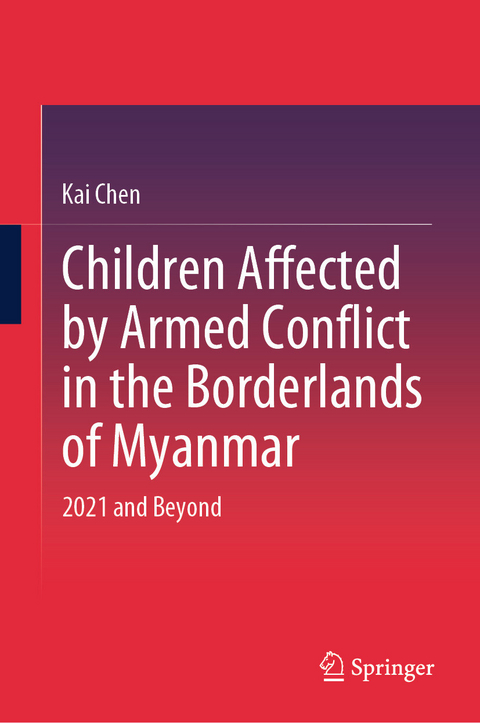
Children Affected by Armed Conflict in the Borderlands of Myanmar (eBook)
87 Seiten
Springer Nature Singapore (Verlag)
978-981-97-2740-7 (ISBN)
This book focuses on children affected by armed conflict in the borderlands of Myanmar since the regime-change event in 2021. In the borderlands of this country, uncountable children have been killed or maimed by indiscriminate weapons, raids, artillery bombardments and air strikes. Concerning the Burmese children living in the rest of Myanmar, they have been exposed to feelings of insecurity and growing anxieties caused by deadly bombings and assassinations. No place in Myanmar is immune from armed conflict. Many displaced Burmese children fled into the neighboring countries, which did not ratify the 1951 Refugee Convention. With no refugee status, some displaced children faced the risk of being arrested and deported. Some displaced children became victims of human trafficking, or led a life of vagrancy. The stakeholders responsible for protecting children from armed conflict, have been promoting Myanmar towards reconciliation in their own ways. However, the stakeholders had to deal with three obstacles, that is, lack of consensus, insufficient cohesion and funding gap. When a national ceasefire is unavailable in Myanmar, the conflicting parties would probably welcome a humanitarian ceasefire in the borderlands of this country, rather than wearing each other out. In the case of Myanmar, a humanitarian ceasefire should be composed of three parts: immediate access to victims of armed conflict, safe passage of civilians, and release of detainees in batches. If everything goes well, an agreement for a humanitarian ceasefire in the borderlands of Myanmar, would be followed with peace talks in the foreseeable future.
This book focuses on children affected by armed conflict in the borderlands of Myanmar since the regime-change event in 2021. In the borderlands of this country, uncountable children have been killed or maimed by indiscriminate weapons, raids, artillery bombardments and air strikes. Concerning the Burmese children living in the rest of Myanmar, they have been exposed to feelings of insecurity and growing anxieties caused by deadly bombings and assassinations. No place in Myanmar is immune from armed conflict. Many displaced Burmese children fled into the neighboring countries, which did not ratify the 1951 Refugee Convention. With no refugee status, some displaced children faced the risk of being arrested and deported. Some displaced children became victims of human trafficking, or led a life of vagrancy. The stakeholders responsible for protecting children from armed conflict, have been promoting Myanmar towards reconciliation in their own ways. However, the stakeholders had to deal with three obstacles, that is, lack of consensus, insufficient cohesion and funding gap. When a national ceasefire is unavailable in Myanmar, the conflicting parties would probably welcome a humanitarian ceasefire in the borderlands of this country, rather than wearing each other out. In the case of Myanmar, a humanitarian ceasefire should be composed of three parts: immediate access to victims of armed conflict, safe passage of civilians, and release of detainees in batches. If everything goes well, an agreement for a humanitarian ceasefire in the borderlands of Myanmar, would be followed with peace talks in the foreseeable future.
| Erscheint lt. Verlag | 6.9.2024 |
|---|---|
| Zusatzinfo | XIV, 87 p. 2 illus., 1 illus. in color. |
| Sprache | englisch |
| Themenwelt | Recht / Steuern ► Strafrecht ► Kriminologie |
| Sozialwissenschaften ► Politik / Verwaltung ► Europäische / Internationale Politik | |
| Sozialwissenschaften ► Politik / Verwaltung ► Vergleichende Politikwissenschaften | |
| Sozialwissenschaften ► Soziologie | |
| Schlagworte | Child Labour • Children affected by Armed Conflict • Children casualties • child soldiering • community-based organization • Ethnic armed organization • Funding Gap • Human insecurity in Myanmar • Humanitarian ceasefire • Indiscriminate weapons • Insufficient cohesion • Insufficient consensus • Myanmar-Bangladesh border • Myanmar-India border • Myanmar’s military • Myanmar-Thai border • Nationwide Ceasefire Agreement • People's Defence Force • Regime-change event in 2021 • United Nations System |
| ISBN-10 | 981-97-2740-5 / 9819727405 |
| ISBN-13 | 978-981-97-2740-7 / 9789819727407 |
| Informationen gemäß Produktsicherheitsverordnung (GPSR) | |
| Haben Sie eine Frage zum Produkt? |
 PDF (Wasserzeichen)
DRM: Digitales Wasserzeichen
Dieses eBook enthält ein digitales Wasserzeichen und ist damit für Sie personalisiert. Bei einer missbräuchlichen Weitergabe des eBooks an Dritte ist eine Rückverfolgung an die Quelle möglich.
Dateiformat: PDF (Portable Document Format)
Mit einem festen Seitenlayout eignet sich die PDF besonders für Fachbücher mit Spalten, Tabellen und Abbildungen. Eine PDF kann auf fast allen Geräten angezeigt werden, ist aber für kleine Displays (Smartphone, eReader) nur eingeschränkt geeignet.
Systemvoraussetzungen:
PC/Mac: Mit einem PC oder Mac können Sie dieses eBook lesen. Sie benötigen dafür einen PDF-Viewer - z.B. den Adobe Reader oder Adobe Digital Editions.
eReader: Dieses eBook kann mit (fast) allen eBook-Readern gelesen werden. Mit dem amazon-Kindle ist es aber nicht kompatibel.
Smartphone/Tablet: Egal ob Apple oder Android, dieses eBook können Sie lesen. Sie benötigen dafür einen PDF-Viewer - z.B. die kostenlose Adobe Digital Editions-App.
Buying eBooks from abroad
For tax law reasons we can sell eBooks just within Germany and Switzerland. Regrettably we cannot fulfill eBook-orders from other countries.
aus dem Bereich