


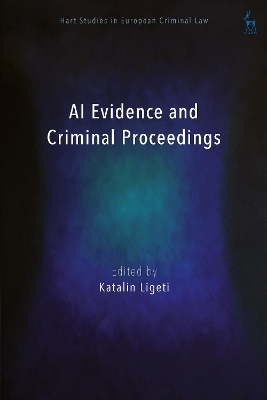
AI Evidence and Criminal Proceedings
Seiten
2026
Hart Publishing (Verlag)
978-1-5099-7656-0 (ISBN)
Hart Publishing (Verlag)
978-1-5099-7656-0 (ISBN)
- Lieferbar (Termin unbekannt)
- Versandkostenfrei
- Auch auf Rechnung
- Artikel merken
This open access book establishes, analyses and systemises the challenges that AI evidence poses to fundamental rights and principles of criminal procedure, as well as the rule of law.
Taking a four-part approach, distinguished experts contribute chapters on the six examined countries (Germany, Luxembourg, the Netherlands, France, England and Wales, and the US) that provide the basis for the comparative analysis and the development of concrete policy proposals.
Part one provides a comparative overview of the challenges of using AI evidence in court, highlighting the gaps in the current regulatory frameworks that cannot be easily closed by the traditional doctrine of criminal proceedings. Part two offers insights from data protection law, ICT law and human rights law that will shape the future regulation of AI evidence in criminal courts. Part three addresses complex issues related to the use of AI evidence and ensuring its admissibility by the courts. Lastly, part four proposes policies to rectify or mitigate the above established deficiencies in the current legal framework.
The ebook editions of this book are available open access under a CC BY-NC-ND 4.0 licence on bloomsburycollections.com. Open access was funded by the University of Luxembourg.
Taking a four-part approach, distinguished experts contribute chapters on the six examined countries (Germany, Luxembourg, the Netherlands, France, England and Wales, and the US) that provide the basis for the comparative analysis and the development of concrete policy proposals.
Part one provides a comparative overview of the challenges of using AI evidence in court, highlighting the gaps in the current regulatory frameworks that cannot be easily closed by the traditional doctrine of criminal proceedings. Part two offers insights from data protection law, ICT law and human rights law that will shape the future regulation of AI evidence in criminal courts. Part three addresses complex issues related to the use of AI evidence and ensuring its admissibility by the courts. Lastly, part four proposes policies to rectify or mitigate the above established deficiencies in the current legal framework.
The ebook editions of this book are available open access under a CC BY-NC-ND 4.0 licence on bloomsburycollections.com. Open access was funded by the University of Luxembourg.
Katalin Ligeti is Professor of European and International Criminal Law at the University of Luxembourg.
| Erscheinungsdatum | 20.12.2025 |
|---|---|
| Reihe/Serie | Hart Studies in European Criminal Law |
| Verlagsort | Oxford |
| Sprache | englisch |
| Maße | 156 x 234 mm |
| Themenwelt | Recht / Steuern ► EU / Internationales Recht |
| Recht / Steuern ► Privatrecht / Bürgerliches Recht ► IT-Recht | |
| Recht / Steuern ► Strafrecht | |
| ISBN-10 | 1-5099-7656-6 / 1509976566 |
| ISBN-13 | 978-1-5099-7656-0 / 9781509976560 |
| Zustand | Neuware |
| Informationen gemäß Produktsicherheitsverordnung (GPSR) | |
| Haben Sie eine Frage zum Produkt? |
Mehr entdecken
aus dem Bereich

aus dem Bereich
EU-Recht, nationales Recht, besondere Vertragsbedingungen
Buch | Hardcover (2025)
Verlag Dr. Otto Schmidt
CHF 348,55


