


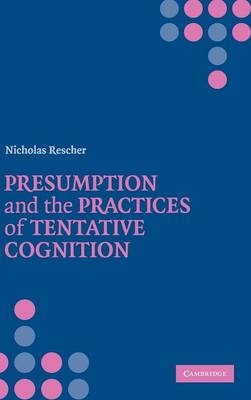
Presumption and the Practices of Tentative Cognition
Seiten
2006
Cambridge University Press (Verlag)
978-0-521-86474-9 (ISBN)
Cambridge University Press (Verlag)
978-0-521-86474-9 (ISBN)
This text endeavors to show that the process of presumption plays a role of virtually indispensable utility in matters of rational inquiry and communication. The origins of presumption may lie in law, but its importance is reinforced by its service to the theory of information management and philosophy.
Presumption is a remarkably versatile and pervasively useful resource. Firmly grounded in the law of evidence from its origins in classical antiquity, it made its way in the days of medieval scholasticism into the theory and practice of disputation and debate. Subsequently, it extended its reach to play an increasingly significant role in the philosophical theory of knowledge. It has thus come to represent a region where lawyers, debaters, and philosophers can all find some common around. In Presumption and the Practices of Tentative Cognition, Nicholas Rescher endeavors to show that the process of presumption plays a role of virtually indispensable utility in matters of rational inquiry and communication. The origins of presumption may lie in law, but its importance is reinforced by its service to the theory of information management and philosophy.
Presumption is a remarkably versatile and pervasively useful resource. Firmly grounded in the law of evidence from its origins in classical antiquity, it made its way in the days of medieval scholasticism into the theory and practice of disputation and debate. Subsequently, it extended its reach to play an increasingly significant role in the philosophical theory of knowledge. It has thus come to represent a region where lawyers, debaters, and philosophers can all find some common around. In Presumption and the Practices of Tentative Cognition, Nicholas Rescher endeavors to show that the process of presumption plays a role of virtually indispensable utility in matters of rational inquiry and communication. The origins of presumption may lie in law, but its importance is reinforced by its service to the theory of information management and philosophy.
Nicholas Rescher is University Professor and Professor of Philosophy at the University of Pittsburgh. He is the author of many books and articles on a range of topics in philosophy.
Preface; 1. The legal roots of presumption; 2. Presumption and burden of proof; 3. Cognitive presumptions and truth; 4. Validating cognitive presumptions; 5. Presumption and inquiry; 6. A default reasoning; 7. Presumption and trust; 8. Presumption and communication; 9. Presumption in science and beyond; 10. Specificity prioritization and the primacy of the particular; 11. Dismissing extremely remote possibilities; Conclusion.
| Erscheint lt. Verlag | 19.6.2006 |
|---|---|
| Verlagsort | Cambridge |
| Sprache | englisch |
| Maße | 152 x 229 mm |
| Gewicht | 460 g |
| Themenwelt | Geisteswissenschaften ► Philosophie ► Philosophie der Neuzeit |
| Geisteswissenschaften ► Psychologie ► Verhaltenstherapie | |
| Recht / Steuern ► EU / Internationales Recht | |
| ISBN-10 | 0-521-86474-7 / 0521864747 |
| ISBN-13 | 978-0-521-86474-9 / 9780521864749 |
| Zustand | Neuware |
| Informationen gemäß Produktsicherheitsverordnung (GPSR) | |
| Haben Sie eine Frage zum Produkt? |
Mehr entdecken
aus dem Bereich



aus dem Bereich
ein Dialog mit Simone Weil
Buch | Softcover (2025)
Matthes & Seitz Berlin (Verlag)
CHF 19,55


