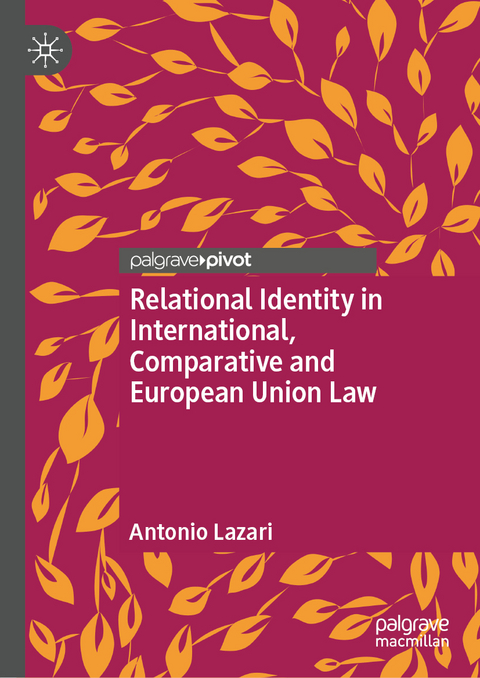
Relational Identity in International, Comparative and European Union Law
Springer International Publishing (Verlag)
978-3-031-59481-6 (ISBN)
- Noch nicht erschienen - erscheint am 03.02.2026
- Versandkostenfrei
- Auch auf Rechnung
- Artikel merken
This book deals with the topic of identity from a legal and extra-legal point of view. In the theme of identity, Law ends up re-proposing the dynamic of difference and the relationship with the other. International law and Comparative law in their very epistemological configuration are vectors of an operation of classification and separation. Is it possible to elaborate a new way of conceiving the relationship with the other in international law and comparative law? In the pars destruens of this monograph, through a series of Encounters with the other, we will see how International and Comparative Law have built an epistemologically hegemonic structure. In the second construens part of our work, we will analyze a new and slender way of conceiving identity in the European Union, arose in the recent jurisprudence of the Court of Justice.
This book delves into the concept of identity from both legal and extra-legal perspectives. Within the theme of identity, the law (Law) often perpetuates the dynamics of difference and the relationship with the other. International and Comparative Law, in their respective epistemological frameworks, serve as vectors for classification and separation. Can we envision a new way of relating to the other in these legal fields?
In the first part of this monograph, through a series of Encounters with the other, we explore how International and Comparative Law have constructed an epistemologically dominant structure. In the second part, we examine a novel and relational approach to identity in the European Union, emerging from recent Court of Justice jurisprudence. The process of cross-fertilization characterizes this new form of complex identity. This relational identity can be studied as a paradigm of the new Comparative and International Law through innovative methodologies.
Antonio Lazari is Professor at Universidad Pablo de Olavide, Seville.
1. PROLOGUE.- 2. ON THE NEED OF CREATING RELATIONAL IDENTITIES OF THE XXI CENTURY.- 3. THE ORIGIN OF SCIENTIFIC IDENTITIES AND THEIR INFLUENCE ON EXCLUSIONARY STATE IDENTITIES.- 4. THE INTERTWINING OF NATIONAL IDENTITY AND INTERNATIONAL LAW IN THE POLITICAL AND JUDICIAL SPHERES.- 5. THE IDENTITY OF THE UNION AS A REPOSITORY OF CONSTITUTIONAL IDENTITIES.- 6. THE BALANCING OF STATE IDENTITY IN PRIMARY WRITTEN LAW OF THE UNION AND IN POLITICAL PROCEDURES.- 8. THE FIGURE OF THE PRINCIPLE OF PLURALISM IN ARTICLE 2 TEU AS AN EXTREME FRAMEWORK FOR DIALOGUE.- 9. RELEVANCE AND LIMITS OF ART. 2 TEU AS GRUNDNORM ETHICS.- 10. THE SPILLOVER EFFECT: THE ART. 2 TEU AS APPLICABLE PROVISION.- 11. EPILOGUE.
| Erscheinungsdatum | 29.11.2025 |
|---|---|
| Zusatzinfo | VI, 360 p. |
| Verlagsort | Cham |
| Sprache | englisch |
| Maße | 148 x 210 mm |
| Themenwelt | Recht / Steuern ► Allgemeines / Lexika |
| Recht / Steuern ► Öffentliches Recht | |
| Sozialwissenschaften ► Politik / Verwaltung ► Politische Theorie | |
| Schlagworte | Constitutional identities • Cross-Fertilization • European Union Law • European Union Politics • Identity of European Union • Judicial dialogue |
| ISBN-10 | 3-031-59481-9 / 3031594819 |
| ISBN-13 | 978-3-031-59481-6 / 9783031594816 |
| Zustand | Neuware |
| Informationen gemäß Produktsicherheitsverordnung (GPSR) | |
| Haben Sie eine Frage zum Produkt? |
aus dem Bereich